







Question: (b) Suppose that two objects, A and B , are both comoving with the Hubble flow. A observes radiation from B . Use the result
(b) Suppose that two objects,
Aand
B, are both comoving with the Hubble\ flow.
Aobserves radiation from
B. Use the result from part (a) to find\
\ u _()(A)/()\ u _(()
B), where
\ u _(()
A)is the frequency of the radiation measured by the observer\ and
\ u _(()
B)is the frequency measured by the source. Write your answer in terms\ of
a(t_(B)), the scale factor at the emission event, and
a(t_(A)), the scale factor\ at the observation event.\ [10 marks]\ (c) In addition to the objects
Aand
Bintroduced in part (b), suppose that\ there is a third object
Cwhich is also comoving with the Hubble flow. If\ objects
A,B, and
Chave respective spatial coordinates
vec(x)_(A),vec(x)_(B), and
vec(x)_(C),\ find the apparent angle between
Band
Cas observed by
A. You may use\ that for a photon traveling from, e.g.,
Bto
A, the constant
vec(c)which appears\ in part (a) must be proportional to
vec(x)_(A)-vec(x)_(B). Hint: Your final answer\ should not depend on time.\ [12 marks]\ (d) Although the observed angle between
Band
Cis constant, the proper\ distance between
Band
Cdepends on time. If
vec(x)_(C)=vec(x)_(B)+dvec(x)for some\ small separation vector
dvec(x), find the proper distance between
Band
C, as\ measured between events on both worldlines which have the same coordinate\ time.\ [8 marks]\ (e) Suppose that an astronaut moves from
Ato
Band then back to
A. The\ proper time between the event at which the astronaut leaves
Aand the event\ at which they return to
Acan be measured both by
Aand by astronaut.\ Which of these two times will be longer? Explain your answer.
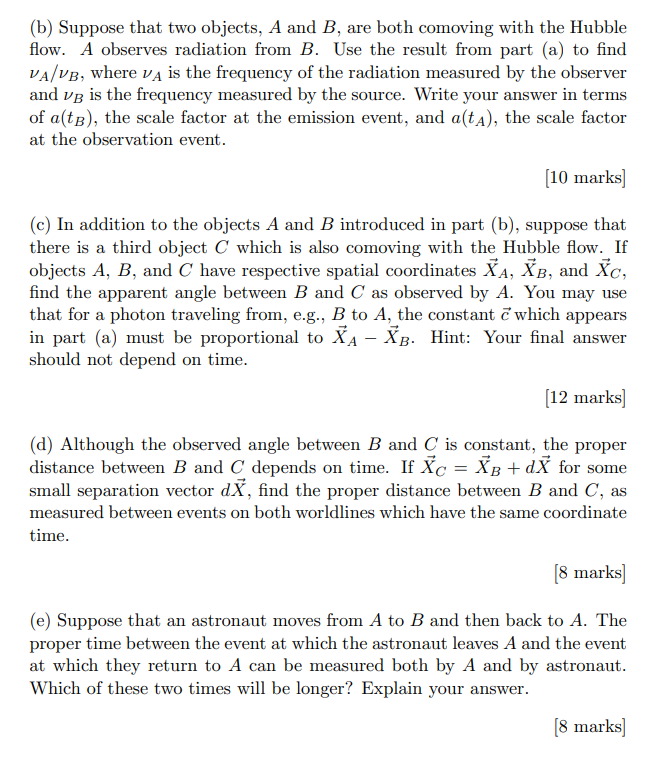
(b) Suppose that two objects, A and B, are both comoving with the Hubble flow. A observes radiation from B. Use the result from part (a) to find A/B, where A is the frequency of the radiation measured by the observer and B is the frequency measured by the source. Write your answer in terms of a(tB), the scale factor at the emission event, and a(tA), the scale factor at the observation event. [10 marks] (c) In addition to the objects A and B introduced in part (b), suppose that there is a third object C which is also comoving with the Hubble flow. If objects A,B, and C have respective spatial coordinates XA,XB, and XC, find the apparent angle between B and C as observed by A. You may use that for a photon traveling from, e.g., B to A, the constant c which appears in part (a) must be proportional to XAXB. Hint: Your final answer should not depend on time. [12 marks] (d) Although the observed angle between B and C is constant, the proper distance between B and C depends on time. If XC=XB+dX for some small separation vector dX, find the proper distance between B and C, as measured between events on both worldlines which have the same coordinate time. [8 marks] (e) Suppose that an astronaut moves from A to B and then back to A. The proper time between the event at which the astronaut leaves A and the event at which they return to A can be measured both by A and by astronaut. Which of these two times will be longer? Explain your answer. [8 marks]
Step by Step Solution
There are 3 Steps involved in it

Get step-by-step solutions from verified subject matter experts
 Study Help