







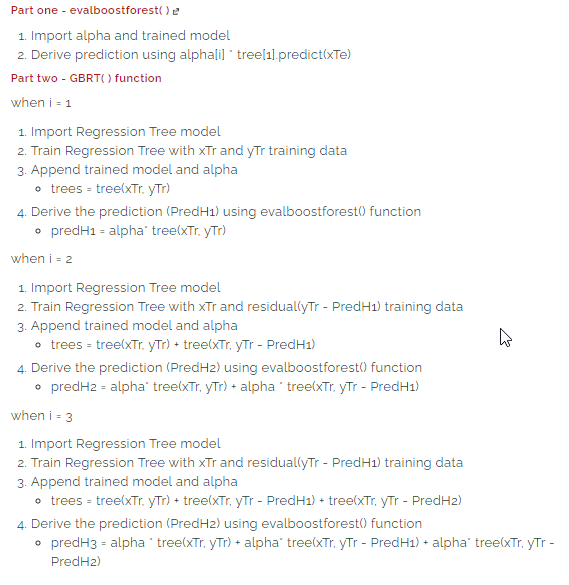
Question: b) We are interested in estimating and constructing a confidence interval for the percentage change in price when a 200-square-foot bedroom is added to a
b) We are interested in estimating and constructing a confidence interval
for the percentage change in price when a 200-square-foot bedroom is
added to a house. How can you construct this confidence interval?
What assumptions are needed to do so? State all assumptions and ex-
plain why you need the assumptions. Calculate the estimates and con-
fidence interval, and interpret them.
(c) In order to construct a confidence interval we need to estimate a stan-
dard error for the estimate in part (b). Provide the way to estimate the
standard error using another multiple regression model (Hint: Define a
parameter which represents the above estimator (in part (b)). Then one
can estimate a standard error using this relationship with another multi-
ple regression model). Based on the estimated standard error, construct
a 95% confidence interval.
(d) Suppose now u does not follow normal distribution any more. Elabo-
rate how can you calculate the confidence interval in (b) and (c). And
calculate such confidence interval using R.
3. Suppose that the model
pctstck = ?0 + ?1funds + ?2risktol + u,
satisfies the first four Gauss-Markov assumptions, where pctstck is the per-
centage of a worker's pension invested in the stock market, funds is the num-
ber of mutual funds that the worker can choose from, and risktol is some
measure of risk tolerance (larger risktol means the person has a higher tol-
erance for risk). If funds and risktol are positively correlated, what are the
bias and inconsistency in ??
1, the slope coefficient in the simple regression of
pctstck on funds? Moreover, how do you interpret the estimates you obtain
from this simple regression? [You SHOULD answer these questions crystal
clear.]
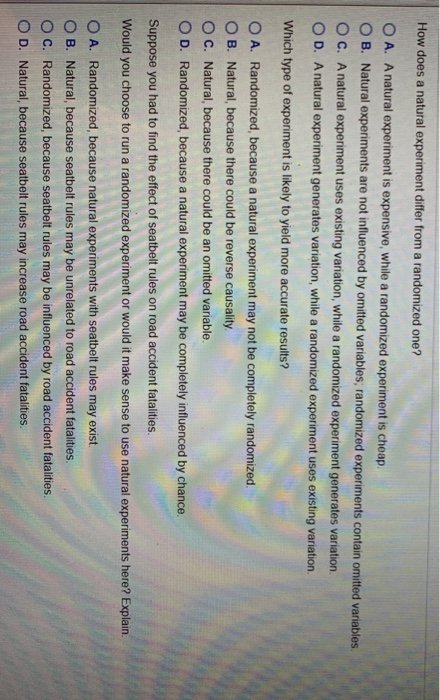
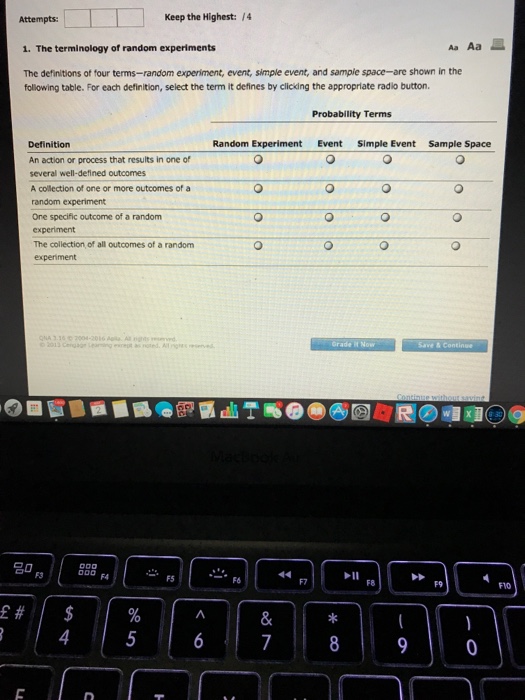
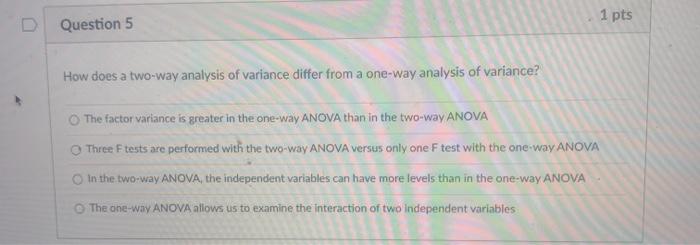
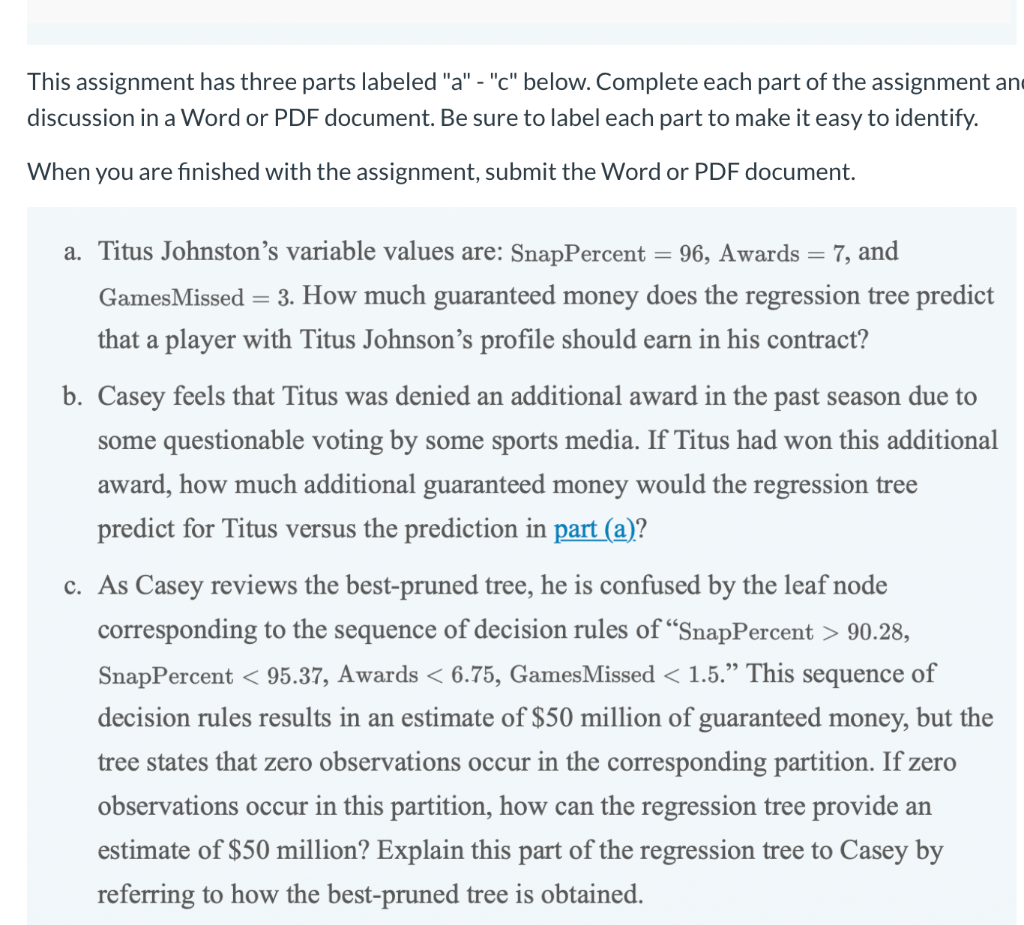
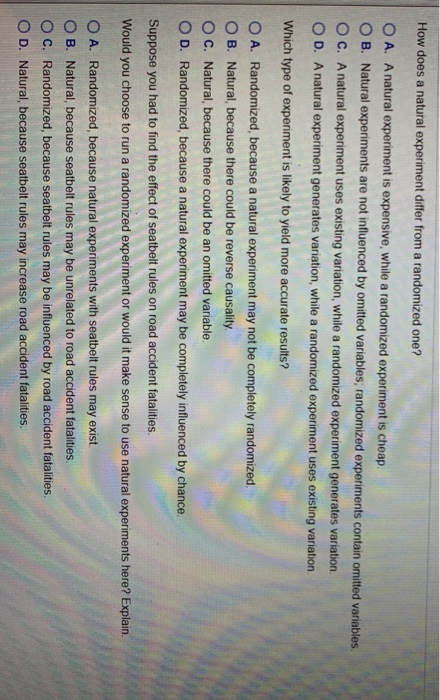
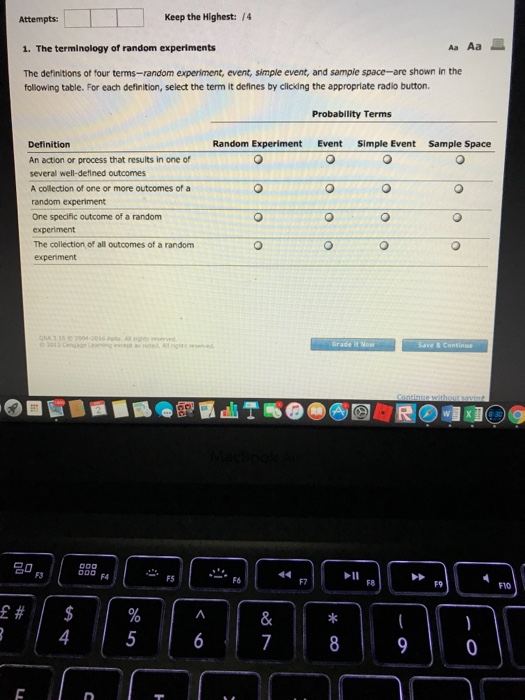
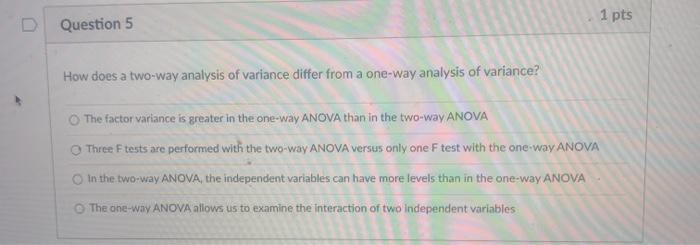
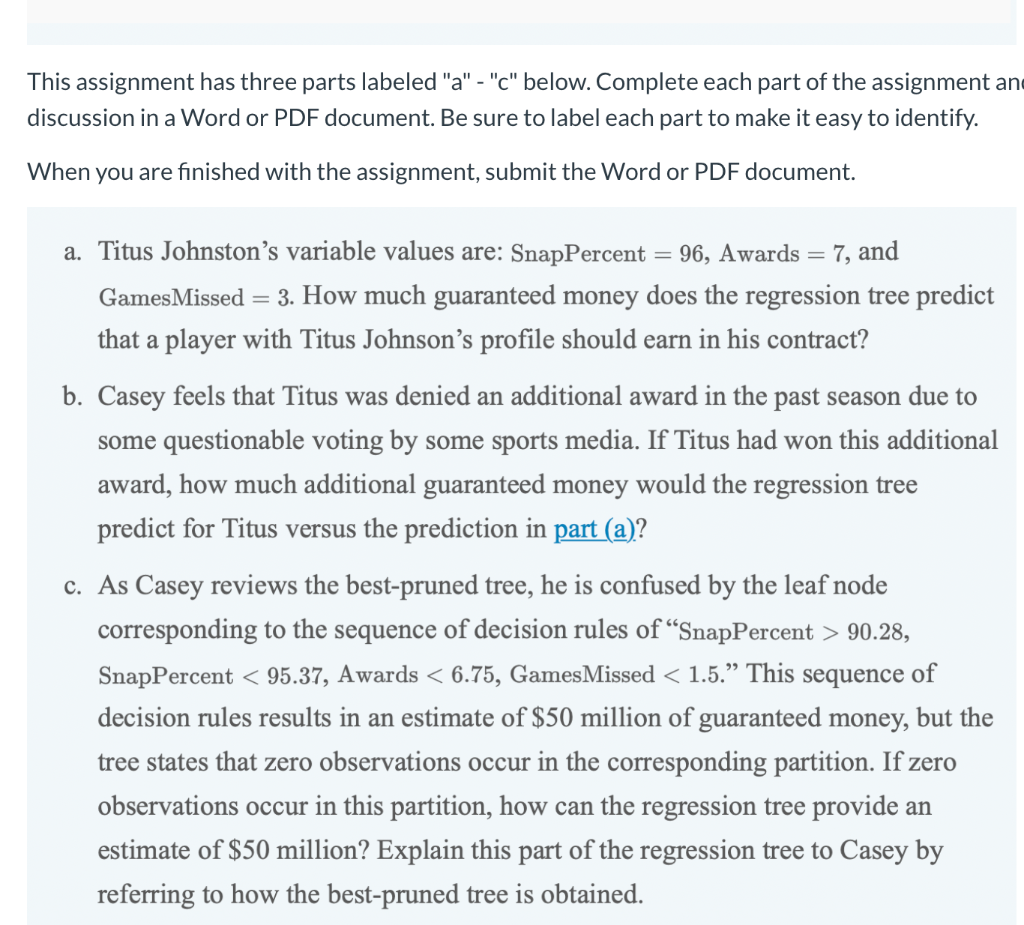
How does a natural experiment differ from a randomized one? O A. A natural experiment is expensive, while a randomized experiment is cheap. O B. Natural experiments are not influenced by omitted variables; randomized experiments contain omitted variables O C. A natural experiment uses existing variation, while a randomized experiment generates variation. O D. A natural experiment generates variation, while a randomized experiment uses existing variation. Which type of experiment is likely to yield more accurate results? O A. Randomized, because a natural experiment may not be completely randomized. O B. Natural, because there could be reverse causality. O C. Natural, because there could be an omitted variable. O D. Randomized, because a natural experiment may be completely influenced by chance. Suppose you had to find the effect of seatbelt rules on road accident fatalities. Would you choose to run a randomized experiment or would it make sense to use natural experiments here? Explain. O A. Randomized, because natural experiments with seatbelt rules may exist. O B. Natural, because seatbelt rules may be unrelated to road accident fatalities. O C. Randomized, because seatbelt rules may be influenced by road accident fatalities. O D. Natural, because seatbelt rules may increase road accident fatalities.Attempts: Keep the Highest: /4 1. The terminology of random experiments As Aa The definitions of four terms-random experiment, event, simple event, and sample space-are shown in the following table. For each definition, select the term it defines by clicking the appropriate radio button. Probability Terms Definition Random Experiment Event Simple Event Sample Space An action or process that results in one of O O O several well-defined outcomes A collection of one or more outcomes of a O O O O random experiment One specific outcome of a random O O O O experiment The collection, of all outcomes of a random O O O O experiment Grade I Now Save & Continue Continue without urine w x MacBook F3 DOO FA FS 14 F7 FB F9 f # LA % V 4 5 OO OD Question 5 1 pts How does a two-way analysis of variance differ from a one-way analysis of variance? The factor variance is greater in the one-way ANOVA than in the two-way ANOVA ) Three F tests are performed with the two-way ANOVA versus only one F test with the one-way ANOVA () In the two-way ANOVA, the independent variables can have more levels than in the one-way ANOVA The one-way ANOVA allows us to examine the interaction of two independent variablesThis assignment has three parts labeled "a" - "c" below. Complete each part of the assignment ani discussion in a Word or PDF document. Be sure to label each part to make it easy to identify. When you are nished with the assignment, submit the Word or PDF document. a. Titus Johnston's Variable Values are: SnapPercent = 96, Awards = 7, and GamesMissed = 3. How much guaranteed money does the regression iree predict that a player with Titus Johnson's prole should earn in his contract? b. Casey feels that Titus was denied an additional award in the past season due to some questionable voting by some sports media. If Titus had won this additional award, how much additional guaranteed money would the regression tree predict for Titus versus the prediction in Ma}? 0. As Casey reviews the best-pruned tree, he is conised by the leaf node corresponding to the sequence of decision rules of \"SnapPercent > 90.28, SnapPement
Step by Step Solution
There are 3 Steps involved in it

Get step-by-step solutions from verified subject matter experts
 Study Help