







Question: Base on the above information please answer the following question. 1. Is any one style of leadership more effective/successful than another? Explain. If so, which
Base on the above information please answer the following question.
1. Is any one style of leadership more effective/successful than another? Explain. If so, which style of leadership do you think is most effective? Why? Least effective? Why? What style of leadership do you exemplify? Provide an example.
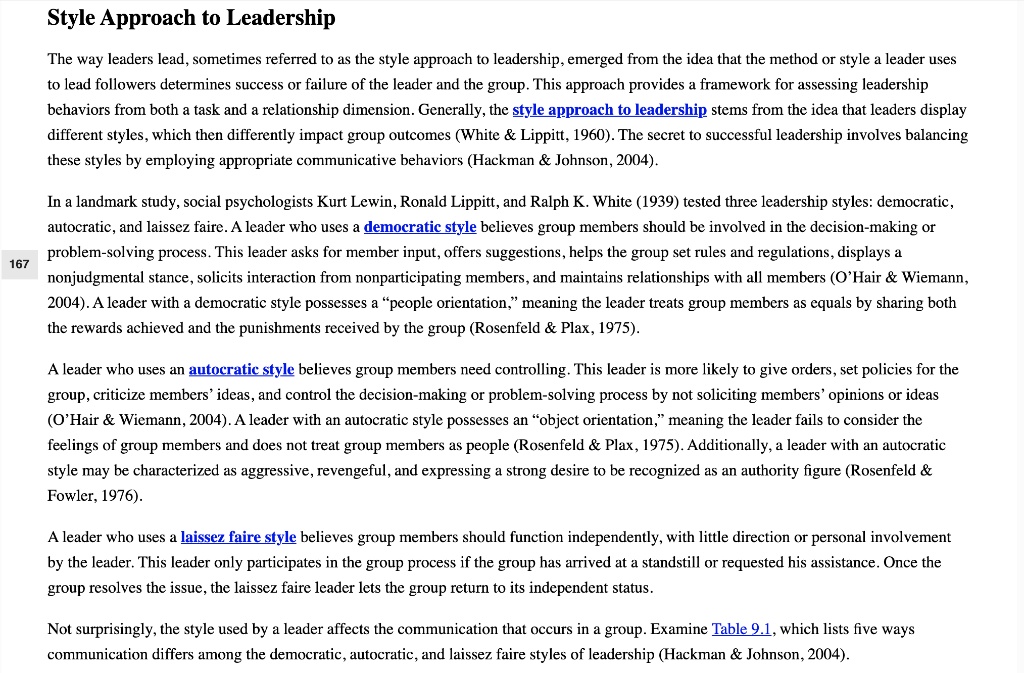
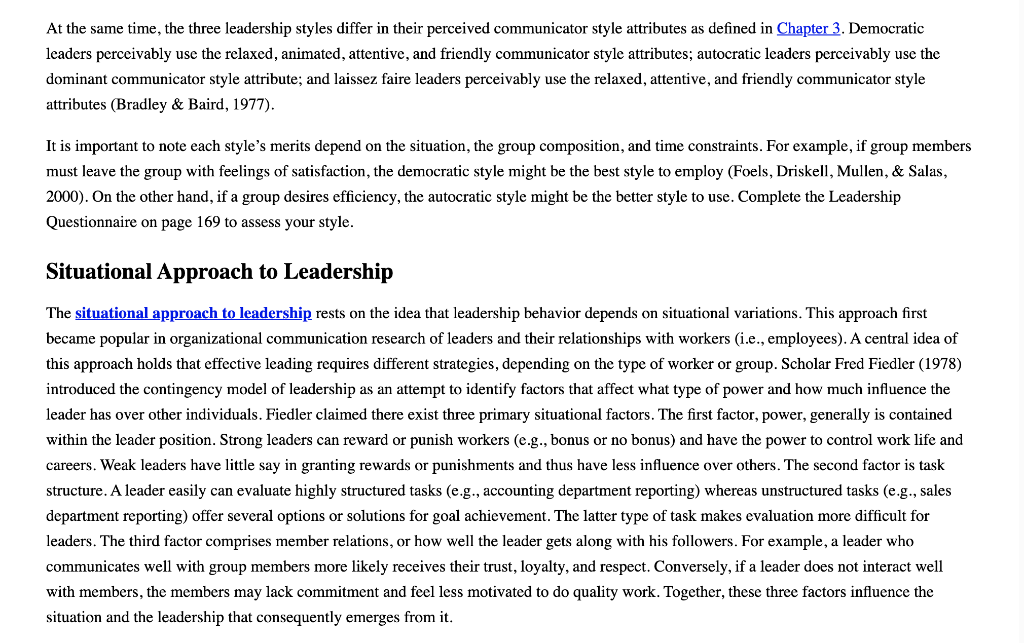
Style Approach to Leadership The way leaders lead, sometimes referred to as the style approach to leadership, emerged from the idea that the method or style a leader uses to lead followers determines success or failure of the leader and the group. This approach provides a framework for assessing leadership behaviors from both a task and a relationship dimension. Generally, the style approach to leadership stems from the idea that leaders display different styles, which then differently impact group outcomes (White & Lippitt, 1960). The secret to successful leadership involves balancing these styles by employing appropriate communicative behaviors (Hackman & Johnson, 2004). 167 In a landmark study, social psychologists Kurt Lewin, Ronald Lippitt, and Ralph K. White (1939) tested three leadership styles: democratic, autocratic, and laissez faire. A leader who uses a democratic style believes group members should be involved in the decision-making or problem-solving process. This leader asks for member input, offers suggestions, helps the group set rules and regulations, displays a nonjudgmental stance, solicits interaction from nonparticipating members, and maintains relationships with all members (O'Hair & Wiemann, 2004). A leader with a democratic style possesses a "people orientation, meaning the leader treats group members as equals by sharing both the rewards achieved and the punishments received by the group (Rosenfeld & Plax, 1975). A leader who uses an autocratic style believes group members need controlling. This leader is more likely to give orders, set policies for the group, criticize members' ideas, and control the decision-making or problem-solving process by not soliciting members' opinions or ideas (O'Hair & Wiemann, 2004). A leader with an autocratic style possesses an "object orientation, meaning the leader fails to consider the feelings of group members and does not treat group members as people (Rosenfeld & Plax, 1975). Additionally, a leader with an autocratic style may be characterized as aggressive, revengeful, and expressing a strong desire to be recognized as an authority figure (Rosenfeld & Fowler, 1976). A leader who uses a laissez faire style believes group members should function independently, with little direction or personal involvement by the leader. This leader only participates in the group process if the group has arrived at a standstill or requested his assistance. Once the group resolves the issue, the laissez faire leader lets the group return to its independent status. Not surprisingly, the style used by a leader affects the communication that occurs in a group. Examine Table 9.1, which lists five ways communication differs among the democratic, autocratic, and laissez faire styles of leadership (Hackman & Johnson, 2004). At the same time, the three leadership styles differ in their perceived communicator style attributes as defined in Chapter 3. Democratic leaders perceivably use the relaxed, animated attentive, and friendly communicator style attributes; autocratic leaders perceivably use the dominant communicator style attribute; and laissez faire leaders perceivably use the relaxed, attentive, and friendly communicator style attributes (Bradley & Baird, 1977). It is important to note each style's merits depend on the situation, the group composition, and time constraints. For example, if group members must leave the group with feelings of satisfaction, the democratic style might be the best style to employ (Foels, Driskell, Mullen, & Salas, 2000). On the other hand, if a group desires efficiency, the autocratic style might be the better style to use. Complete the Leadership Questionnaire on page 169 to assess your style. Situational Approach to Leadership The situational approach to leadership rests on the idea that leadership behavior depends on situational variations. This approach first became popular in organizational communication research of leaders and their relationships with workers (i.e., employees). A central idea of this approach holds that effective leading requires different strategies, depending on the type of worker or group. Scholar Fred Fiedler (1978) introduced the contingency model of leadership as an attempt to identify factors that affect what type of power and how much influence the leader has over other individuals. Fiedler claimed there exist three primary situational factors. The first factor, power, generally is contained within the leader position. Strong leaders can reward or punish workers (e.g., bonus or no bonus) and have the power to control work life and careers. Weak leaders have little say in granting rewards or punishments and thus have less influence over others. The second factor is task structure. A leader easily can evaluate highly structured tasks (e.g., accounting department reporting) whereas unstructured tasks (e.g., sales department reporting) offer several options or solutions for goal achievement. The latter type of task makes evaluation more difficult for leaders. The third factor comprises member relations, or how well the leader gets along with his followers. For example, a leader who communicates well with group members more likely receives their trust, loyalty, and respect. Conversely, if a leader does not interact well with members, the members may lack commitment and feel less motivated to do quality work. Together, these three factors influence the situation and the leadership that consequently emerges from itStep by Step Solution
There are 3 Steps involved in it
1 Expert Approved Answer
Step: 1 Unlock

Question Has Been Solved by an Expert!
Get step-by-step solutions from verified subject matter experts
Step: 2 Unlock
Step: 3 Unlock
 Study Help