







Question: Based on the above, please answer the below questions: How does LEGO generate royalties by using contractual entry strategies? What are the advantages of licensing
Based on the above, please answer the below questions:
- How does LEGO generate royalties by using contractual entry strategies?
- What are the advantages of licensing as described in the case?
3. What risk(s) does LEGO face from licensing its brand, logo, toy patents, and LEGO Movie?
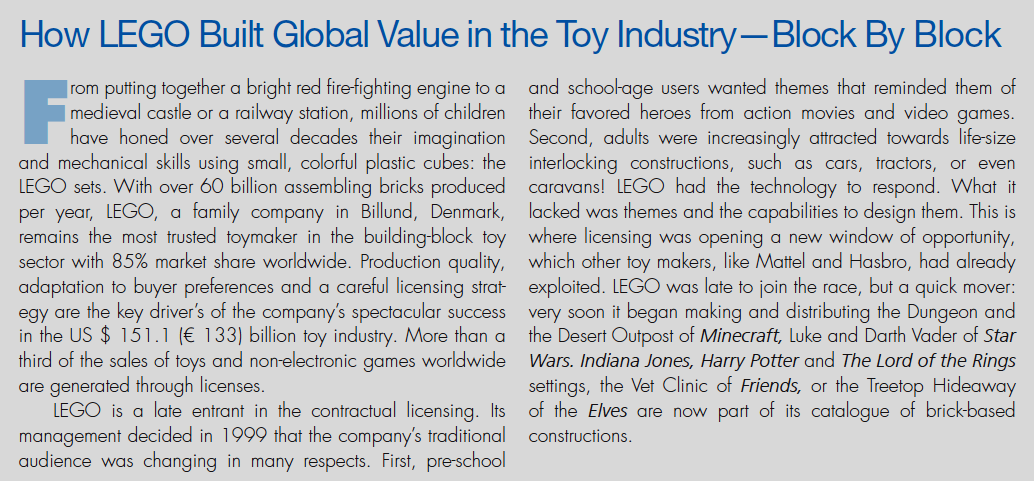
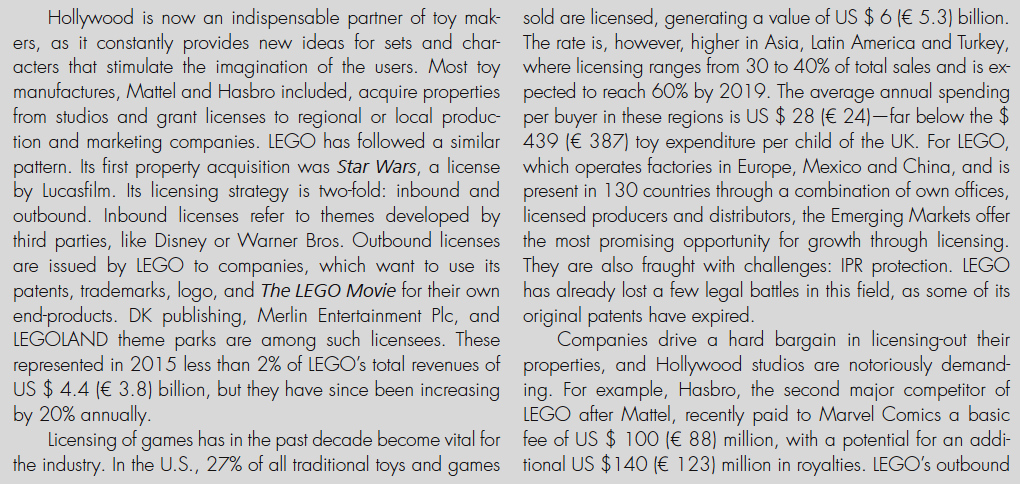
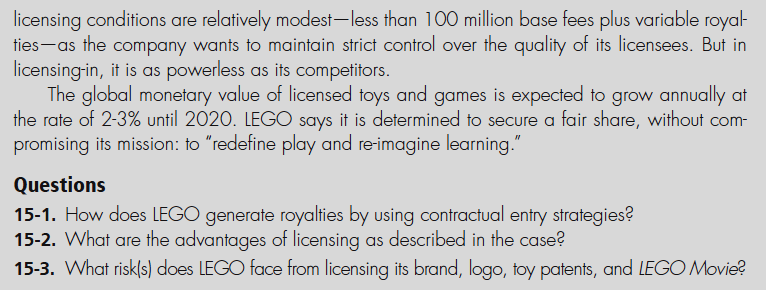
How LEGO Built Global Value in the Toy Industry-Block By Block | rom putting together a bright red firefighting engine to a and schoolage users wanted themes that reminded them of medieval castle or a railway station, millions of children their favored heroes from action movies and video games. have honed over several decades their imagination Second, adults were increasingly attracted towards life-size and mechanical skills using small, colorful plastic cubes: the interlocking constructions, such as cars, tractors, or even LEGO sets. With over 60 billion assembling bricks produced caravans! LEGO had the technology to respond. What it per year, LEGO, a family company in Billund, Denmark, lacked was themes and the capabilities to design them. This is remains the most trusted toymaker in the building block toy where licensing was opening a new window of opportunity, sector with 85% market share worldwide. Production quality, which other toy makers, like Mattel and Hasbro, had already adaptation to buyer preferences and a careful licensing strat exploited. LEGO was late to join the race, but a quick mover: egy are the key driver's of the company's spectacular success very soon it began making and distributing the Dungeon and in the US $ 151.1 ( 133) billion toy industry. More than a the Desert Outpost of Minecraft, Luke and Darth Vader of Star third of the sales of toys and non-electronic games worldwide Wars. Indiana Jones, Harry Potter and The Lord of the Rings are generated through licenses. settings, the Vet Clinic of Friends, or the Treetop Hideaway LEGO is a late entrant in the contractual licensing. Its of the Elves are now part of its catalogue of brick-based management decided in 1999 that the company's traditional constructions. audience was changing in many respects. First, pre-school Hollywood is now an indispensable partner of toy mak sold are licensed, generating a value of US $ 61 5.3) billion. ers, as it constantly provides new ideas for sets and char- The rate is, however, higher in Asia, Latin America and Turkey, acters that stimulate the imagination of the users. Most toy where licensing ranges from 30 to 40% of total sales and is ex- manufactures, Mattel and Hasbro included, acquire properties pected to reach 60% by 2019. The average annual spending from studios and grant licenses to regional or local produc per buyer in these regions is US $ 28 ( 24) -far below the $ tion and marketing companies. LEGO has followed a similar 439 ( 387) toy expenditure per child of the UK. For LEGO, pattern. Its first property acquisition was Star Wars, a license which operates factories in Europe, Mexico and China, and is by Lucasfilm. Its licensing strategy is two-fold: inbound and present in 130 countries through a combination of own offices, outbound. Inbound licenses refer to themes developed by licensed producers and distributors, the Emerging Markets offer third parties, like Disney or Warner Bros. Outbound licenses the most promising opportunity for growth through licensing. are issued by LEGO to companies, which want to use its They are also fraught with challenges: IPR protection. LEGO patents, trademarks, logo, and The LEGO Movie for their own has already lost a few legal battles in this field, as some of its end-products. DK publishing, Merlin Entertainment Plc, and original patents have expired. LEGOLAND theme parks are among such licensees. These companies drive a hard bargain in licensing out their represented in 2015 less than 2% of LEGO's total revenues of properties, and Hollywood studios are notoriously demand- US $ 4.4 ( 3.8) billion, but they have since been increasing ing. For example, Hasbro, the second major competitor of by 20% annually. LEGO after Mattel, recently paid to Marvel Comics a basic Licensing of games has in the past decade become vital for fee of US $ 100 ( 88) million, with a potential for an addi- the industry. In the U.S., 27% of all traditional toys and games tional US $140 ( 123) million in royalties. LEGO's outbound licensing conditions are relatively modest-less than 100 million base fees plus variable royal ties-as the company wants to maintain strict control over the quality of its licensees. But in licensing-in, it is as powerless as its competitors. The global monetary value of licensed toys and games is expected to grow annually at the rate of 2-3% until 2020. LEGO says it is determined to secure a fair share, without com- promising its mission: to "redefine play and re-imagine learning." Questions 15-1. How does LEGO generate royalties by using contractual entry strategies? 15-2. What are the advantages of licensing as described in the case? 15-3. What risk(s) does LEGO face from licensing its brand, logo, toy patents, and LEGO MovieStep by Step Solution
There are 3 Steps involved in it
1 Expert Approved Answer
Step: 1 Unlock

Question Has Been Solved by an Expert!
Get step-by-step solutions from verified subject matter experts
Step: 2 Unlock
Step: 3 Unlock
 Study Help