







Question: Based on the case, please analyze and benchmark compensation in the Bay Area.(must list reference) identification with their employers, which, overall, increases levels of employee
Based on the case, please analyze and benchmark compensation in the Bay Area.(must list reference)
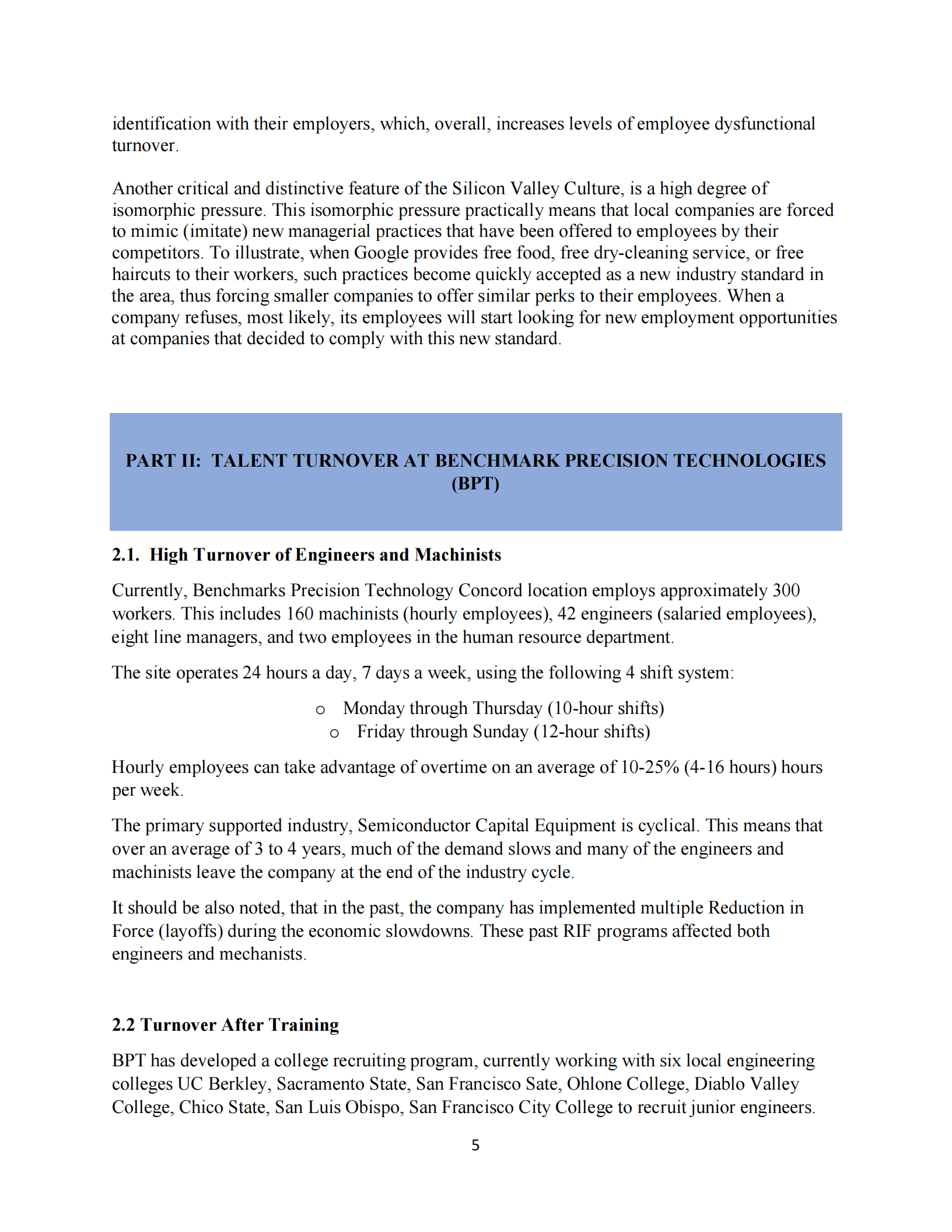
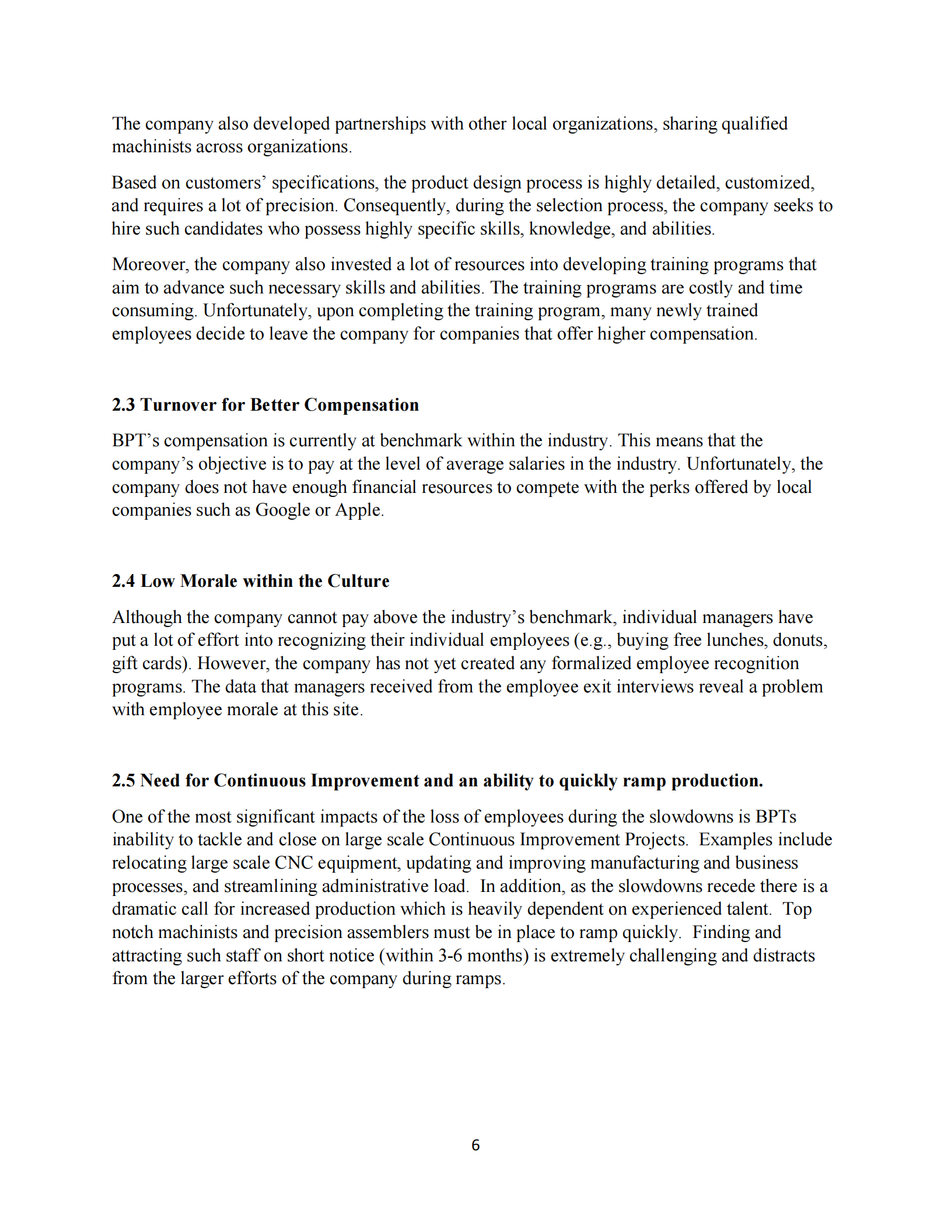
identification with their employers, which, overall, increases levels of employee dysfunctional turnover. Another critical and distinctive feature of the Silicon Valley Culture, is a high degree of isomorphic pressure. This isomorphic pressure practically means that local companies are forced to mimic (imitate) new managerial practices that have been offered to employees by their competitors. To illustrate, when Google provides free food, free dry-cleaning service, or ee haircuts to their workers, such practices become quickly accepted as a new industry standard in the area, thus forcing smaller companies to offer similar perks to their employees. When a company refuses, most likely, its employees will start looking for new employment opportunities at companies that decided to comply with this new standard. 2.1. High Turnover of Engineers and Machinists Currently, Benchmarks Precision Technology Concord location employs approximately 300 workers. This includes 160 machinists (hourly employees), 42 engineers (salaried employees), eight line managers, and two employees in the human resource department. The site operates 24 hours a day, 7 days a week, using the following 4 shift system: 0 Monday through Thursday (10-hour shifts) 0 Friday through Sunday (12-hour shifts) Hourly employees can take advantage of overtime on an average of 10-25% (4-16 hours) hours per week. The primary supported industry, Semiconductor Capital Equipment is cyclical. This means that over an average of 3 to 4 years, much of the demand slows and many of the engineers and machinists leave the company at the end of the industry cycle. It should be also noted, that in the past, the company has implemented multiple Reduction in Force (layoffs) during the economic slowdowns. These past RJF programs affected both engineers and mechanists. 2.2 Turnover After Training BPT has developed a college recruiting program, currently working with six local engineering colleges UC Berkley, Sacramento State, San Francisco Sate, Ohlone College, Diablo Valley College, Chico State, San Luis Obispo, San Francisco City College to recruit junior engineers. 5 The company also developed partnerships with other local organizations, sharing qualied machinists across organizations. Based on customers' specifications, the product design process is highly detailed, customized, and requires a lot of precision. Consequently, during the selection process, the company seeks to hire such candidates who possess highly specific skills, knowledge, and abilities. Moreover, the company also invested a lot of resources into developing training programs that aim to advance such necessary skills and abilities. The training programs are costly and time consuming. Unfortunately, upon completing the training program, many newly trained employees decide to leave the company for companies that offer higher compensation. 2.3 Turnover for Better Compensation BPT's compensation is currently at benchmark within the industry. This means that the company's objective is to pay at the level of average salaries in the industry. Unfortunately, the company does not have enough nancial resources to compete with the perks offered by local companies such as Google or Apple. 2.4 Low Morale within the Culture Although the company cannot pay above the industry's benchmark, individual managers have put a lot of effort into recognizing their individual employees (e.g., buying free lunches, donuts, gift cards). However, the company has not yet created any formalized employee recognition programs. The data that managers received from the employee exit interviews reveal a problem with employee morale at this site. 2.5 Need for Continuous Improvement and an ability to quickly ramp production. One of the most signicant impacts of the loss of employees during the slowdowns is BPTs inability to tackle and close on large scale Continuous Improvement Proj ects. Examples include relocating large scale CNC equipment, updating and improving manufacturing and business processes, and streamlining administrative load. In addition, as the slowdowns recede there is a dramatic call for increased production which is heavily dependent on experienced talent. Top notch machinists and precision assemblers must be in place to ramp quickly. Finding and attracting such staff on short notice (within 3-6 months) is extremely challenging and distracts from the larger efforts of the company during ramps
Step by Step Solution
There are 3 Steps involved in it

Get step-by-step solutions from verified subject matter experts
 Study Help