







Question: Based on the following information, develop 2 high cognitive multiple choice question with 4 possible answers Why Am I Here?: The Importance of Sexual Harassment
Based on the following information, develop 2 high cognitive multiple choice question with 4 possible answers
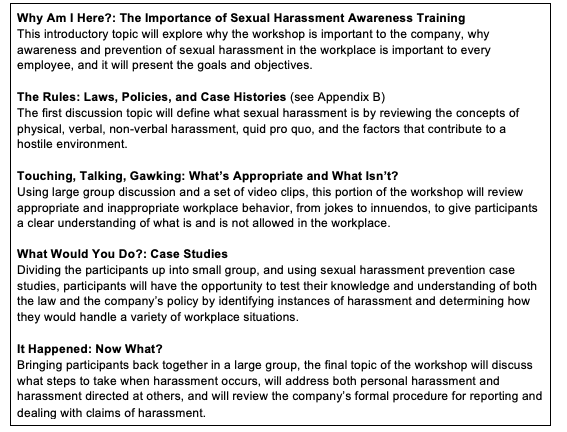
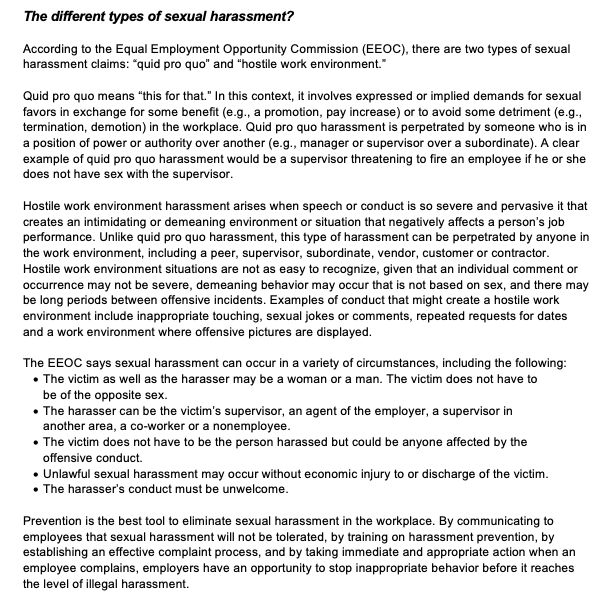
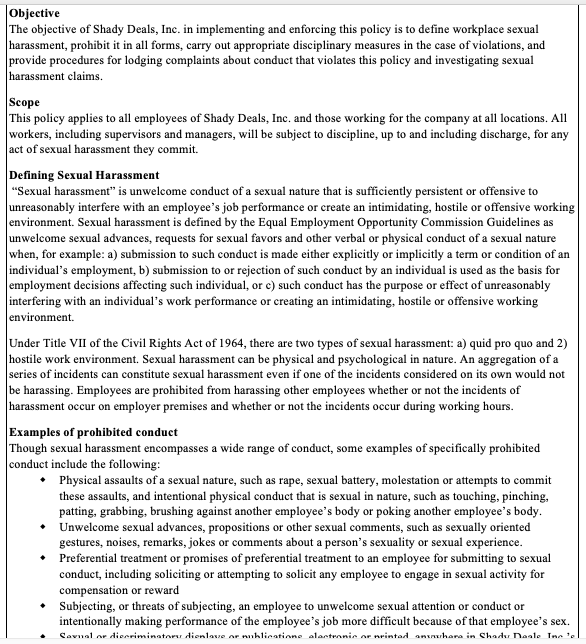
Why Am I Here?: The Importance of Sexual Harassment Awareness Training This introductory topic will explore why the workshop is important to the company, why awareness and prevention of sexual harassment in the workplace is important to every employee, and it will present the goals and objectives. The Rules: Laws, Policies, and Case Histories (see Appendix B) The first discussion topic will define what sexual harassment is by reviewing the concepts of physical, verbal, non-verbal harassment, quid pro quo, and the factors that contribute to a hostile environment. Touching, Talking, Gawking: What's Appropriate and What Isn't? Using large group discussion and a set of video clips, this portion of the workshop will review appropriate and inappropriate workplace behavior, from jokes to innuendos, to give participants a clear understanding of what is and is not allowed in the workplace. What Would You Do?: Case Studies Dividing the participants up into small group, and using sexual harassment prevention case studies, participants will have the opportunity to test their knowledge and understanding of both the law and the company's policy by identifying instances of harassment and determining how they would handle a variety of workplace situations. It Happened: Now What? Bringing participants back together in a large group, the final topic of the workshop will discuss what steps to take when harassment occurs, will address both personal harassment and harassment directed at others, and will review the company's formal procedure for reporting and dealing with claims of harassment. The different types of sexual harassment? According to the Equal Employment Opportunity Commission (EEOC), there are two types of sexual harassment claims: "quid pro quo" and "hostile work environment." Quid pro quo means "this for that." In this context, it involves expressed or implied demands for sexual favors in exchange for some benefit (e.g., a promotion, pay increase) or to avoid some detriment (e.g., termination, demotion) in the workplace. Quid pro quo harassment is perpetrated by someone who is in a position of power or authority over another (e.g., manager or supervisor over a subordinate). A clear example of quid pro quo harassment would be a supervisor threatening to fire an employee if he or she does not have sex with the supervisor. Hostile work environment harassment arises when speech or conduct is so severe and pervasive it that creates an intimidating or demeaning environment or situation that negatively affects a person's job performance. Unlike quid pro quo harassment, this type of harassment can be the work environment, including a peer, supervisor, subordinate, vendor, customer or contractor. Hostile work environment situations are not as easy to recognize, given that an individual comment or occurrence may not be severe, demeaning behavior may occur that is not based on sex, and there may be long periods between offensive incidents. Examples of conduct that might create a hostile work environment include inappropriate touching, sexual jokes or comments, repeated requests for dates and a work environment where offensive pictures are displayed. The EEOC says sexual harassment can occur in a variety of circumstances, including the following: The victim as well as the harasser may be a woman or a man. The victim does not have to be of the opposite sex. The harasser can be the victim's supervisor, an agent of the employer, a supervisor in another area, a co-worker or a nonemployee. The victim does not have to be the person harassed but could be anyone affected by the offensive conduct. Unlawful sexual harassment may occur without economic injury to or discharge of the victim. . The harasser's conduct must be unwelcome. Prevention is the best tool to eliminate sexual harassment in the workplace. By communicating to employees that sexual harassment will not be tolerated, by training on harassment prevention, by establishing an effective complaint process, and by taking immediate and appropriate action when an employee complains, employers have an opportunity to stop inappropriate behavior before it reaches the level of illegal harassment. Objective The objective of Shady Deals, Inc. in implementing and enforcing this policy is to define workplace sexual harassment, prohibit it in all forms, carry out appropriate disciplinary measures in the case of violations, and provide procedures for lodging complaints about conduct that violates this policy and investigating sexual harassment claims. Scope This policy applies to all employees of Shady Deals, Inc. and those working for the company at all locations. All workers, including supervisors and managers, will be subject to discipline, up to and including discharge, for any act of sexual harassment they commit. Defining Sexual Harassment "Sexual harassment" is unwelcome conduct of a sexual nature that is sufficiently persistent or offensive to unreasonably interfere with an employee's job performance or create an intimidating, hostile or offensive working environment. Sexual harassment is defined by the Equal Employment Opportunity Commission Guidelines as unwelcome sexual advances, requests for sexual favors and other verbal or physical conduct of a sexual nature when, for example: a) submission to such conduct is made either explicitly or implicitly a term or condition of an individual's employment, b) submission to or rejection of such conduct by an individual is used as the basis for employment decisions affecting such individual, or c) such conduct has the purpose or effect of unreasonably interfering with an individual's work performance or creating an intimidating, hostile or offensive working environment. Under Title VII of the Civil Rights Act of 1964, there are two types of sexual harassment: a) quid pro quo and 2) hostile work environment. Sexual harassment can be physical and psychological in nature. An aggregation of a series of incidents can constitute sexual harassment even if one of the incidents considered on its own would not |be harassing. Employees are prohibited from harassing other employees whether or not the incidents of harassment occur on employer premises and whether or not the incidents occur during working hours. Examples of prohibited conduct Though sexual harassment encompasses a wide range of conduct, some examples of specifically prohibited conduct include the following: Physical assaults of a sexual nature, such as rape, sexual battery, molestation or attempts to commit these assaults, and intentional physical conduct that is sexual in nature, such as touching, pinching, patting, grabbing, brushing against another employee's body or poking another employee's body. Unwelcome sexual advances, propositions or other sexual comments, such as sexually oriented gestures, noises, remarks, jokes or comments about a person's sexuality or sexual experience. Preferential treatment or promises of preferential treatment to an employee for submitting to sexual conduct, including soliciting or attempting to solicit any employee to engage in sexual activity for compensation or reward Subjecting, or threats of subjecting, an employee to unwelcome sexual attention or conductor intentionally making performance of the employee's job more difficult because of that employee's sex. Savnal ar dieeriminatarr dienlase ar aublicatione alactranie ar printed anthara in Shad Deale Incol
Step by Step Solution
There are 3 Steps involved in it
1 Expert Approved Answer
Step: 1 Unlock

Question Has Been Solved by an Expert!
Get step-by-step solutions from verified subject matter experts
Step: 2 Unlock
Step: 3 Unlock
 Study Help