







Question: Based on the given information: Please answer Question a (a) State three (3) practical assumptions applicable to this linear programming in problem. Your assumptions must
Based on the given information: Please answer Question a
(a) State three (3) practical assumptions applicable to this linear programming in problem. Your assumptions must be specific to the LP problem. (Assumptions = 6 marks)
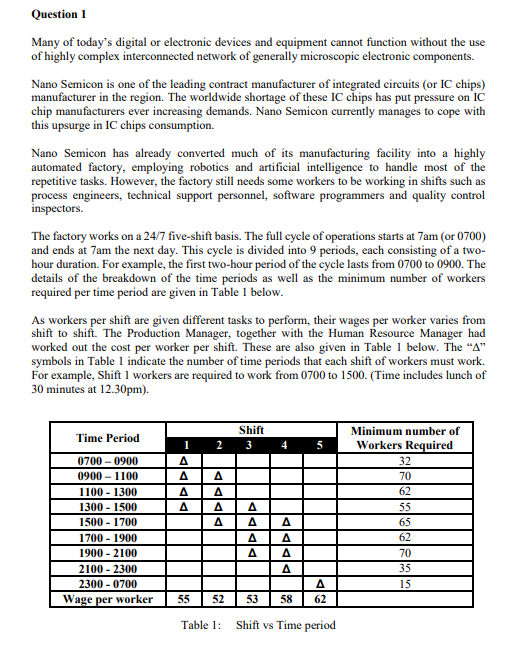
(b) Develop a linear programming (LP) model to minimise the worker costs of Nano Semicon for one cycle of operations (0700 on Day 1 to 0700 on Day 2). Your model must be in the form of algebraic equations and inequalities where appropriate. Define clearly your Decision Variables, Objective function and Constraints. (LP model = 17 marks)
Question 1 Many of today's digital or electronic devices and equipment cannot function without the use of highly complex interconnected network of generally microscopic electronic components. Nano Semicon is one of the leading contract manufacturer of integrated circuits (or IC chips) manufacturer in the region. The worldwide shortage of these IC chips has put pressure on IC chip manufacturers ever increasing demands. Nano Semicon currently manages to cope with this upsurge in IC chips consumption. Nano Semicon has already converted much of its manufacturing facility into a highly automated factory, employing robotics and artificial intelligence to handle most of the repetitive tasks. However, the factory still needs some workers to be working in shifts such as process engineers, technical support personnel, software programmers and quality control inspectors. The factory works on a 24/7 five-shift basis. The full cycle of operations starts at 7am (or 0700) and ends at 7am the next day. This cycle is divided into 9 periods, each consisting of a two- hour duration. For example, the first two-hour period of the cycle lasts from 0700 to 0900. The details of the breakdown of the time periods as well as the minimum number of workers required per time period are given in Table 1 below. As workers per shift are given different tasks to perform, their wages per worker varies from shift to shift. The Production Manager, together with the Human Resource Manager had worked out the cost per worker per shift. These are also given in Table 1 below. The A symbols in Table 1 indicate the number of time periods that each shift of workers must work. For example, Shift l workers are required to work from 0700 to 1500. (Time includes lunch of 30 minutes at 12.30pm). Time Period Shift 3 2 4 5 1 A A - alal A A DIPIDID DI A 0700-0900 0900 - 1100 1100 - 1300 1300 - 1500 1500-1700 1700 - 1900 1900 - 2100 2100 - 2300 2300 - 0700 Wage per worker Minimum number of Workers Required 32 70 62 55 65 62 70 35 15 PIPIPI A DIDIE 62 ale 55 52 53 58 Table 1 : Shift vs Time periodStep by Step Solution
There are 3 Steps involved in it
1 Expert Approved Answer
Step: 1 Unlock

Question Has Been Solved by an Expert!
Get step-by-step solutions from verified subject matter experts
Step: 2 Unlock
Step: 3 Unlock
 Study Help