







Question: based on the instructions given create a mechanism, will upvote ur answer answer asap plz Introduction: The oxidation of alcohols is a very important reaction.
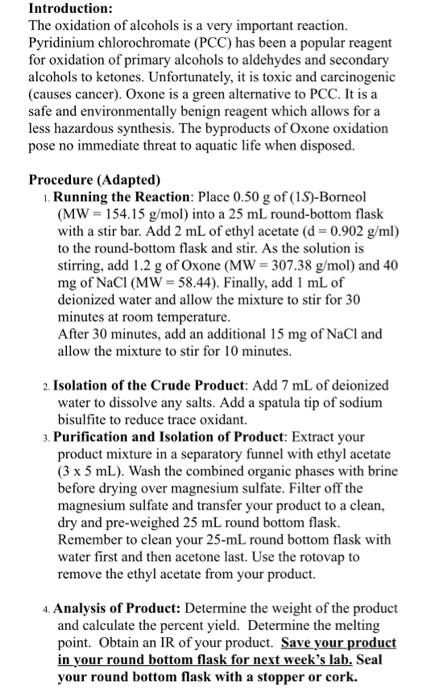
Introduction: The oxidation of alcohols is a very important reaction. Pyridinium chlorochromate (PCC) has been a popular reagent for oxidation of primary alcohols to aldehydes and secondary alcohols to ketones. Unfortunately, it is toxic and carcinogenic (causes cancer). Oxone is a green alternative to PCC. It is a safe and environmentally benign reagent which allows for a less hazardous synthesis. The byproducts of Oxone oxidation pose no immediate threat to aquatic life when disposed. Procedure (Adapted) 1. Running the Reaction: Place 0.50g of (1S)-Borneol (MW=154.15g/mol) into a25mL round-bottom flask with a stir bar. Add 2mL of ethyl acetate (d=0.902g/ml) to the round-bottom flask and stir. As the solution is stirring, add 1.2g of Oxone ( MW=307.38g/mol ) and 40 mg of NaCl (MW =58.44). Finally, add 1mL of deionized water and allow the mixture to stir for 30 minutes at room temperature. After 30 minutes, add an additional 15mg of NaCl and allow the mixture to stir for 10 minutes. 2. Isolation of the Crude Product: Add 7mL of deionized water to dissolve any salts. Add a spatula tip of sodium bisulfite to reduce trace oxidant. 3. Purification and Isolation of Product: Extract your product mixture in a separatory funnel with ethyl acetate (35mL). Wash the combined organic phases with brine before drying over magnesium sulfate. Filter off the magnesium sulfate and transfer your product to a clean, dry and pre-weighed 25mL round bottom flask. Remember to clean your 25mL round bottom flask with water first and then acetone last. Use the rotovap to remove the ethyl acetate from your product. 4. Analysis of Product: Determine the weight of the product and calculate the percent yield. Determine the melting point. Obtain an IR of your product. Save your product in your round bottom flask for next week's lab. Seal your round bottom flask with a stopper or cork
Step by Step Solution
There are 3 Steps involved in it

Get step-by-step solutions from verified subject matter experts
 Study Help