







Question: Based on your p-chart and the data from the last 3 weeks, what can you conclude about the absenteeism of nurses' aides? A. The proportion
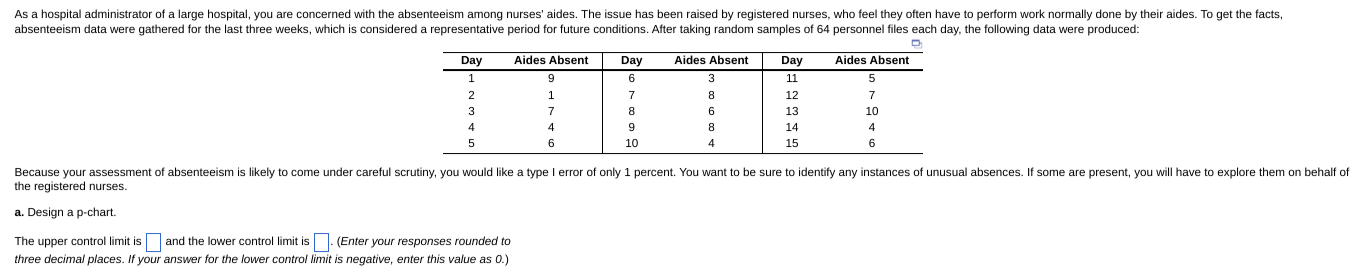 Based on your p-chart and the data from the last 3 weeks, what can you conclude about the absenteeism of nurses' aides?
A. The proportion of absent aides from day 15 is below the lower control limit, so the process is not in control
B. The proportion of absent aides from day 13 is above the upper control limit, so the process is not in control
C. The proportion of absent aides from day 14 is above the upper control limit, so the process is not in control
D. All sample proportions are within the control limits, so the process is in control
As a hospital administrator of a large hospital, you are concerned with the absenteeism among nurses' aides. The issue has been raised by registered nurses, who feel they often have to perform work normally done by their aides. To get the facts, absenteeism data were gathered for the last three weeks, which considered a representative period for future conditions. After taking random samples of 64 personnel files each day, the following data were produced: Day Aides Absent Aides Absent Day 6 Day 11 12 13 14 15 8 6 8 4 Aides Absent 5 7 10 4 6 8 9 10 4 6 5 Because your assessment of absenteeism is likely to come under careful scrutiny, you would like a type I error of only 1 percent. You want to be sure to identify any instances of unusual absences. If some are present, you will have to explore them on behalf of the registered nurses. a. Design a p-chart. The upper controllimit is and the lower control limit is. (Enter your responses rounded to three decimal places. If your answer for the lower controllimit is negative, enter this value as 0.)Step by Step Solution
There are 3 Steps involved in it
1 Expert Approved Answer
Step: 1 Unlock

Question Has Been Solved by an Expert!
Get step-by-step solutions from verified subject matter experts
Step: 2 Unlock
Step: 3 Unlock
 Study Help