Question: Basic Problem 5.6. (PROOF DISSECTION) Read the statement and proof of Theorem 1 below, and answer the questions (a)-(g) that follow. The bold numbers in
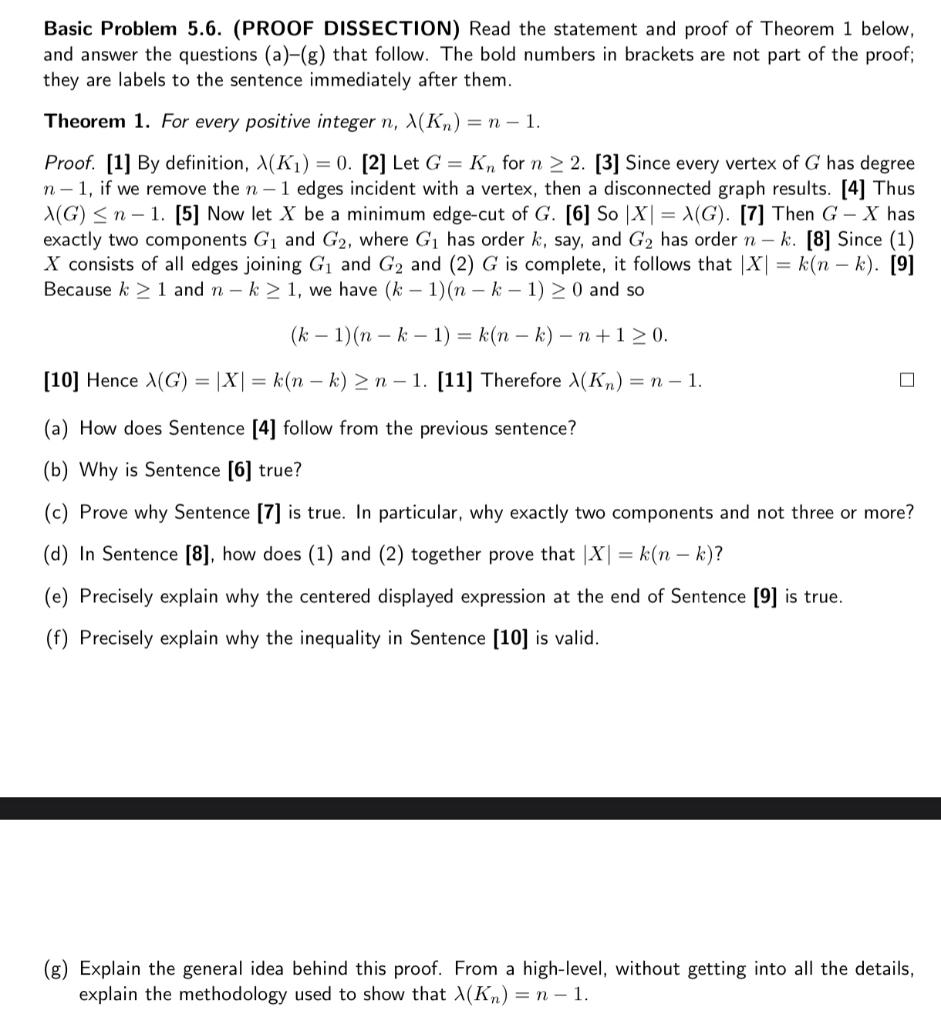
Basic Problem 5.6. (PROOF DISSECTION) Read the statement and proof of Theorem 1 below, and answer the questions (a)-(g) that follow. The bold numbers in brackets are not part of the proof; they are labels to the sentence immediately after them. Theorem 1. For every positive integer n, (Kn) = n - 1. Proof. [1] By definition, \(K1) = 0. [2] Let G = Kn for n > 2. [3] Since every vertex of G has degree n-1, if we remove the n-1 edges incident with a vertex, then a disconnected graph results. [4] Thus (G) 1 and n - k> 1, we have (k 1)(n- k-1) > 0 and so (k - 1)(n - k-1)= kan k) - n+1 > 0. [10] Hence (G) = [X] = k(n - k) >n-1. [11] Therefore (Kn) = n - 1. (a) How does Sentence [4] follow from the previous sentence? (b) Why is Sentence [6] true? (c) Prove why Sentence (7] is true. In particular, why exactly two components and not three or more? (d) In Sentence [8], how does (1) and (2) together prove that (X) = kn k)? (e) Precisely explain why the centered displayed expression at the end of Sentence [9] is true. (f) Precisely explain why the inequality in Sentence [10] is valid. (g) Explain the general idea behind this proof. From a high-level, without getting into all the details, explain the methodology used to show that (Kn)= n - 1. Basic Problem 5.6. (PROOF DISSECTION) Read the statement and proof of Theorem 1 below, and answer the questions (a)-(g) that follow. The bold numbers in brackets are not part of the proof; they are labels to the sentence immediately after them. Theorem 1. For every positive integer n, (Kn) = n - 1. Proof. [1] By definition, \(K1) = 0. [2] Let G = Kn for n > 2. [3] Since every vertex of G has degree n-1, if we remove the n-1 edges incident with a vertex, then a disconnected graph results. [4] Thus (G) 1 and n - k> 1, we have (k 1)(n- k-1) > 0 and so (k - 1)(n - k-1)= kan k) - n+1 > 0. [10] Hence (G) = [X] = k(n - k) >n-1. [11] Therefore (Kn) = n - 1. (a) How does Sentence [4] follow from the previous sentence? (b) Why is Sentence [6] true? (c) Prove why Sentence (7] is true. In particular, why exactly two components and not three or more? (d) In Sentence [8], how does (1) and (2) together prove that (X) = kn k)? (e) Precisely explain why the centered displayed expression at the end of Sentence [9] is true. (f) Precisely explain why the inequality in Sentence [10] is valid. (g) Explain the general idea behind this proof. From a high-level, without getting into all the details, explain the methodology used to show that (Kn)= n - 1









 Study Help