







Question: Before attempting this you should do two things: Read the article above in the Playing to Win Folder. WATCH the Why You Spend So Much
Before attempting this you should do two things:
Read the article above in the Playing to Win Folder.
WATCH the "Why You Spend So Much Money at Trader Joe's" video and review other information
Based on this information, write a short paper on the topic of how Trader Joe's answers the 5 questions in the Playing to Win framework. (Word Limit = 500 words).
You can use other things you know or find out about Trader Joe's to help answer the questions, if needed.
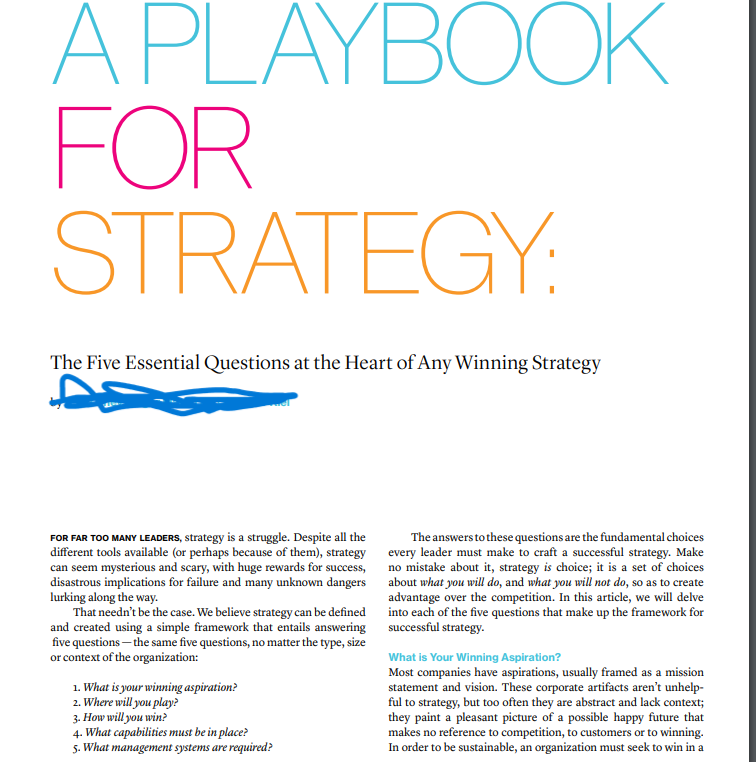
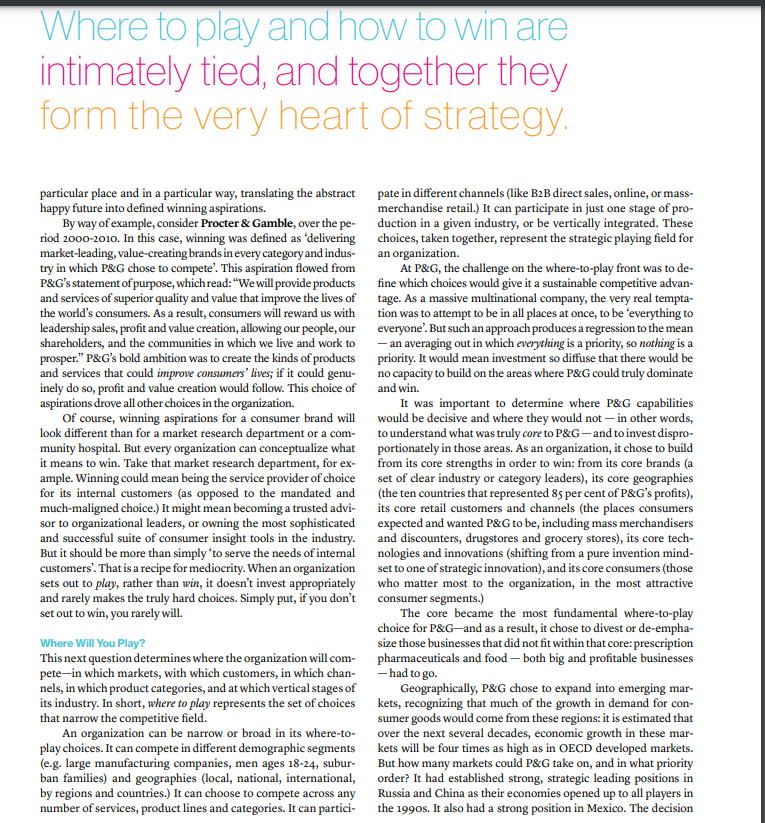
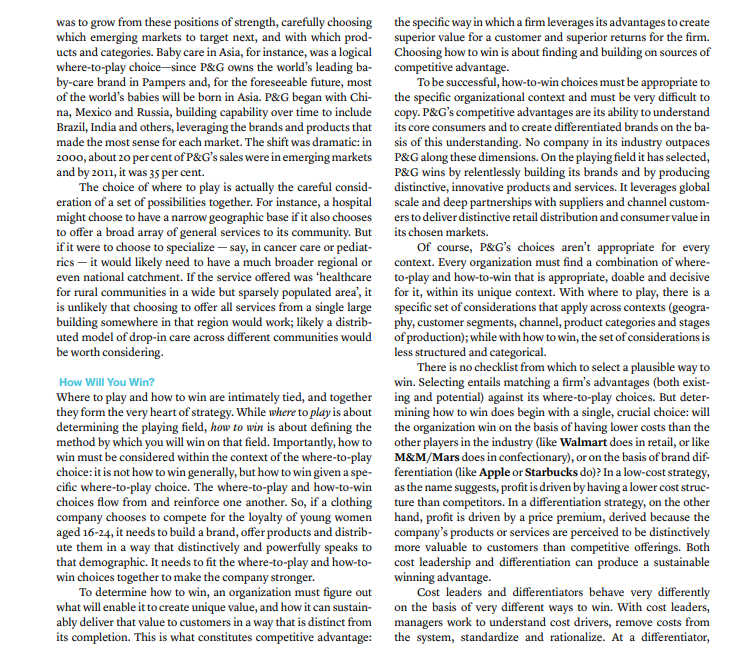
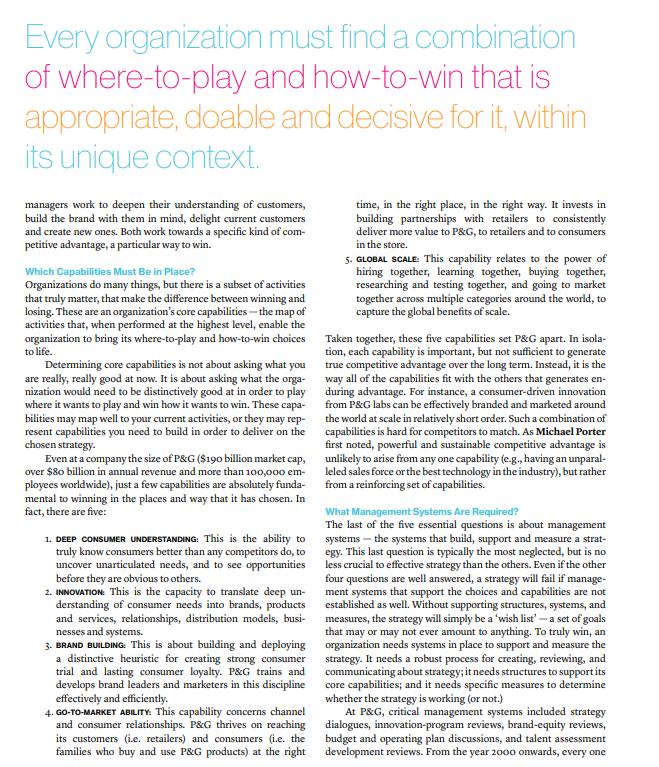
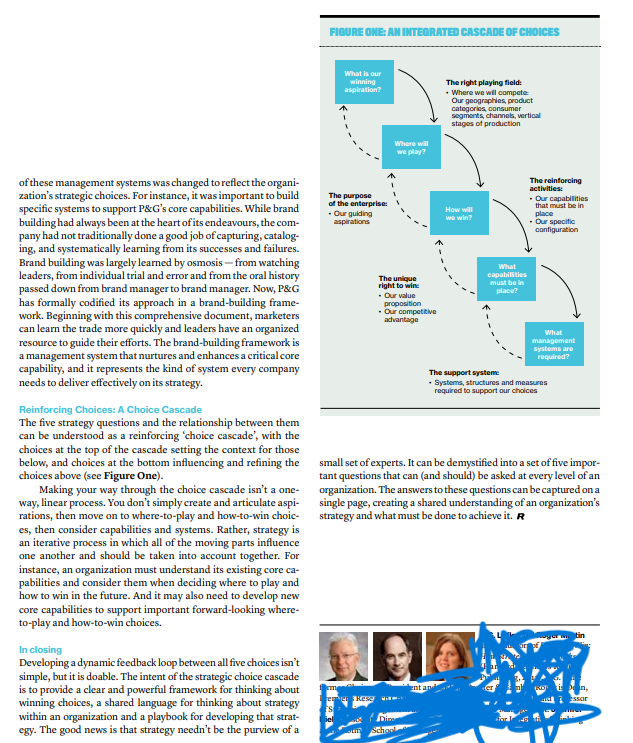
The Five Essential Questions at the Heart of Any Winning Strategy FOR FAR TOO MANY LEADERS, strategy is a struggle. Despite all the The answers to these questionsare the fundamental choices different tools available (or perhaps because of them), strategy every leader must make to craft a successful strategy. Make can seem mysterious and scary, with huge rewards for success, no mistake about it, strategy is choice; it is a set of choices disastrous implications for failure and many unknown dangers about what you will do, and what you will not do, so as to create lurking along the way. advantage over the competition. In this article, we will delve That needn't be the case. We believe strategy can be defined into each of the five questions that make up the framework for and created using a simple framework that entails answering successful strategy. five questions - the same five questions, no matter the type, size or context of the organization: What is Your Winning Aspiration? 1.Whatisyourwinningaspiration?statementandvision.Thesecorporateartifactsarentunhelp-Mostcompanieshaveaspirations,usuallyframedasamission 2. Where will you play? ful to strategy, but too often they are abstract and lack context; 3. How willyou win? they paint a pleasant picture of a possible happy future that 4.Whatcapabilitiesmustbeinplace?5.Whatmanagementsystemsarerequired?makesnoreferencetocompetition,tocustomersortowinning.Inordertobesustainable,anorganizationmustseektowinina of these management systems was changed to reflect the organization's strategic choices. For instance, it was important to build specific systems to support P\&G's core capabilities. While brand building had always been at the heart of its endeavours, the company had not traditionally done a good job of capturing, cataloging, and systematically learning from its successes and failures. Brand building was largely learned by osmosis - from watching leaders, from individual trial and error and from the oral history passed down from brand manager to brand manager. Now, P\&G has formally codified its approach in a brand-building framework. Beginning with this comprehensive document, marketers can learn the trade more quickly and leaders have an organized resource to guide their efforts. The brand-building framework is a management system that nurtures and enhances a critical core capability, and it represents the kind of system every company needs to deliver effectively on its strategy. Reinforcing Choices: A Choice Cascade The five strategy questions and the relationship between them can be understood as a reinforcing 'choice cascade', with the choices at the top of the cascade setting the context for those below, and choices at the bottom influencing and refining the small set of experts. It can be demystified into a set of five imporchoices above (see Figure One). tant questions that can (and should) be asked at every level of an Making your way through the choice cascade isn't a one- organization. The answers to these questions can be captured on a way, linear process. You don't simply create and articulate aspi- single page, creating a shared understanding of an organization's rations, then move on to where-to-play and how-to-win choic- strategy and what must be done to achieve it. R es, then consider capabilities and systems. Rather, strategy is an iterative process in which all of the moving parts influence one another and should be taken into account together. For instance, an organization must understand its existing core capabilities and consider them when deciding where to play and how to win in the future. And it may also need to develop new core capabilities to support important forward-looking whereto-play and how-to-win choices. In closing Developing a dynamic feedback loop between all five choices isn't simple, but it is doable. The intent of the strategic choice cascade is to provide a clear and powerful framework for thinking about winning choices, a shared language for thinking about strategy within an organization and a playbook for developing that strategy. The good news is that strategy needn't be the purview of a The Five Essential Questions at the Heart of Any Winning Strategy FOR FAR TOO MANY LEADERS, strategy is a struggle. Despite all the The answers to these questionsare the fundamental choices different tools available (or perhaps because of them), strategy every leader must make to craft a successful strategy. Make can seem mysterious and scary, with huge rewards for success, no mistake about it, strategy is choice; it is a set of choices disastrous implications for failure and many unknown dangers about what you will do, and what you will not do, so as to create lurking along the way. advantage over the competition. In this article, we will delve That needn't be the case. We believe strategy can be defined into each of the five questions that make up the framework for and created using a simple framework that entails answering successful strategy. five questions - the same five questions, no matter the type, size or context of the organization: What is Your Winning Aspiration? 1.Whatisyourwinningaspiration?statementandvision.Thesecorporateartifactsarentunhelp-Mostcompanieshaveaspirations,usuallyframedasamission 2. Where will you play? ful to strategy, but too often they are abstract and lack context; 3. How willyou win? they paint a pleasant picture of a possible happy future that 4.Whatcapabilitiesmustbeinplace?5.Whatmanagementsystemsarerequired?makesnoreferencetocompetition,tocustomersortowinning.Inordertobesustainable,anorganizationmustseektowinina of these management systems was changed to reflect the organization's strategic choices. For instance, it was important to build specific systems to support P\&G's core capabilities. While brand building had always been at the heart of its endeavours, the company had not traditionally done a good job of capturing, cataloging, and systematically learning from its successes and failures. Brand building was largely learned by osmosis - from watching leaders, from individual trial and error and from the oral history passed down from brand manager to brand manager. Now, P\&G has formally codified its approach in a brand-building framework. Beginning with this comprehensive document, marketers can learn the trade more quickly and leaders have an organized resource to guide their efforts. The brand-building framework is a management system that nurtures and enhances a critical core capability, and it represents the kind of system every company needs to deliver effectively on its strategy. Reinforcing Choices: A Choice Cascade The five strategy questions and the relationship between them can be understood as a reinforcing 'choice cascade', with the choices at the top of the cascade setting the context for those below, and choices at the bottom influencing and refining the small set of experts. It can be demystified into a set of five imporchoices above (see Figure One). tant questions that can (and should) be asked at every level of an Making your way through the choice cascade isn't a one- organization. The answers to these questions can be captured on a way, linear process. You don't simply create and articulate aspi- single page, creating a shared understanding of an organization's rations, then move on to where-to-play and how-to-win choic- strategy and what must be done to achieve it. R es, then consider capabilities and systems. Rather, strategy is an iterative process in which all of the moving parts influence one another and should be taken into account together. For instance, an organization must understand its existing core capabilities and consider them when deciding where to play and how to win in the future. And it may also need to develop new core capabilities to support important forward-looking whereto-play and how-to-win choices. In closing Developing a dynamic feedback loop between all five choices isn't simple, but it is doable. The intent of the strategic choice cascade is to provide a clear and powerful framework for thinking about winning choices, a shared language for thinking about strategy within an organization and a playbook for developing that strategy. The good news is that strategy needn't be the purview of a
Step by Step Solution
There are 3 Steps involved in it

Get step-by-step solutions from verified subject matter experts
 Study Help