







Question: begin { tabular } { cccc } hline & begin { tabular } { c } Time Since Order Arrived
begintabularcccc
hline & begintabularc
Time Since
Order Arrived
days ago
endtabular & begintabularc
Processing
Time days
endtabular & begintabularc
Due Date
days from
now
endtabular
hline A & & &
B & & &
C & & &
D & & &
E & & &
hline
endtabular
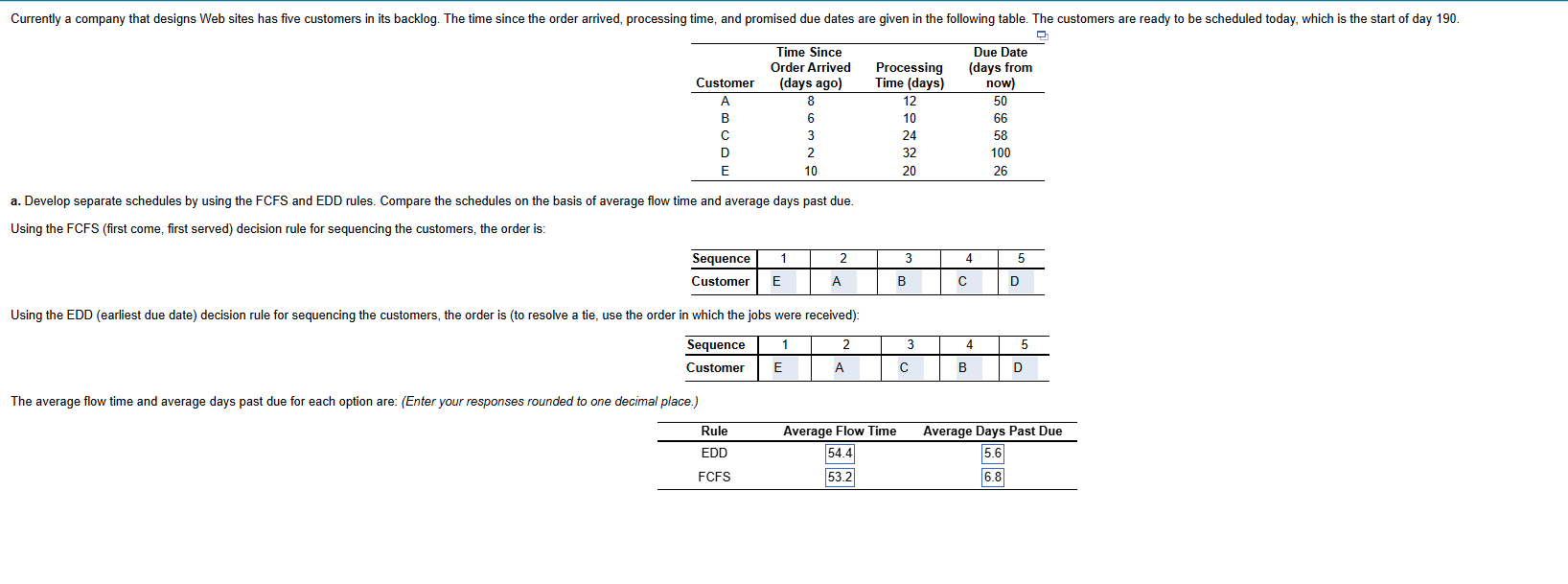
a Develop separate schedules by using the FCFS and EDD rules. Compare the schedules on the basis of average flow time and average days past due.
Using the FCFS first come, first served decision rule for sequencing the customers, the order is:
begintabularlccccc
hline Sequence & & & & &
hline Customer & E & A & B & C & D
hline
endtabular
Using the EDD earliest due date decision rule for sequencing the customers, the order is to resolve a tie, use the order in which the jobs were received:
begintabularlccccc
hline Sequence & & & & &
hline Customer & E & A & C & B & D
hline
endtabular
The average flow time and average days past due for each option are: Enter your responses rounded to one decimal place.
begintabularccc
hline Rule & Average Flow Time & Average Days Past Due
hline EDD & &
FCFS & &
hline
endtabular
Step by Step Solution
There are 3 Steps involved in it
1 Expert Approved Answer
Step: 1 Unlock

Question Has Been Solved by an Expert!
Get step-by-step solutions from verified subject matter experts
Step: 2 Unlock
Step: 3 Unlock
 Study Help