







Question: behavioral & experimental economic 2) Suppose you are considering taking the train (at a cost of $50 ) or driving your car (at a cost
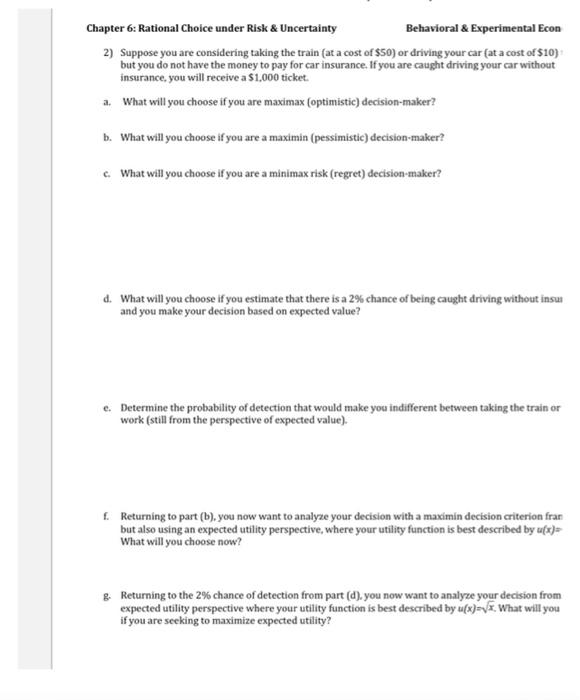
2) Suppose you are considering taking the train (at a cost of $50 ) or driving your car (at a cost of $10 ) but you do not have the money to pay for car insurance. If you are caught driving your car without insurance, you will receive a $1,000 ticket. a. What will you choose if you are maximax (optimistic) decision-maker? b. What will you choose if you are a maximin (pessimistic) decision-maker? c. What will you choose if you are a minimax risk (regret) decision-maker? d. What will you choose if you estimate that there is a 2% chance of being caught driving without insua and you make your decision based on expected value? e. Determine the probability of detection that would make you indifferent between taking the train or work (still from the perspective of expected value). f. Returning to part (b), you now want to analyze your decision with a maximin decision criterion fran but also using an expected utility perspective, where your utility function is best described by u(x)= What will you choose now? g. Returning to the 2% chance of detection from part (d), you now want to analyze your decision from expected utility perspective where your utility function is best described by u(x)=x. What will you if you are seeking to maximize expected utility? 2) Suppose you are considering taking the train (at a cost of $50 ) or driving your car (at a cost of $10 ) but you do not have the money to pay for car insurance. If you are caught driving your car without insurance, you will receive a $1,000 ticket. a. What will you choose if you are maximax (optimistic) decision-maker? b. What will you choose if you are a maximin (pessimistic) decision-maker? c. What will you choose if you are a minimax risk (regret) decision-maker? d. What will you choose if you estimate that there is a 2% chance of being caught driving without insua and you make your decision based on expected value? e. Determine the probability of detection that would make you indifferent between taking the train or work (still from the perspective of expected value). f. Returning to part (b), you now want to analyze your decision with a maximin decision criterion fran but also using an expected utility perspective, where your utility function is best described by u(x)= What will you choose now? g. Returning to the 2% chance of detection from part (d), you now want to analyze your decision from expected utility perspective where your utility function is best described by u(x)=x. What will you if you are seeking to maximize expected utility
Step by Step Solution
There are 3 Steps involved in it

Get step-by-step solutions from verified subject matter experts
 Study Help