







Question: Below is the FishCratesV1.doc Case Study for System Analysis & Design Repeat Assignment Fish Crates SAD Crates is in the business of leasing plastic fish
Below is the FishCratesV1.doc
Case Study for System Analysis & Design Repeat Assignment
Fish Crates SAD Crates is in the business of leasing plastic fish crates to commercial fishing companies. The containers hold fish as they are caught at sea, and later as they are sold at market.
It has encountered difficulties in locating and identifying its crates. SAD Crates requires a system that will facilitate the firm:
- to reduce the loss and theft of its crates,
- to bill the appropriate party in the event that the reusable containers are not returned.
The new system must enable crate-leasing firm SAD Crates to know where its containers are as they pass from fisherman to auction house to buyer throughout Europe
SAD Crates leases hundreds of thousands of crates to fishermen, who load them onto ships plying the North Sea, fill the containers with their catch, and then deliver them to auction houses in Britain, Denmark and other European countries. The model allows fishermen to lease, fill with fish and bring to auction houses or buyers, who can then distribute and sell the catch, and return the crates to SAD Fish Crate so that they can be washed and reused.
To date the company had relied mainly on a manual method of tracking its containers, using pen and paper to record the number of crates a fisherman, auction house or buyer has at any given time, along with when they need to be returned. However, the experience of SAD Crates is epitomised by a business trip through Poland in 2009, where the CEO and other SAD Crates staff travelled through ports and identified enough abandoned SAD Crates containers to fill two trucks.
Between 5% to 10% of the company's crates are lost each year.
Before going out to sea, a fisherman goes to SAD Crates and rents crates. The required number of containers are taken out of the company's storage area and assigned to that fisherman, who then loads them onto his boat and sails out. Upon catching fish, a mariner has two options:
1. using the crates for storing his catch without sorting the fish, and then delivering them to an onshore facility that does the sorting for him
2. sorting them at sea based on species, sizes and qualities.
The latter option is the more usual. With the latter option, when the ship returns to the harbour, the loaded crates are delivered directly to an auction house, to be sold. The fish then travel to the buyer's factory for processing, or are exported to other European countries.
In the first scenario (in which a variety of fish are packed in the same container), the crates have an added step - passing from the sorting company to the auction house for sale. On the boat, as well as in the harbour, the crates are stored in cooling rooms and freezers. When the containers are emptied it is the responsibility of the factory or other party in possession of those crates to return them to one of SAD Crates, where they are cleaned in a high-pressure, high-temperature washing machine before being placed into storage again.
There are several ways in which the crates can go missing: They can be stolen from the storage area, or from the companies processing the fish, they can fall overboard at sea, or fishermen can deliver their catch to a facility that then holds onto the containers. In addition, some are damaged during handling. The fishermen, the factories and the exporters pay a fee to rent each crate, and if SAD Crates is aware that they are not returned, it will continue to charge that fee until the crate is fully paid for, assuming it can ascertain the party responsible.
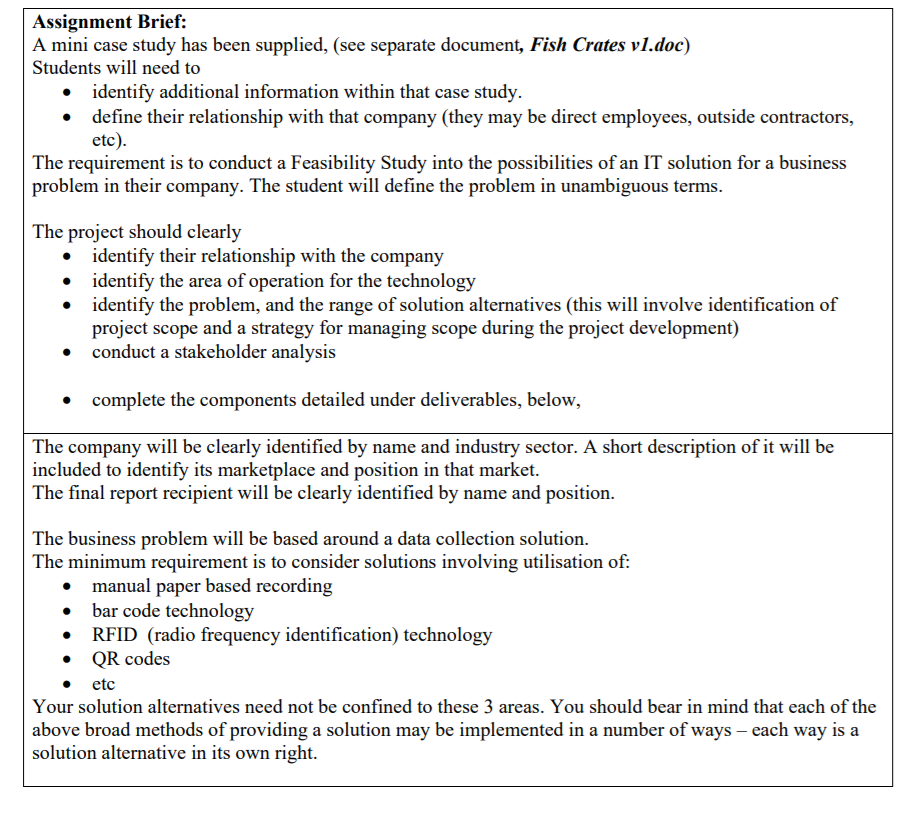
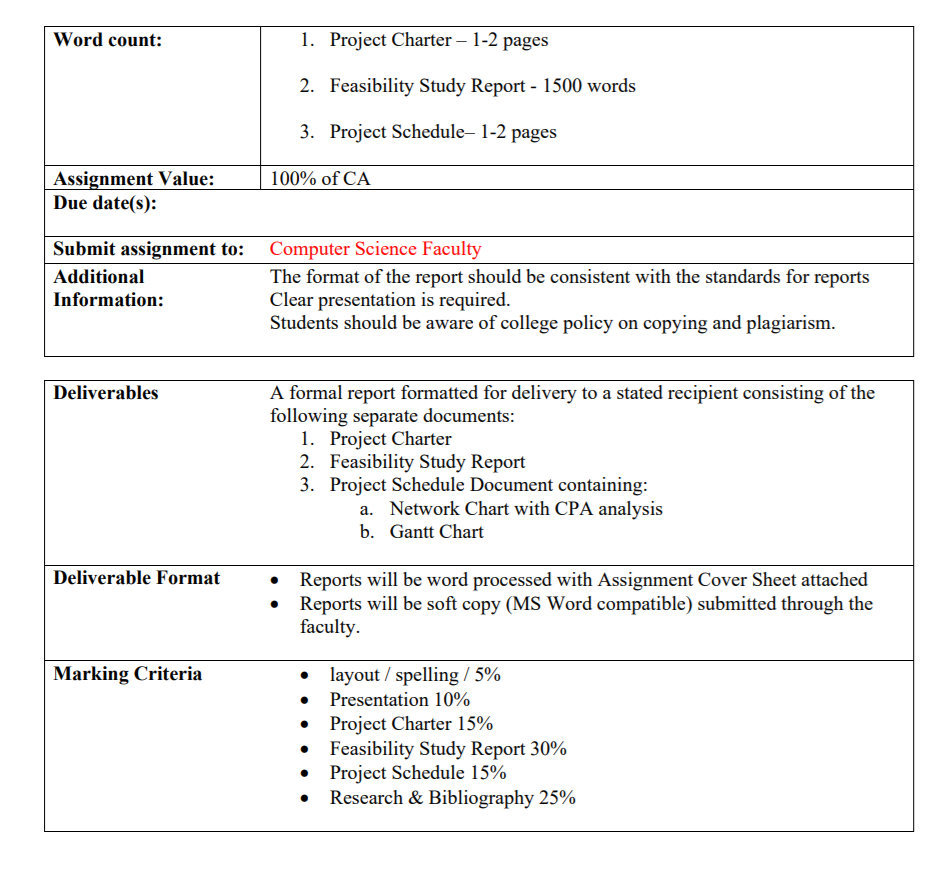
Assignment Brief: A mini case study has been supplied, (see separate document, Fish Crates vl.doc) Students will need to identify additional information within that case study. define their relationship with that company (they may be direct employees, outside contractors, etc). The requirement is to conduct a Feasibility Study into the possibilities of an IT solution for a business problem in their company. The student will define the problem in unambiguous terms. The project should clearly identify their relationship with the company identify the area of operation for the technology identify the problem, and the range of solution alternatives (this will involve identification of project scope and a strategy for managing scope during the project development) conduct a stakeholder analysis complete the components detailed under deliverables, below, The company will be clearly identified by name and industry sector. A short description of it will be included to identify its marketplace and position in that market. The final report recipient will be clearly identified by name and position. The business problem will be based around a data collection solution. The minimum requirement is to consider solutions involving utilisation of: manual paper based recording bar code technology RFID (radio frequency identification) technology QR codes etc Your solution alternatives need not be confined to these 3 areas. You should bear in mind that each of the above broad methods of providing a solution may be implemented in a number of ways each way is a solution alternative in its own right. Word count: 1. Project Charter - 1-2 pages 2. Feasibility Study Report - 1500 words 3. Project Schedule- 1-2 pages 100% of CA Assignment Value: Due date(s): Submit assignment to: Additional Information: Computer Science Faculty The format of the report should be consistent with the standards for reports Clear presentation is required. Students should be aware of college policy on copying and plagiarism. Deliverables A formal report formatted for delivery to a stated recipient consisting of the following separate documents: 1. Project Charter 2. Feasibility Study Report 3. Project Schedule Document containing: a. Network Chart with CPA analysis b. Gantt Chart Deliverable Format Reports will be word processed with Assignment Cover Sheet attached Reports will be soft copy (MS Word compatible) submitted through the faculty. Marking Criteria layout / spelling / 5% Presentation 10% Project Charter 15% Feasibility Study Report 30% Project Schedule 15% Research & Bibliography 25% Assignment Brief: A mini case study has been supplied, (see separate document, Fish Crates vl.doc) Students will need to identify additional information within that case study. define their relationship with that company (they may be direct employees, outside contractors, etc). The requirement is to conduct a Feasibility Study into the possibilities of an IT solution for a business problem in their company. The student will define the problem in unambiguous terms. The project should clearly identify their relationship with the company identify the area of operation for the technology identify the problem, and the range of solution alternatives (this will involve identification of project scope and a strategy for managing scope during the project development) conduct a stakeholder analysis complete the components detailed under deliverables, below, The company will be clearly identified by name and industry sector. A short description of it will be included to identify its marketplace and position in that market. The final report recipient will be clearly identified by name and position. The business problem will be based around a data collection solution. The minimum requirement is to consider solutions involving utilisation of: manual paper based recording bar code technology RFID (radio frequency identification) technology QR codes etc Your solution alternatives need not be confined to these 3 areas. You should bear in mind that each of the above broad methods of providing a solution may be implemented in a number of ways each way is a solution alternative in its own right. Word count: 1. Project Charter - 1-2 pages 2. Feasibility Study Report - 1500 words 3. Project Schedule- 1-2 pages 100% of CA Assignment Value: Due date(s): Submit assignment to: Additional Information: Computer Science Faculty The format of the report should be consistent with the standards for reports Clear presentation is required. Students should be aware of college policy on copying and plagiarism. Deliverables A formal report formatted for delivery to a stated recipient consisting of the following separate documents: 1. Project Charter 2. Feasibility Study Report 3. Project Schedule Document containing: a. Network Chart with CPA analysis b. Gantt Chart Deliverable Format Reports will be word processed with Assignment Cover Sheet attached Reports will be soft copy (MS Word compatible) submitted through the faculty. Marking Criteria layout / spelling / 5% Presentation 10% Project Charter 15% Feasibility Study Report 30% Project Schedule 15% Research & Bibliography 25%Step by Step Solution
There are 3 Steps involved in it

Get step-by-step solutions from verified subject matter experts
 Study Help