







Question: Brief For this coursework project the candidate is required to answer a number of different questions on a simple single name credit default swap (CDS)
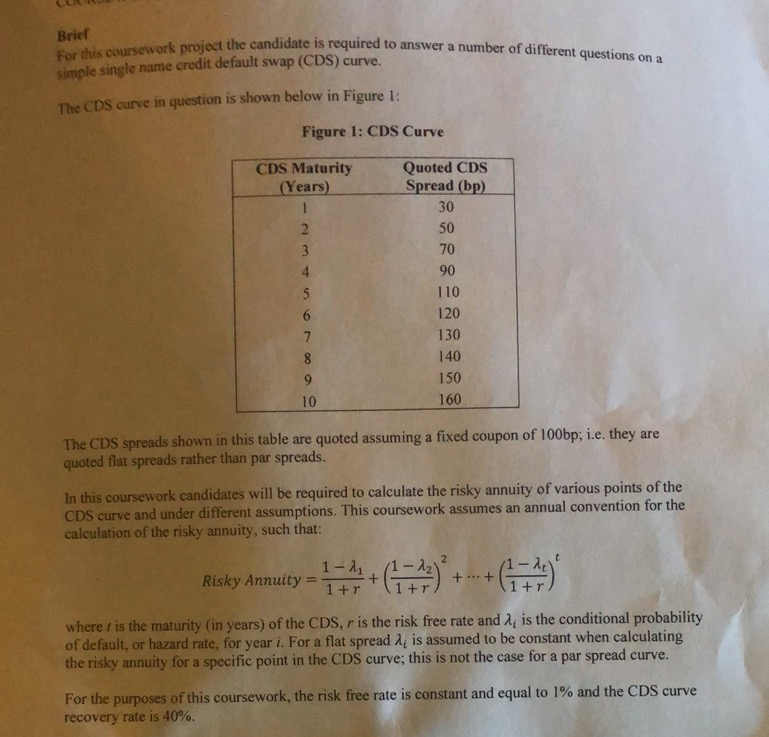
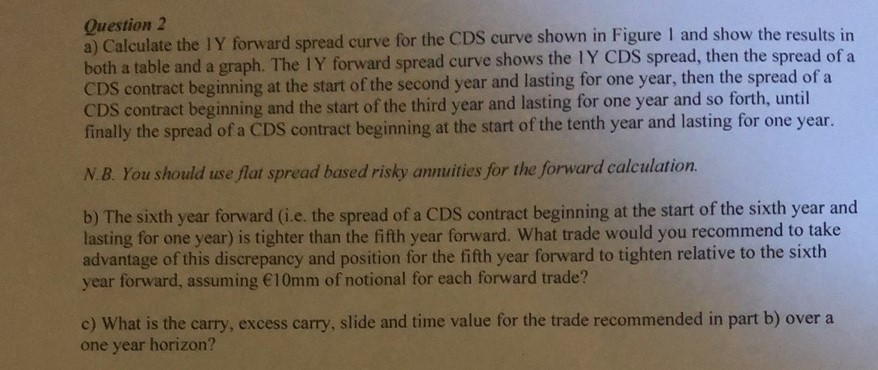
Brief For this coursework project the candidate is required to answer a number of different questions on a simple single name credit default swap (CDS) curve. The CDS curve in question is shown below in Figure 1: Figure 1: CDS Curve CDS Maturity (Years) 1 2 3 4 5 6 7 8 9 10 Quoted CDS Spread (bp) 30 50 70 90 110 120 130 140 150 160 The CDS spreads shown in this table are quoted assuming a fixed coupon of 100bp; i.e. they are quoted flat spreads rather than par spreads. In this coursework candidates will be required to calculate the risky annuity of various points of the CDS curve and under different assumptions. This coursework assumes an annual convention for the calculation of the risky annuity, such that: t Risky Annuity 1-4 + 1 +r + ... + 1+r where is the maturity (in years) of the CDS, r is the risk free rate and li is the conditional probability of default, or hazard rate, for year i. For a flat spread 2 is assumed to be constant when calculating the risky annuity for a specific point in the CDS curve; this is not the case for a par spread curve. For the purposes of this coursework, the risk free rate is constant and equal to 1% and the CDS curve recovery rate is 40%. Question 2 a) Calculate the IY forward spread curve for the CDS curve shown in Figure 1 and show the results in both a table and a graph. The 1Y forward spread curve shows the TY CDS spread, then the spread of a CDS contract beginning at the start of the second year and lasting for one year, then the spread of a CDS contract beginning and the start of the third year and lasting for one year and so forth, until finally the spread of a CDS contract beginning at the start of the tenth year and lasting for one year. N.B. You should use flat spread based risky annuities for the forward calculation. b) The sixth year forward (i.e. the spread of a CDS contract beginning at the start of the sixth year and lasting for one year) is tighter than the fifth year forward. What trade would you recommend to take advantage of this discrepancy and position for the fifth year forward to tighten relative to the sixth year forward, assuming 10mm of notional for each forward trade? c) What is the carry, excess carry, slide and time value for the trade recommended in part b) over a one year horizon? Brief For this coursework project the candidate is required to answer a number of different questions on a simple single name credit default swap (CDS) curve. The CDS curve in question is shown below in Figure 1: Figure 1: CDS Curve CDS Maturity (Years) 1 2 3 4 5 6 7 8 9 10 Quoted CDS Spread (bp) 30 50 70 90 110 120 130 140 150 160 The CDS spreads shown in this table are quoted assuming a fixed coupon of 100bp; i.e. they are quoted flat spreads rather than par spreads. In this coursework candidates will be required to calculate the risky annuity of various points of the CDS curve and under different assumptions. This coursework assumes an annual convention for the calculation of the risky annuity, such that: t Risky Annuity 1-4 + 1 +r + ... + 1+r where is the maturity (in years) of the CDS, r is the risk free rate and li is the conditional probability of default, or hazard rate, for year i. For a flat spread 2 is assumed to be constant when calculating the risky annuity for a specific point in the CDS curve; this is not the case for a par spread curve. For the purposes of this coursework, the risk free rate is constant and equal to 1% and the CDS curve recovery rate is 40%. Question 2 a) Calculate the IY forward spread curve for the CDS curve shown in Figure 1 and show the results in both a table and a graph. The 1Y forward spread curve shows the TY CDS spread, then the spread of a CDS contract beginning at the start of the second year and lasting for one year, then the spread of a CDS contract beginning and the start of the third year and lasting for one year and so forth, until finally the spread of a CDS contract beginning at the start of the tenth year and lasting for one year. N.B. You should use flat spread based risky annuities for the forward calculation. b) The sixth year forward (i.e. the spread of a CDS contract beginning at the start of the sixth year and lasting for one year) is tighter than the fifth year forward. What trade would you recommend to take advantage of this discrepancy and position for the fifth year forward to tighten relative to the sixth year forward, assuming 10mm of notional for each forward trade? c) What is the carry, excess carry, slide and time value for the trade recommended in part b) over a one year horizon
Step by Step Solution
There are 3 Steps involved in it

Get step-by-step solutions from verified subject matter experts
 Study Help