







Question: Briefly describe the differences between a hostile merger and a friendly merger. Is there any reason to think that acquiring companies would, on average, pay
Briefly describe the differences between a hostile merger and a friendly merger. Is there any reason to think that acquiring companies would, on average, pay a greater premium over target companies' preannouncement prices in hostile mergers than in friendly mergers?
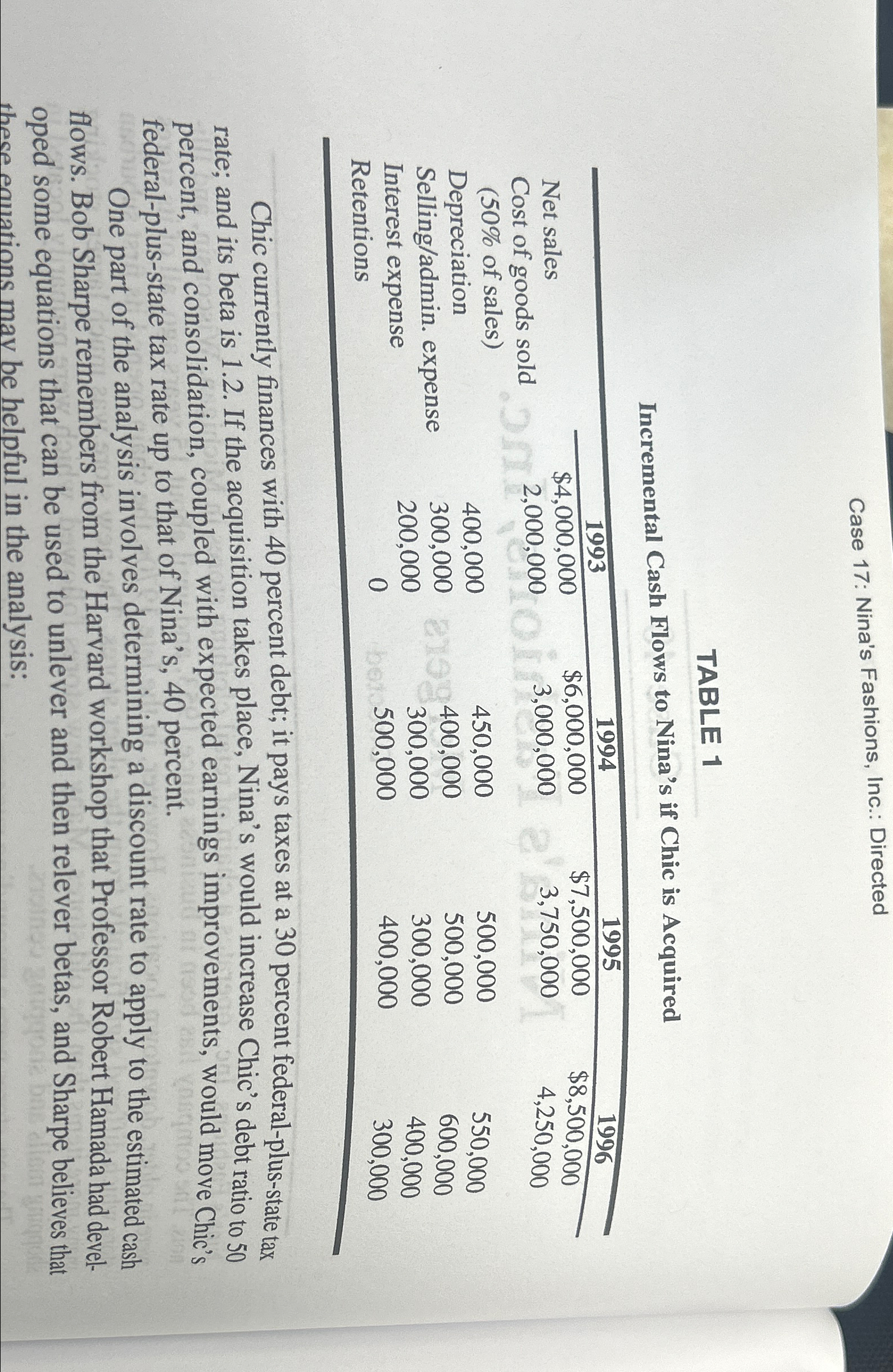
Use the data contained in Table to construct Chic's cash flow statements for through Why is interest expense typically deducted in merger cash flow statements, whereas it is not normally deducted in capital budgeting cash flow analysis? Why are retentions deducted in the cash flow statement?
Conceptually, what is the appropriate discount rate to apply to the cash flows developed in Question What is the numerical value? How much confidence can one place in this estimate; that is is the estimated discount rate likely to be in error by a small amount such as percentage point or a large amount such as or percentage points?
What is the terminal value of Chic; that is what is the value of the cash flows Chic is expected to generate beyond What is Chic's value to Nina's at the beginning of Suppose another firm was evaluating Chic as a potential acquisition candidate. Would they obtain the same value? Explain.
Case : Nina's Fashions, Inc.: Directed
TABLE
Incremental Cash Flows to Nina's if Chic is Acquired
tableNet sales,$$$$
Step by Step Solution
There are 3 Steps involved in it
1 Expert Approved Answer
Step: 1 Unlock

Question Has Been Solved by an Expert!
Get step-by-step solutions from verified subject matter experts
Step: 2 Unlock
Step: 3 Unlock
 Study Help