







Question: Built-in Shell Commands vs. Unix Utilities LinProg vs. Program vs. Shell Questions: Group 2 Questions: Group 1 Log into linprog. What's the CPU clock speed
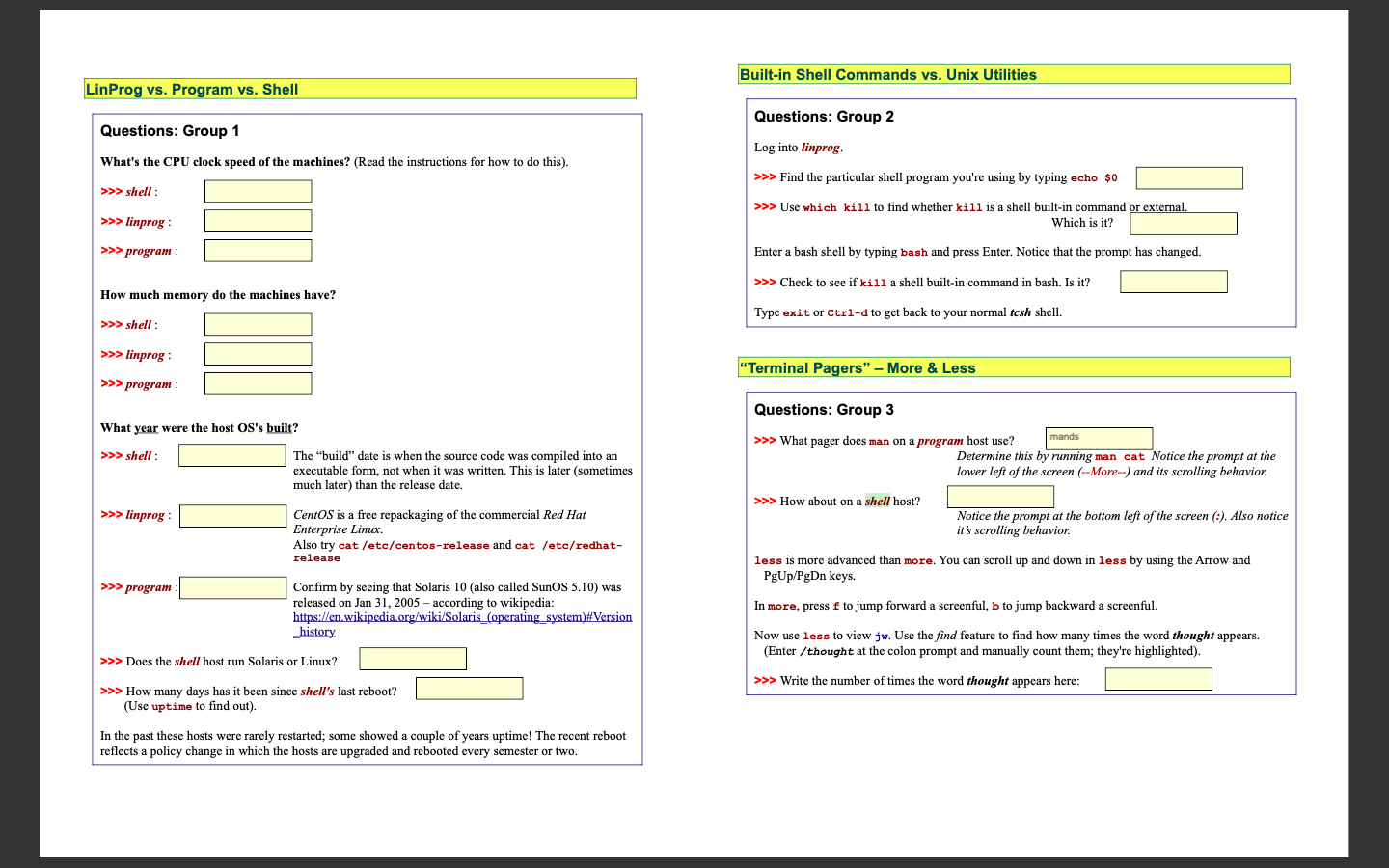
Built-in Shell Commands vs. Unix Utilities LinProg vs. Program vs. Shell Questions: Group 2 Questions: Group 1 Log into linprog. What's the CPU clock speed of the machines? (Read the instructions for how to do this). >>> shell: >>> Find the particular shell program you're using by typing echo $0 >>> Use which kill to find whether kill is a shell built-in command or external. Which is it? >>> linprog: >>> program: Enter a bash shell by typing bash and press Enter. Notice that the prompt has changed. >>> Check to see if kill a shell built-in command in bash. Is it? How much memory do the machines have? Type exit or Ctrl-d to get back to your normal tcsh shell. >>> shell: >>> linprog: Terminal Pagers" - More & Less >>> program: Questions: Group 3 What year were the host OS's built? >>> shell: The "build" date is when the source code was compiled into an executable form, not when it was written. This is later (sometimes much later) than the release date. mands >>> What pager does man on a program host use? Determine this by running man cat Notice the prompt at the lower left of the screen (--More--) and its scrolling behavior. >>> How about on a shell host? >>> linprog CentOS is a free repackaging of the commercial Red Hat Enterprise Linux. Also try cat /etc/centos-release and cat /etc/redhat- release Notice the prompt at the bottom left of the screen (). Also notice it's scrolling behavior >>> program Confirm by seeing that Solaris 10 (also called SunOS 5.10) was released on Jan 31, 2005 - according to wikipedia: https://en.wikipedia.org/wiki/Solaris_(operating system)#Version history less is more advanced than more. You can scroll up and down in less by using the Arrow and PgUp/PgDn keys. In more, press f to jump forward a screenful, b to jump backward a screenful. >>> Does the shell host run Solaris or Linux? Now use less to view jw. Use the find feature to find how many times the word thought appears. (Enter /thought at the colon prompt and manually count them; they're highlighted). >>> Write the number of times the word thought appears here: >>> How many days has it been since shell's last reboot? (Use uptime to find out). In the past these hosts were rarely restarted; some showed a couple of years uptime! The recent reboot reflects a policy change in which the hosts are upgraded and rebooted every semester or two. Built-in Shell Commands vs. Unix Utilities LinProg vs. Program vs. Shell Questions: Group 2 Questions: Group 1 Log into linprog. What's the CPU clock speed of the machines? (Read the instructions for how to do this). >>> shell: >>> Find the particular shell program you're using by typing echo $0 >>> Use which kill to find whether kill is a shell built-in command or external. Which is it? >>> linprog: >>> program: Enter a bash shell by typing bash and press Enter. Notice that the prompt has changed. >>> Check to see if kill a shell built-in command in bash. Is it? How much memory do the machines have? Type exit or Ctrl-d to get back to your normal tcsh shell. >>> shell: >>> linprog: Terminal Pagers" - More & Less >>> program: Questions: Group 3 What year were the host OS's built? >>> shell: The "build" date is when the source code was compiled into an executable form, not when it was written. This is later (sometimes much later) than the release date. mands >>> What pager does man on a program host use? Determine this by running man cat Notice the prompt at the lower left of the screen (--More--) and its scrolling behavior. >>> How about on a shell host? >>> linprog CentOS is a free repackaging of the commercial Red Hat Enterprise Linux. Also try cat /etc/centos-release and cat /etc/redhat- release Notice the prompt at the bottom left of the screen (). Also notice it's scrolling behavior >>> program Confirm by seeing that Solaris 10 (also called SunOS 5.10) was released on Jan 31, 2005 - according to wikipedia: https://en.wikipedia.org/wiki/Solaris_(operating system)#Version history less is more advanced than more. You can scroll up and down in less by using the Arrow and PgUp/PgDn keys. In more, press f to jump forward a screenful, b to jump backward a screenful. >>> Does the shell host run Solaris or Linux? Now use less to view jw. Use the find feature to find how many times the word thought appears. (Enter /thought at the colon prompt and manually count them; they're highlighted). >>> Write the number of times the word thought appears here: >>> How many days has it been since shell's last reboot? (Use uptime to find out). In the past these hosts were rarely restarted; some showed a couple of years uptime! The recent reboot reflects a policy change in which the hosts are upgraded and rebooted every semester or two
Step by Step Solution
There are 3 Steps involved in it

Get step-by-step solutions from verified subject matter experts
 Study Help