







Question: Unix shell This is what I have so far: #include #include #include #include #include #include /* Function Declarations for builtin shell commands: */ int lsh_cd(char
Unix shell
This is what I have so far:
#include
#include
#include
#include
#include
#include
/*
Function Declarations for builtin shell commands:
*/
int lsh_cd(char **args);
int lsh_help(char **args);
int lsh_exit(char **args);
/*
List of builtin commands, followed by their corresponding functions.
*/
char *builtin_str[] = {
"cd",
"help",
"exit"
};
int (*builtin_func[]) (char **) = {
&lsh_cd,
&lsh_help,
&lsh_exit
};
int lsh_num_builtins() {
return sizeof(builtin_str) / sizeof(char *);
}
/*
Builtin function implementations.
*/
/**
@brief Bultin command: change directory.
@param args List of args. args[0] is "cd". args[1] is the directory.
@return Always returns 1, to continue executing.
*/
int lsh_cd(char **args)
{
if (args[1] == NULL) {
fprintf(stderr, "lsh: expected argument to \"cd\" ");
} else {
if (chdir(args[1]) != 0) {
perror("lsh");
}
}
return 1;
}
/**
@brief Builtin command: print help.
@param args List of args. Not examined.
@return Always returns 1, to continue executing.
*/
int lsh_help(char **args)
{
int i;
printf("Stephen Brennan's LSH ");
printf("Type program names and arguments, and hit enter. ");
printf("The following are built in: ");
for (i = 0; i
printf(" %s ", builtin_str[i]);
}
printf("Use the man command for information on other programs. ");
return 1;
}
/**
@brief Builtin command: exit.
@param args List of args. Not examined.
@return Always returns 0, to terminate execution.
*/
int lsh_exit(char **args)
{
return 0;
}
/**
@brief Launch a program and wait for it to terminate.
@param args Null terminated list of arguments (including program).
@return Always returns 1, to continue execution.
*/
int lsh_launch(char **args)
{
pid_t pid;
int status;
pid = fork();
if (pid == 0) {
// Child process
if (execvp(args[0], args) == -1) {
perror("lsh");
}
exit(EXIT_FAILURE);
} else if (pid
// Error forking
perror("lsh");
} else {
// Parent process
do {
waitpid(pid, &status, WUNTRACED);
} while (!WIFEXITED(status) && !WIFSIGNALED(status));
}
return 1;
}
/**
@brief Execute shell built-in or launch program.
@param args Null terminated list of arguments.
@return 1 if the shell should continue running, 0 if it should terminate
*/
int lsh_execute(char **args)
{
int i;
if (args[0] == NULL) {
// An empty command was entered.
return 1;
}
for (i = 0; i
if (strcmp(args[0], builtin_str[i]) == 0) {
return (*builtin_func[i])(args);
}
}
return lsh_launch(args);
}
#define LSH_RL_BUFSIZE 1024
/**
@brief Read a line of input from stdin.
@return The line from stdin.
*/
char *lsh_read_line(void)
{
int bufsize = LSH_RL_BUFSIZE;
int position = 0;
char *buffer = malloc(sizeof(char) * bufsize);
int c;
if (!buffer) {
fprintf(stderr, "lsh: allocation error ");
exit(EXIT_FAILURE);
}
while (1) {
// Read a character
c = getchar();
if (c == EOF) {
exit(EXIT_SUCCESS);
} else if (c == ' ') {
buffer[position] = '\0';
return buffer;
} else {
buffer[position] = c;
}
position++;
// If we have exceeded the buffer, reallocate.
if (position >= bufsize) {
bufsize += LSH_RL_BUFSIZE;
buffer = realloc(buffer, bufsize);
if (!buffer) {
fprintf(stderr, "lsh: allocation error ");
exit(EXIT_FAILURE);
}
}
}
}
#define LSH_TOK_BUFSIZE 64
#define LSH_TOK_DELIM " \t \a"
/**
@brief Split a line into tokens (very naively).
@param line The line.
@return Null-terminated array of tokens.
*/
char **lsh_split_line(char *line)
{
int bufsize = LSH_TOK_BUFSIZE, position = 0;
char **tokens = malloc(bufsize * sizeof(char*));
char *token, **tokens_backup;
if (!tokens) {
fprintf(stderr, "lsh: allocation error ");
exit(EXIT_FAILURE);
}
token = strtok(line, LSH_TOK_DELIM);
while (token != NULL) {
tokens[position] = token;
position++;
if (position >= bufsize) {
bufsize += LSH_TOK_BUFSIZE;
tokens_backup = tokens;
tokens = realloc(tokens, bufsize * sizeof(char*));
if (!tokens) {
free(tokens_backup);
fprintf(stderr, "lsh: allocation error ");
exit(EXIT_FAILURE);
}
}
token = strtok(NULL, LSH_TOK_DELIM);
}
tokens[position] = NULL;
return tokens;
}
/**
@brief Loop getting input and executing it.
*/
void lsh_loop(void)
{
char *line;
char **args;
int status;
do {
printf("> ");
line = lsh_read_line();
args = lsh_split_line(line);
status = lsh_execute(args);
free(line);
free(args);
} while (status);
}
/**
@brief Main entry point.
@param argc Argument count.
@param argv Argument vector.
@return status code
*/
int main(int argc, char **argv)
{
// Load config files, if any.
// Run command loop.
lsh_loop();
// Perform any shutdown/cleanup.
return EXIT_SUCCESS;
}
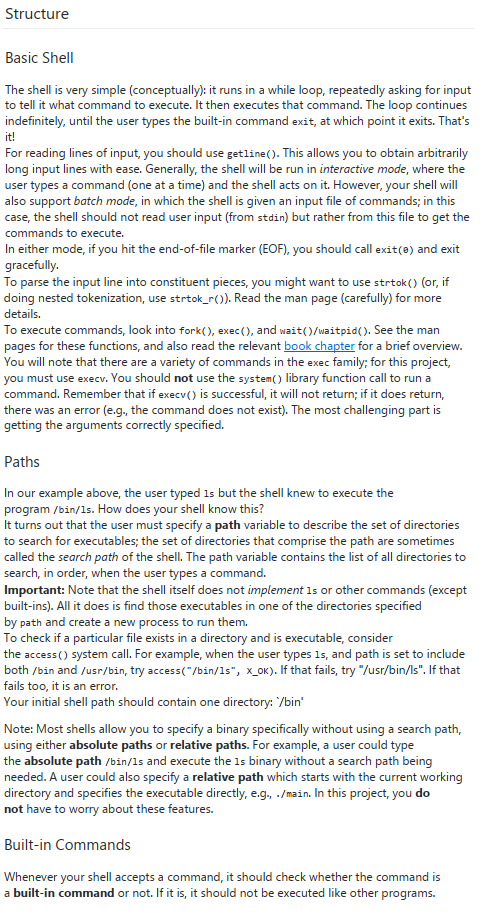
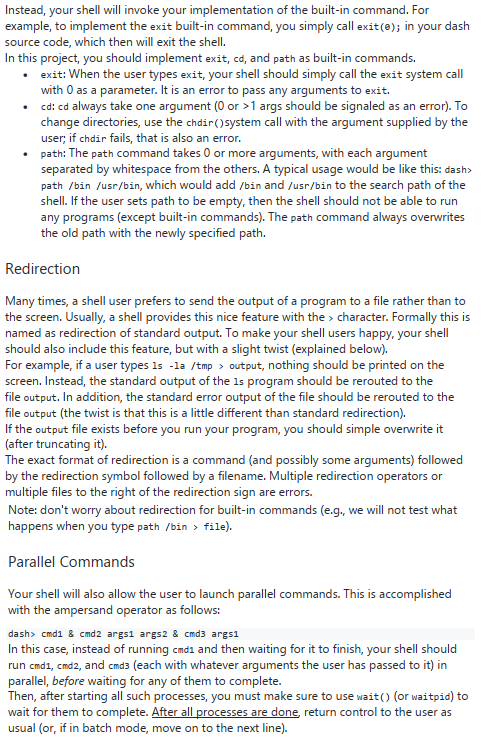
I need path, parallel and redirect part. Thank you in advance!
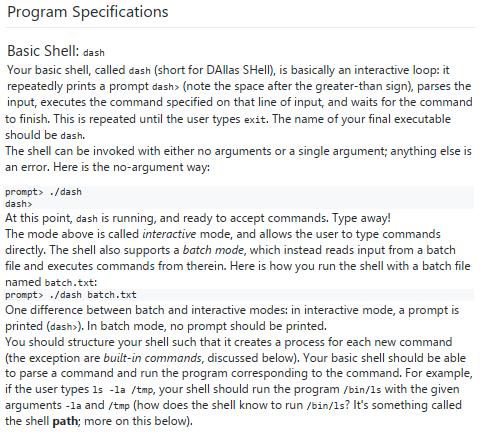
rogram Specifications Basic Shell: dash Your basic shell, called dash (short for DAllas SHell), is basically an interactive loop: it repeatedly prints a prompt dash> (note the space after the greater-than sign), parses the input, executes the command specified on that line of input, and waits for the command to finish. This is repeated until the user types exit. The name of your final executable should be dash. The shell can be invoked with either no arguments or a single argument; anything else is an error. Here is the no-argument way: prompt> ./dash dash> At this point, dash is running, and ready to accept commands. Type away! The mode above is called interactive mode, and allows the user to type commands directly. The shell also supports a batch mode, which instead reads input from a batch file and executes commands from therein. Here is how you run the shell with a batch file named batch.txt: prompt> ./dash batch.txt One difference between batch and interactive modes: in interactive mode, a prompt is printed (dash>). In batch mode, no prompt should be printed. You should structure your shell such that it creates a process for each new command (the exception are built-in commands, discussed below). Your basic shell should be able to parse a command and run the program corresponding to the command. For example, if the user types 1s -la /tmp, your shell should run the program /bin/1s with the given arguments -la and /tmp (how does the shell know to run /bin/1s? It's something called the shell path; more on this below)
Step by Step Solution
There are 3 Steps involved in it

Get step-by-step solutions from verified subject matter experts
 Study Help