







Question: bus230 please read first the research then answer the tasks the questions are the last 2 papers (2007), Koohsar.et al (2007) showed that there is
bus230
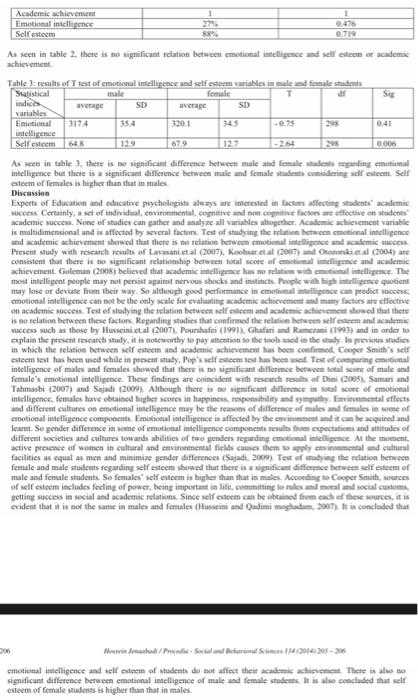
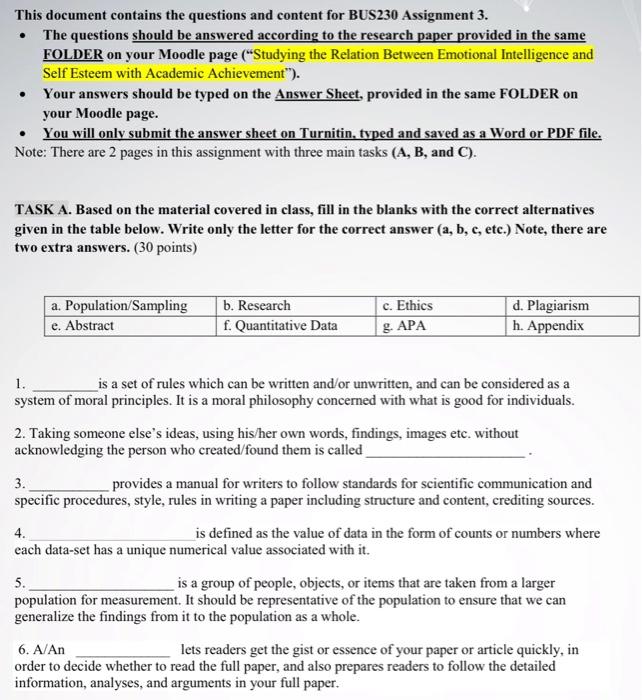
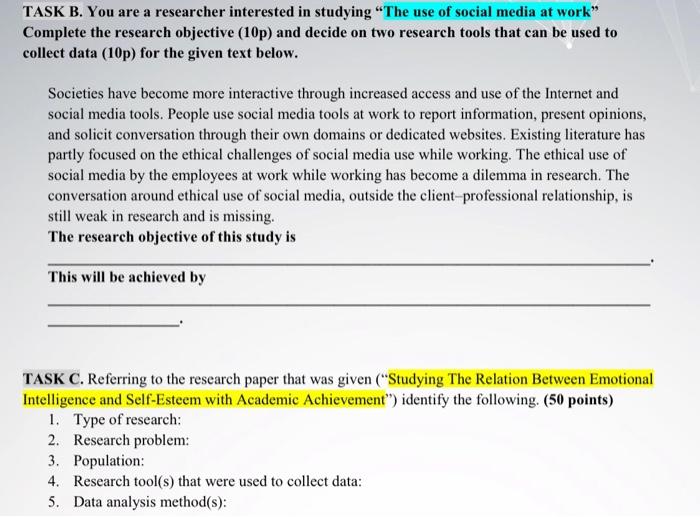
(2007), Koohsar.et al (2007) showed that there is no significant relation between emotional intelligence and academic achievement. According to Brodi and Hal who studied emotional differences between male and female genders, females replaced emotional reactions with hand to hand combat better than males. On the contrary, males do not show their feelings and are not aware from emotional state of themselves and others. In this direction, Besharat.et.al (2006) reported emotional intelligence of female students higher than that in male students. It is evident that it is not reasonable to consider emotional skills without paying attention to psychological personal dimensions such as self esteem. Self esteem can be one of the main factors of academic achievement. Self esteem means self satisfaction and feeling valuable (Nathanael, 2000). On the other hand, self esteem means that how people think about themselves, how much they like themselves and whether they are satisfied about their performance especially what their feeling is about their social and educational status and how much coordination is there between their ideal and real selves (Husseini, 2007). In a study done by Ras Bera who investigated the relation between self esteem and academic achievement, the real score of exam was given to a group of students while a score 10 times lower than the real score was given to another group. Results showed that self esteem and academic achievement had a direct relationship. Studies done by Pourshafei (1991) showed positive and significant relation between self esteem and academic achievement. Results of some researches and studies show the role and importance of emotional intelligence and self esteem to explain academic achievement. So the present study is aimed to study the relation between emotional intelligence and self esteem and academic achievement in male and female students. Method It is a descriptive correlative study. Statistical population of this study is all students of Kahnooj Payam-e Nour University including 2000 students who are completing M.A degree in 2010-2011. The sample group is 300 students (150 females and 150 males) who were chosen randomly based on Morgan table. In order to gather information, Ann-Bar's emotional intelligence questionnaire and Pop's self esteem questionnaire were used and average index was used to measure academic achievement. Ann-Bar's emotional intelligence questionnaire consists of 90 questions. In addition of total score, this tests 15 components of emotional intelligence. Reliability of the test has been reported 93% in terms of Kranbakh's alpha (Samari and Tahmasbi, 2007). Pop's self esteem questionnaire was made by Allen Pop in the United States including 6 scales such as general, academic, physical, family and social self esteems and one lie evaluating scale. This test has 57 questions, Reliability coefficient of the test was estimated 87% based on Kranbakh's alpha (Ghafari and Ramezani, 1994). In order to analyze data, descriptive statistic indices such as frequency, average, standard deviation were used. In order to study the relation between emotional intelligence and self esteem and academic success, Pearson correlation coefficient was used and in order to compare emotional intelligence and self esteem between male and female students, independent T test was used. Findings Average and standard deviation of emotional intelligence, self esteem and academic achievements of students are shown in table 1 based on total sample and gender Table 1: Average and standard deviation of emotional intelligence, self esteem and academic achievements of based on total sample and gender, statistics Total sample male female variables Standar number average Standard number average Standard number average deviation deviation d deviatio 318.8 34.5 n 345 150 317.4 35.4 150 320.1 Emotional 00 intelligence Self esteem Academic achieveme nt 66.6 16.6 12.9 1.8 64,8 16.2 12.9 1.7 67.9 17 12.7 1.8 Table 2: Pearson's correlation coefficients of success with emotional intelligence and self esteem variable Sis 1 Academic achievement Emotional intelligence Self esteem 1 0.476 0719 8. As seen in table 2. there is no significant relation between emotional intelligence and self esteem or academic achievement Table 3: results of Trest of emotional intelligence and self esteem variables in male and female students Statistical male female T ar Sig indices average SD average SD variables Emotional 317.4 35.4 345 29 0.41 intelligence Self esteem 127 -264 000 As seen in table ), there is no significant difference between male and female students regarding emotional intelligence but there is a significant difference between male and female students considering self esteem. Self esteem of females is higher than that in males. Discussion Experts of Education and educative psychologists always are interested in factors affecting students academic success. Certainly a set of individual environmental, cognitive and son cognitive factors are effective on students academic success. None of studies can gather and analyze all variables altogether. Academic achievement variable is multidimensional and is affected by several factors. Test of studying the relation between cmotional intelligence and academic achievement showed that there is no relation between emotional intelligence and academic success Present study with research results of Lavasani et al (2007). Koosa et al (2007) and not al (2004) are consistent that there is no significant relationship between total score of metal intelligence and academic achievement. Goleman (2008) believed that academic intelligence has no relation with emotional intelligence. The most intelligent people may not persist against nervous shocks and instincts. People with high intelligence quotient may lose or deviate from their way. So although good performance in moltelligence ca predict success emotional intelligence can not be the only scale for evaluating academic achievement and many factors are effective on academic success. Test of studying the relation between self esteem and academic achievementwed that there is no relation between these factors. Regarding studies that confirmed the relation between self esteem and academic success such as those by Husseinital (2007). Pourhafei (1991). Ghafarind Ramzani (1993) and in order to explain the present research study, it is noteworthy to pay action to the tools used in the style previous studies in which the relation between self esteem and academic achievement has been confirmed. Cooper Smith's ser esteem testlus been used while in present study, Pop's self esteem test has been used Test of comparing emotional intelligence of males and females showed that there is no significant difference between total score of male and female's emotional intelligence. These findings are coincident with researchers of Din (2005. Samari and Tamashi (2007) and Sajadi (2009). Although there is no significant difference in a score of emotional intelligence, females have obtained higher scores in happiness, responsibility and sympty Environmental effects and different cultures on emotional intelligence may be the reasons of difference of males and females in some of emotional intelligence components Emotional intelligence is affected by the environment and it can be acquired and learnt. So gender difference in some of emotional intelligence components results from expectations and attitudes of different societies and cultures towards abilities of two genders regarding emotional intelligence. At the moment active presence of women in cultural and environmental fields causes them to apply immental and cultural facilities as equal as men and minimize gender differences (Sajadi, 2009). Test of dying the relation between female and male students regarding self esteem showed that there is a significant difference between self esteem of male and female students. So females' self esteem is higher than that in males coording to Cooper Smith, of self esteem includes feeling of power, being important in life. committing to rules and cal and social customs setting success in social and academic relations. Since self estem can be obtained from each of these sources, it is evident that it is not the same in males and females (Husseini and Qedimi moghadam. 2007). It is concluded that 26 - Sidan 2016 emotional intelligence and self esteem of students do not affect their academic achievement. There is also no significant difference between emotional intelligence of male and female students. It is also concluded that sell esteem of female students is higher than that in males . This document contains the questions and content for BUS230 Assignment 3. The questions should be answered according to the research paper provided in the same FOLDER on your Moodle page (Studying the Relation Between Emotional Intelligence and Self Esteem with Academic Achievement"). Your answers should be typed on the Answer Sheet, provided in the same FOLDER on your Moodle page. You will only submit the answer sheet on Turnitin, typed and saved as a Word or PDF file. Note: There are 2 pages in this assignment with three main tasks (A, B, and C). TASK A. Based on the material covered in class, fill in the blanks with the correct alternatives given in the table below. Write only the letter for the correct answer (a, b, c, etc.) Note, there are two extra answers. (30 points) c. Ethics a. Population Sampling e. Abstract b. Research f. Quantitative Data d. Plagiarism h. Appendix g. APA 1. is a set of rules which can be written and/or unwritten, and can be considered as a system of moral principles. It is a moral philosophy concerned with what is good for individuals. 2. Taking someone else's ideas, using his/her own words, findings, images etc. without acknowledging the person who created/found them is called 3. provides a manual for writers to follow standards for scientific communication and specific procedures, style, rules in writing a paper including structure and content, crediting sources. 4. is defined as the value of data in the form of counts or numbers where each data-set has a unique numerical value associated with it. 5. is a group of people, objects, or items that are taken from a larger population for measurement. It should be representative of the population to ensure that we can generalize the findings from it to the population as a whole. 6. A/An lets readers get the gist or essence of your paper or article quickly, in order to decide whether to read the full paper, and also prepares readers to follow the detailed information, analyses, and arguments in your full paper. TASK B. You are a researcher interested in studying "The use of social media at work Complete the research objective (10p) and decide on two research tools that can be used to collect data (10p) for the given text below. Societies have become more interactive through increased access and use of the Internet and social media tools. People use social media tools at work to report information, present opinions, and solicit conversation through their own domains or dedicated websites. Existing literature has partly focused on the ethical challenges of social media use while working. The ethical use of social media by the employees at work while working has become a dilemma in research. The conversation around ethical use of social media, outside the client professional relationship, is still weak in research and is missing. The research objective of this study is This will be achieved by TASK C. Referring to the research paper that was given ("Studying The Relation Between Emotional Intelligence and Self-Esteem with Academic Achievement) identify the following. (50 points) 1. Type of research: 2. Research problem: 3. Population: 4. Research tool(s) that were used to collect data: 5. Data analysis method(s): (2007), Koohsar.et al (2007) showed that there is no significant relation between emotional intelligence and academic achievement. According to Brodi and Hal who studied emotional differences between male and female genders, females replaced emotional reactions with hand to hand combat better than males. On the contrary, males do not show their feelings and are not aware from emotional state of themselves and others. In this direction, Besharat.et.al (2006) reported emotional intelligence of female students higher than that in male students. It is evident that it is not reasonable to consider emotional skills without paying attention to psychological personal dimensions such as self esteem. Self esteem can be one of the main factors of academic achievement. Self esteem means self satisfaction and feeling valuable (Nathanael, 2000). On the other hand, self esteem means that how people think about themselves, how much they like themselves and whether they are satisfied about their performance especially what their feeling is about their social and educational status and how much coordination is there between their ideal and real selves (Husseini, 2007). In a study done by Ras Bera who investigated the relation between self esteem and academic achievement, the real score of exam was given to a group of students while a score 10 times lower than the real score was given to another group. Results showed that self esteem and academic achievement had a direct relationship. Studies done by Pourshafei (1991) showed positive and significant relation between self esteem and academic achievement. Results of some researches and studies show the role and importance of emotional intelligence and self esteem to explain academic achievement. So the present study is aimed to study the relation between emotional intelligence and self esteem and academic achievement in male and female students. Method It is a descriptive correlative study. Statistical population of this study is all students of Kahnooj Payam-e Nour University including 2000 students who are completing M.A degree in 2010-2011. The sample group is 300 students (150 females and 150 males) who were chosen randomly based on Morgan table. In order to gather information, Ann-Bar's emotional intelligence questionnaire and Pop's self esteem questionnaire were used and average index was used to measure academic achievement. Ann-Bar's emotional intelligence questionnaire consists of 90 questions. In addition of total score, this tests 15 components of emotional intelligence. Reliability of the test has been reported 93% in terms of Kranbakh's alpha (Samari and Tahmasbi, 2007). Pop's self esteem questionnaire was made by Allen Pop in the United States including 6 scales such as general, academic, physical, family and social self esteems and one lie evaluating scale. This test has 57 questions, Reliability coefficient of the test was estimated 87% based on Kranbakh's alpha (Ghafari and Ramezani, 1994). In order to analyze data, descriptive statistic indices such as frequency, average, standard deviation were used. In order to study the relation between emotional intelligence and self esteem and academic success, Pearson correlation coefficient was used and in order to compare emotional intelligence and self esteem between male and female students, independent T test was used. Findings Average and standard deviation of emotional intelligence, self esteem and academic achievements of students are shown in table 1 based on total sample and gender Table 1: Average and standard deviation of emotional intelligence, self esteem and academic achievements of based on total sample and gender, statistics Total sample male female variables Standar number average Standard number average Standard number average deviation deviation d deviatio 318.8 34.5 n 345 150 317.4 35.4 150 320.1 Emotional 00 intelligence Self esteem Academic achieveme nt 66.6 16.6 12.9 1.8 64,8 16.2 12.9 1.7 67.9 17 12.7 1.8 Table 2: Pearson's correlation coefficients of success with emotional intelligence and self esteem variable Sis 1 Academic achievement Emotional intelligence Self esteem 1 0.476 0719 8. As seen in table 2. there is no significant relation between emotional intelligence and self esteem or academic achievement Table 3: results of Trest of emotional intelligence and self esteem variables in male and female students Statistical male female T ar Sig indices average SD average SD variables Emotional 317.4 35.4 345 29 0.41 intelligence Self esteem 127 -264 000 As seen in table ), there is no significant difference between male and female students regarding emotional intelligence but there is a significant difference between male and female students considering self esteem. Self esteem of females is higher than that in males. Discussion Experts of Education and educative psychologists always are interested in factors affecting students academic success. Certainly a set of individual environmental, cognitive and son cognitive factors are effective on students academic success. None of studies can gather and analyze all variables altogether. Academic achievement variable is multidimensional and is affected by several factors. Test of studying the relation between cmotional intelligence and academic achievement showed that there is no relation between emotional intelligence and academic success Present study with research results of Lavasani et al (2007). Koosa et al (2007) and not al (2004) are consistent that there is no significant relationship between total score of metal intelligence and academic achievement. Goleman (2008) believed that academic intelligence has no relation with emotional intelligence. The most intelligent people may not persist against nervous shocks and instincts. People with high intelligence quotient may lose or deviate from their way. So although good performance in moltelligence ca predict success emotional intelligence can not be the only scale for evaluating academic achievement and many factors are effective on academic success. Test of studying the relation between self esteem and academic achievementwed that there is no relation between these factors. Regarding studies that confirmed the relation between self esteem and academic success such as those by Husseinital (2007). Pourhafei (1991). Ghafarind Ramzani (1993) and in order to explain the present research study, it is noteworthy to pay action to the tools used in the style previous studies in which the relation between self esteem and academic achievement has been confirmed. Cooper Smith's ser esteem testlus been used while in present study, Pop's self esteem test has been used Test of comparing emotional intelligence of males and females showed that there is no significant difference between total score of male and female's emotional intelligence. These findings are coincident with researchers of Din (2005. Samari and Tamashi (2007) and Sajadi (2009). Although there is no significant difference in a score of emotional intelligence, females have obtained higher scores in happiness, responsibility and sympty Environmental effects and different cultures on emotional intelligence may be the reasons of difference of males and females in some of emotional intelligence components Emotional intelligence is affected by the environment and it can be acquired and learnt. So gender difference in some of emotional intelligence components results from expectations and attitudes of different societies and cultures towards abilities of two genders regarding emotional intelligence. At the moment active presence of women in cultural and environmental fields causes them to apply immental and cultural facilities as equal as men and minimize gender differences (Sajadi, 2009). Test of dying the relation between female and male students regarding self esteem showed that there is a significant difference between self esteem of male and female students. So females' self esteem is higher than that in males coording to Cooper Smith, of self esteem includes feeling of power, being important in life. committing to rules and cal and social customs setting success in social and academic relations. Since self estem can be obtained from each of these sources, it is evident that it is not the same in males and females (Husseini and Qedimi moghadam. 2007). It is concluded that 26 - Sidan 2016 emotional intelligence and self esteem of students do not affect their academic achievement. There is also no significant difference between emotional intelligence of male and female students. It is also concluded that sell esteem of female students is higher than that in males . This document contains the questions and content for BUS230 Assignment 3. The questions should be answered according to the research paper provided in the same FOLDER on your Moodle page (Studying the Relation Between Emotional Intelligence and Self Esteem with Academic Achievement"). Your answers should be typed on the Answer Sheet, provided in the same FOLDER on your Moodle page. You will only submit the answer sheet on Turnitin, typed and saved as a Word or PDF file. Note: There are 2 pages in this assignment with three main tasks (A, B, and C). TASK A. Based on the material covered in class, fill in the blanks with the correct alternatives given in the table below. Write only the letter for the correct answer (a, b, c, etc.) Note, there are two extra answers. (30 points) c. Ethics a. Population Sampling e. Abstract b. Research f. Quantitative Data d. Plagiarism h. Appendix g. APA 1. is a set of rules which can be written and/or unwritten, and can be considered as a system of moral principles. It is a moral philosophy concerned with what is good for individuals. 2. Taking someone else's ideas, using his/her own words, findings, images etc. without acknowledging the person who created/found them is called 3. provides a manual for writers to follow standards for scientific communication and specific procedures, style, rules in writing a paper including structure and content, crediting sources. 4. is defined as the value of data in the form of counts or numbers where each data-set has a unique numerical value associated with it. 5. is a group of people, objects, or items that are taken from a larger population for measurement. It should be representative of the population to ensure that we can generalize the findings from it to the population as a whole. 6. A/An lets readers get the gist or essence of your paper or article quickly, in order to decide whether to read the full paper, and also prepares readers to follow the detailed information, analyses, and arguments in your full paper. TASK B. You are a researcher interested in studying "The use of social media at work Complete the research objective (10p) and decide on two research tools that can be used to collect data (10p) for the given text below. Societies have become more interactive through increased access and use of the Internet and social media tools. People use social media tools at work to report information, present opinions, and solicit conversation through their own domains or dedicated websites. Existing literature has partly focused on the ethical challenges of social media use while working. The ethical use of social media by the employees at work while working has become a dilemma in research. The conversation around ethical use of social media, outside the client professional relationship, is still weak in research and is missing. The research objective of this study is This will be achieved by TASK C. Referring to the research paper that was given ("Studying The Relation Between Emotional Intelligence and Self-Esteem with Academic Achievement) identify the following. (50 points) 1. Type of research: 2. Research problem: 3. Population: 4. Research tool(s) that were used to collect data: 5. Data analysis method(s)
please read first the research then answer the tasks 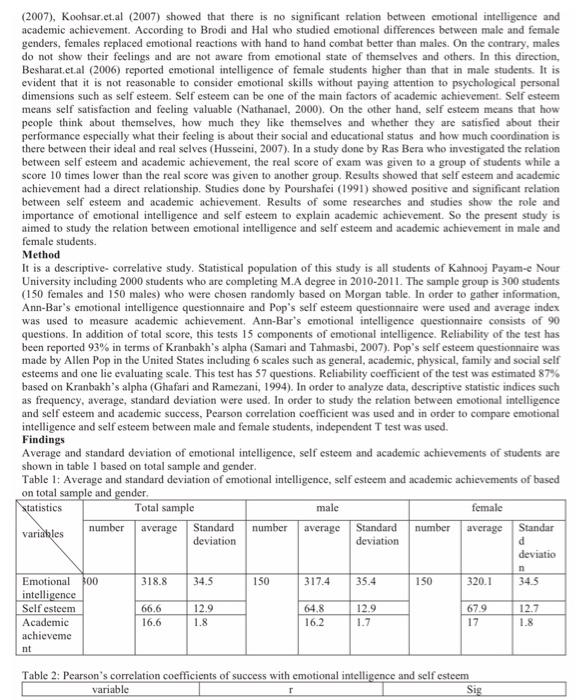
the questions are the last 2 papers 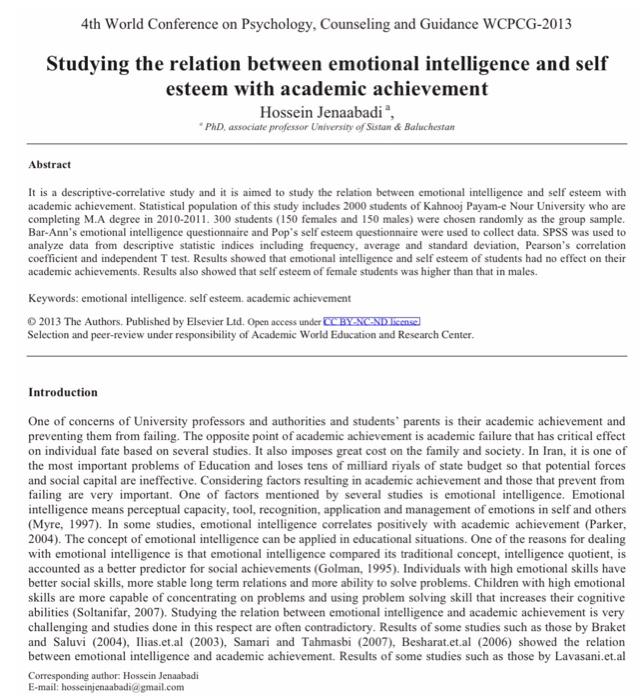
Step by Step Solution
There are 3 Steps involved in it
1 Expert Approved Answer
Step: 1 Unlock

Question Has Been Solved by an Expert!
Get step-by-step solutions from verified subject matter experts
Step: 2 Unlock
Step: 3 Unlock
 Study Help