



Question: (c) internal energy, (d) work, and (@) quasi-equilibrium process. Are (a)-(d) properties of the system? Why or why not? (This part is a self-test: please
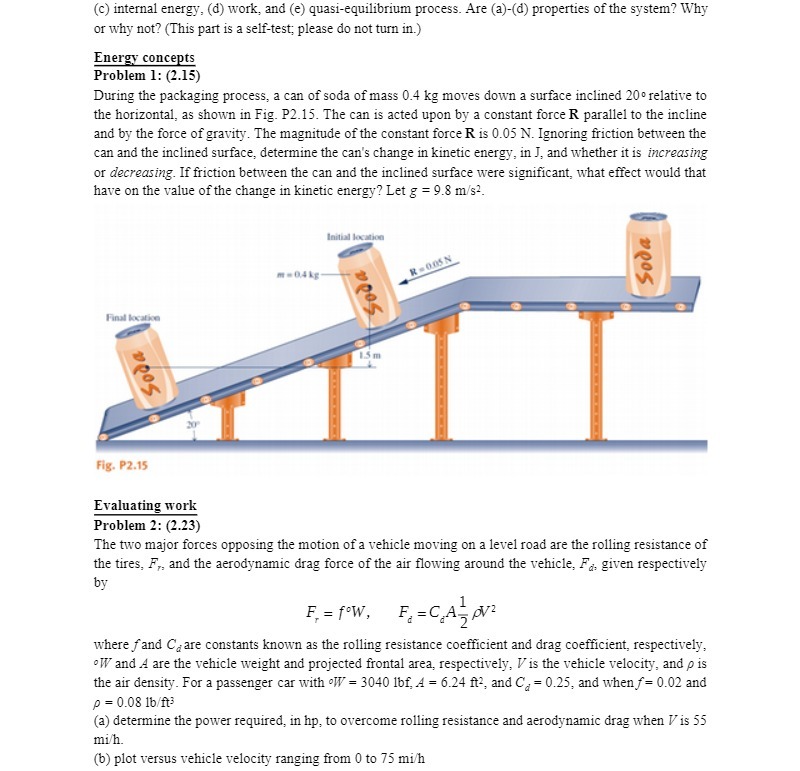
(c) internal energy, (d) work, and (@) quasi-equilibrium process. Are (a)-(d) properties of the system? Why or why not? (This part is a self-test: please do not turn in.) Energy concepts Problem 1: (2.15) During the packaging process, a can of soda of mass 0.4 kg moves down a surface inclined 20 relative to the horizontal, as shown in Fig. P2.15. The can is acted upon by a constant force R parallel to the incline and by the force of gravity. The magnitude of the constant force R is 0.05 N. Ignoring friction between the can and the inclined surface, determine the can's change in kinetic energy, in J, and whether it is increasing or decreasing. If friction between the can and the inclined surface were significant, what effect would that have on the value of the change in kinetic energy? Let g = 9.8 m/s. Initial location Soda Soda Final location 15 m Soda Fig. P2.15 Evaluating work Problem 2: (2.23) The two major forces opposing the motion of a vehicle moving on a level road are the rolling resistance of the tires, F,, and the aerodynamic drag force of the air flowing around the vehicle, Fa given respectively by F = foW, F. =CA_ PVZ where fand Care constants known as the rolling resistance coefficient and drag coefficient, respectively, W and A are the vehicle weight and projected frontal area, respectively, I is the vehicle velocity, and p is the air density. For a passenger car with W = 3040 1bf, A = 6.24 ft?, and C- = 0.25, and when f= 0.02 and p = 0.08 1b/ft3 (a) determine the power required, in hip, to overcome rolling resistance and aerodynamic drag when V is 55 mi/h. (b) plot versus vehicle velocity ranging from 0 to 75 mi/h
Step by Step Solution
There are 3 Steps involved in it

Get step-by-step solutions from verified subject matter experts