







Question: C++ programming (OBject Oriented) Which statement about const member function is true? ber functions declared const are allowed to modify the object const declarations are
C++ programming (OBject Oriented)
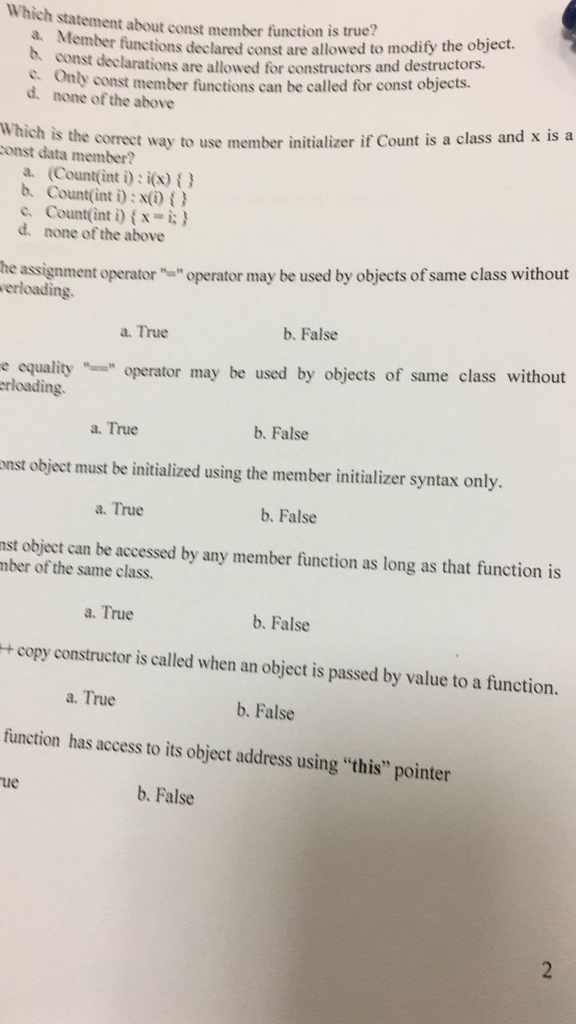
Which statement about const member function is true? ber functions declared const are allowed to modify the object const declarations are allowed for constructors and destructors. c. Only d. none of the above h. const member functions can be called for const objects. Vhich is the correct way to use member initializer if Count is a class and x is a onst data member? a. (Count(int) N) h. Count int ) N() c Count int i xi d none of the above he assignment operator " "operator may be used by objects of same class without erloading. a. True b. False e equalityoperator may be used by objects of same class without crloading. a. True b. False onst object must be initialized using the member initializer syntax only. a. True b. False nst object can be accessed by any member function as long as that function is mber of the same class. a. True b. False +copy constructor is called when an object is passed by value to a function. a. True b. False function has access to its object address using "this" pointer ue b.False
Step by Step Solution
There are 3 Steps involved in it

Get step-by-step solutions from verified subject matter experts
 Study Help