







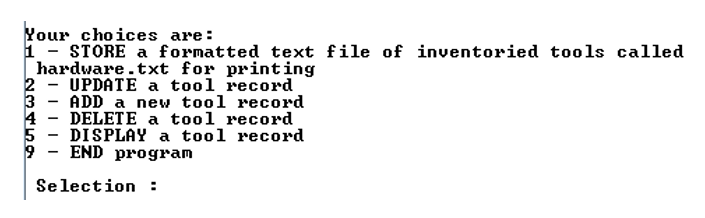
Question: C programming Please notice the intended output and the original question are a little different. Specifically choice number 1. Here is the code I made
C programming Please notice the intended output and the original question are a little different. Specifically choice number 1.
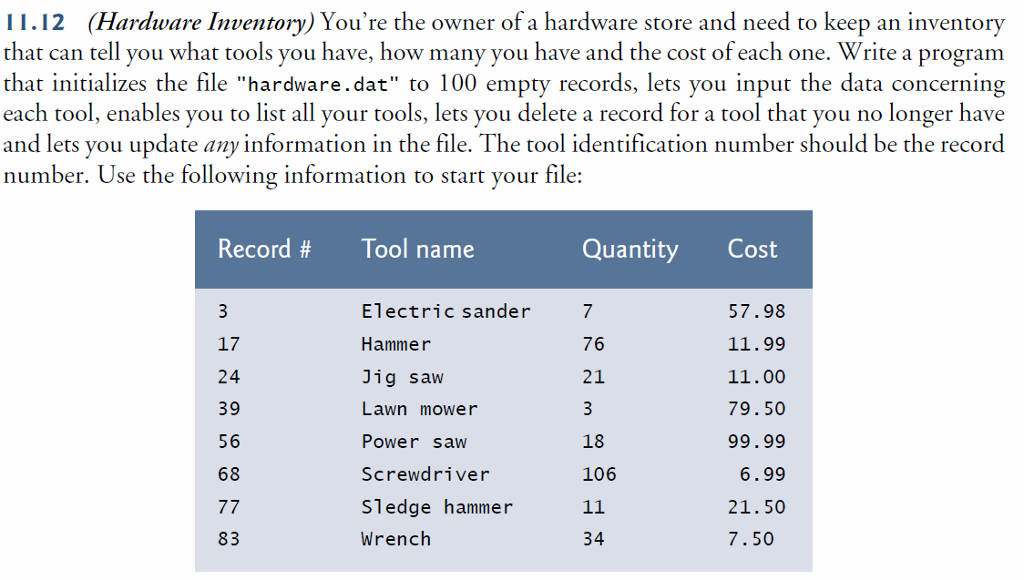 Here is the code I made to initialize the .dat file
// Creating a random-access file sequentially
#include
// item structure definition
struct item {
int number;
char name[10];
int quantity;
float cost;
};
// begin main function
int main(){
int i;
FILE *cfPtr;
// fopen opens the file; exits if file cannot be opened
if(( cfPtr = fopen("hardware.dat", "wb")) == NULL){
puts("File could not be opened.");
}
else{
// create clientData with default information
struct item createEmptyRecord = {0, "", 0, 0.0};
for (i=1;i
//the fwrite function in the stdio.h library
//declartion size_t fwrite(const void *ptr, size_t size, size_t nmemb, FILE *stream)
fwrite (&createEmptyRecord, sizeof (struct item), 1, cfPtr);
} // end for loop
}
fclose(cfPtr);
} // end main function
Your choices are 1 - STORE a formatted text file of inventoried tools called choices are hardware.txt for printing UPDATE a tool record - ADD a new tool record 4DELETE a tool record - DISPLAY a tool record END program Selection: Your choices are 1 - STORE a formatted text file of inventoried tools called choices are hardware.txt for printing UPDATE a tool record - ADD a new tool record 4DELETE a tool record - DISPLAY a tool record END program Selection
Step by Step Solution
There are 3 Steps involved in it

Get step-by-step solutions from verified subject matter experts
 Study Help