







Question: The control system of the steam-jacketed kettle is shown in the figure. The system consists of a kettle through which water flows at a
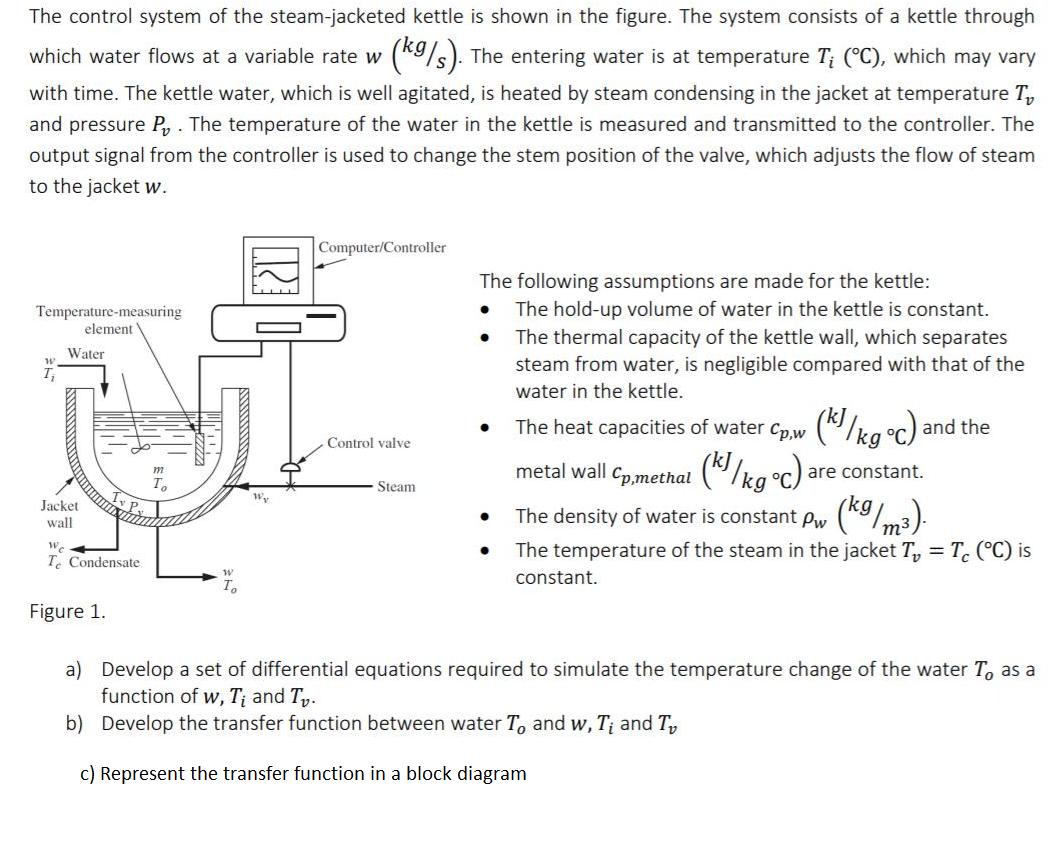
The control system of the steam-jacketed kettle is shown in the figure. The system consists of a kettle through which water flows at a variable rate w (K9/s). The entering water is at temperature T; (C), which may vary with time. The kettle water, which is well agitated, is heated by steam condensing in the jacket at temperature T, and pressure P, . The temperature of the water in the kettle is measured and transmitted to the controller. The output signal from the controller is used to change the stem position of the valve, which adjusts the flow of steam to the jacket w. Computer/Controller The following assumptions are made for the kettle: The hold-up volume of water in the kettle is constant. Temperature-measuring element The thermal capacity of the kettle wall, which separates steam from water, is negligible compared with that of the Water water in the kettle. The heat capacities of water cp,w (*/kac) and the Control valve metal wall are constant. m Cp,methal Steam Wy Jacket The density of water is constant pw (*9%m3). wall The temperature of the steam in the jacket T, = T. (C) is T. Condensate constant. Figure 1. a) Develop a set of differential equations required to simulate the temperature change of the water T, as a function of w, T and Ty. b) Develop the transfer function between water T, and w, T and T, c) Represent the transfer function in a block diagram
Step by Step Solution
3.46 Rating (166 Votes )
There are 3 Steps involved in it
To solve the problem we rely on the following provided assumptions The volume is constant Heat loss ... View full answer

Get step-by-step solutions from verified subject matter experts
 Study Help