







Question: c. When this split occurs, all else held constant, what do you think happens to the denominator of Equation 3.1? (Select the best answer below.)
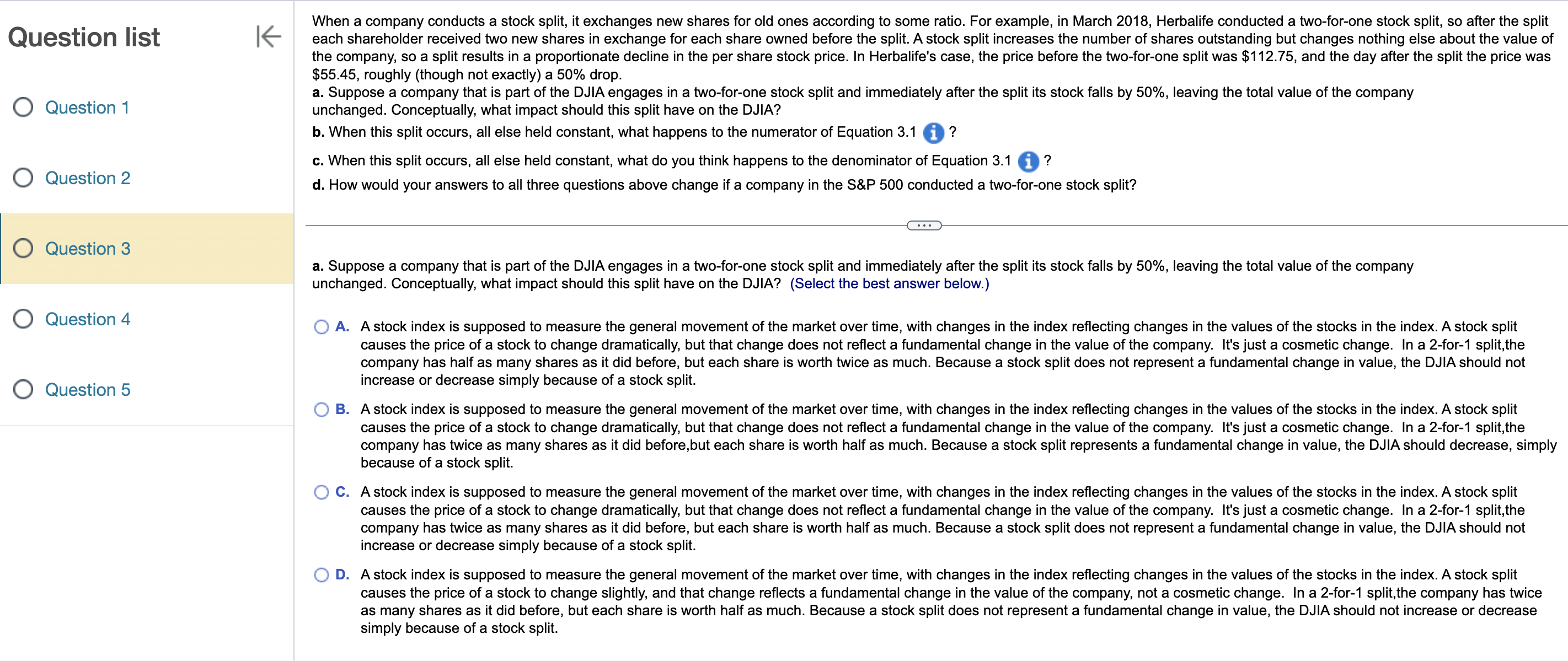
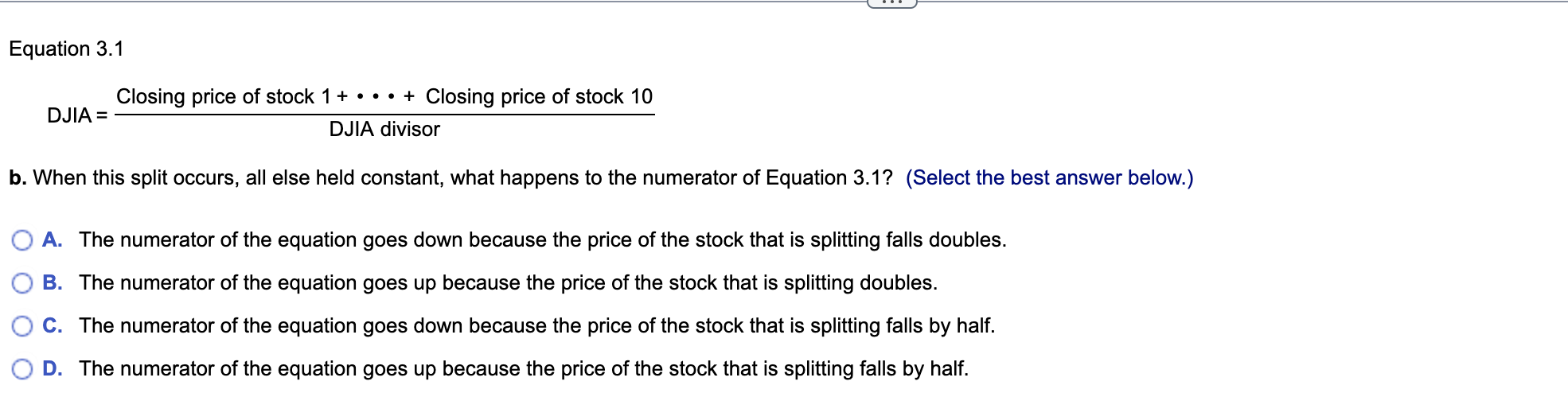

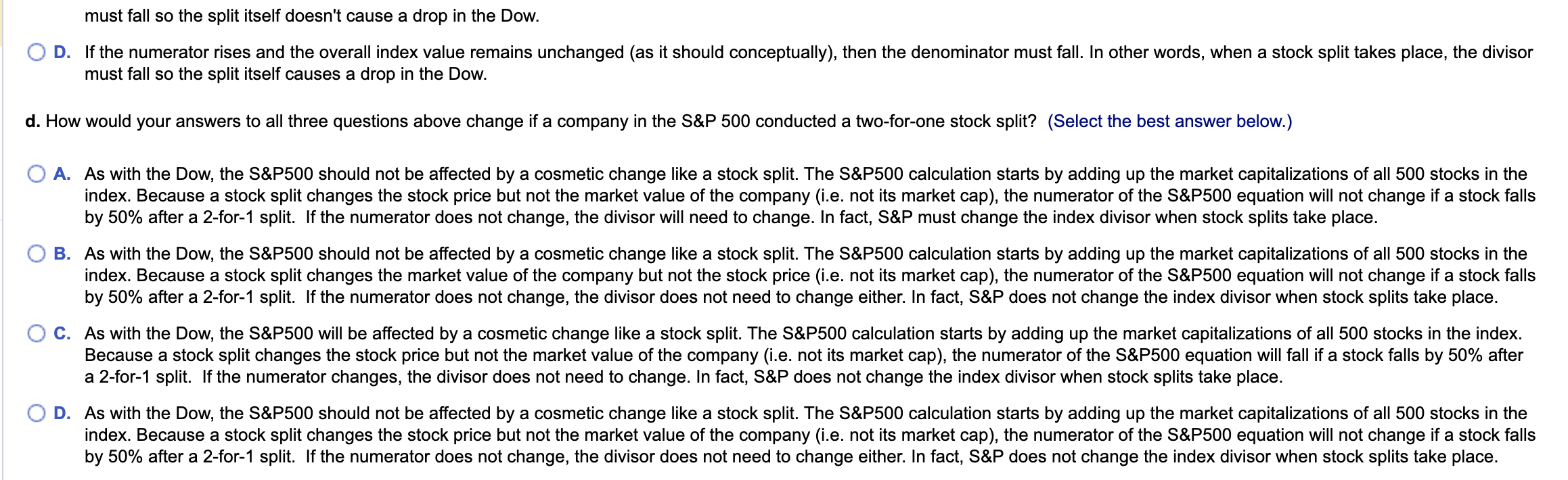
c. When this split occurs, all else held constant, what do you think happens to the denominator of Equation 3.1? (Select the best answer below.) A. If the numerator falls and the overall index value falls (as it should conceptually), then the denominator must rise. In other words, when a stock split takes place, the divisor must rise so the split itself doesn't cause a drop in the Dow. B. If the numerator falls and the overall index value remains unchanged (as it should conceptually), then the denominator must rise. In other words, when a stock split takes place, the divisor must rise so the split itself doesn't cause a drop in the Dow. C. If the numerator falls and the overall index value remains unchanged (as it should conceptually), then the denominator must fall. In other words, when a stock split takes place, the divisor must fall so the split itself doesn't cause a drop in the Dow. D. If the numerator rises and the overall index value remains unchanged (as it should conceptually), then the denominator must fall. In other words, when a stock split takes place, the divisor must fall so the split itself causes a drop in the Dow. must fall so the split itself doesn't cause a drop in the Dow. D. If the numerator rises and the overall index value remains unchanged (as it should conceptually), then the denominator must fall. In other words, when a stock split takes place, the divisor must fall so the split itself causes a drop in the Dow. d. How would your answers to all three questions above change if a company in the S\&P 500 conducted a two-for-one stock split? (Select the best answer below.) A. As with the Dow, the S\&P500 should not be affected by a cosmetic change like a stock split. The S\&P500 calculation starts by adding up the market capitalizations of all 500 stocks in the index. Because a stock split changes the stock price but not the market value of the company (i.e. not its market cap), the numerator of the S\&P500 equation will not change if a stock falls by 50% after a 2-for-1 split. If the numerator does not change, the divisor will need to change. In fact, S\&P must change the index divisor when stock splits take place. B. As with the Dow, the S\&P500 should not be affected by a cosmetic change like a stock split. The S\&P500 calculation starts by adding up the market capitalizations of all 500 stocks in the index. Because a stock split changes the market value of the company but not the stock price (i.e. not its market cap), the numerator of the S\&P500 equation will not change if a stock falls by 50% after a 2 -for-1 split. If the numerator does not change, the divisor does not need to change either. In fact, S\&P does not change the index divisor when stock splits take place. C. As with the Dow, the S\&P500 will be affected by a cosmetic change like a stock split. The S\&P500 calculation starts by adding up the market capitalizations of all 500 stocks in the index. Because a stock split changes the stock price but not the market value of the company (i.e. not its market cap), the numerator of the S\&P500 equation will fall if a stock falls by 50% after a 2-for-1 split. If the numerator changes, the divisor does not need to change. In fact, S\&P does not change the index divisor when stock splits take place. D. As with the Dow, the S\&P500 should not be affected by a cosmetic change like a stock split. The S\&P500 calculation starts by adding up the market capitalizations of all 500 stocks in the index. Because a stock split changes the stock price but not the market value of the company (i.e. not its market cap), the numerator of the S\&P500 equation will not change if a stock falls by 50% after a 2 -for-1 split. If the numerator does not change, the divisor does not need to change either. In fact, S\&P does not change the index divisor when stock splits take place. Question list When a company conducts a stock split, it exchanges new shares for old ones according to some ratio. For example, in March 2018, Herbalife conducted a two-for-one stock split, so after the split each shareholder received two new shares in exchange for each share owned before the split. A stock split increases the number of shares outstanding but changes nothing else about the value of the company, so a split results in a proportionate decline in the per share stock price. In Herbalife's case, the price before the two-for-one split was $112.75, and the day after the split the price was $55.45, roughly (though not exactly) a 50% drop. a. Suppose a company that is part of the DJIA engages in a two-for-one stock split and immediately after the split its stock falls by 50%, leaving the total value of the company unchanged. Conceptually, what impact should this split have on the DJIA? b. When this split occurs, all else held constant, what happens to the numerator of Equation 3.1 ? c. When this split occurs, all else held constant, what do you think happens to the denominator of Equation 3.1 ? Question 2 d. How would your answers to all three questions above change if a company in the S\&P 500 conducted a two-for-one stock split? Question 3 Question 4 a. Suppose a company that is part of the DJIA engages in a two-for-one stock split and immediately after the split its stock falls by 50%, leaving the total value of the company unchanged. Conceptually, what impact should this split have on the DJIA? (Select the best answer below.) A. A stock index is supposed to measure the general movement of the market over time, with changes in the index reflecting changes in the values of the stocks in the index. A stock split causes the price of a stock to change dramatically, but that change does not reflect a fundamental change in the value of the company. It's just a cosmetic change. In a 2-for-1 split,the company has half as many shares as it did before, but each share is worth twice as much. Because a stock split does not represent a fundamental change in value, the DJIA should not increase or decrease simply because of a stock split. Question 5 B. A stock index is supposed to measure the general movement of the market over time, with changes in the index reflecting changes in the values of the stocks in the index. A stock split causes the price of a stock to change dramatically, but that change does not reflect a fundamental change in the value of the company. It's just a cosmetic change. In a 2-for-1 split,the company has twice as many shares as it did before,but each share is worth half as much. Because a stock split represents a fundamental change in value, the DJIA should decrease, simpl) because of a stock split. C. A stock index is supposed to measure the general movement of the market over time, with changes in the index reflecting changes in the values of the stocks in the index. A stock split causes the price of a stock to change dramatically, but that change does not reflect a fundamental change in the value of the company. It's just a cosmetic change. In a 2 -for- 1 split,the company has twice as many shares as it did before, but each share is worth half as much. Because a stock split does not represent a fundamental change in value, the DJIA should not increase or decrease simply because of a stock split. D. A stock index is supposed to measure the general movement of the market over time, with changes in the index reflecting changes in the values of the stocks in the index. A stock split causes the price of a stock to change slightly, and that change reflects a fundamental change in the value of the company, not a cosmetic change. In a 2-for-1 split,the company has twice as many shares as it did before, but each share is worth half as much. Because a stock split does not represent a fundamental change in value, the DJIA should not increase or decrease simply because of a stock split. b. When this split occurs, all else held constant, what happens to the numerator of Equation 3.1? (Select the best answer below.) A. The numerator of the equation goes down because the price of the stock that is splitting falls doubles. B. The numerator of the equation goes up because the price of the stock that is splitting doubles. C. The numerator of the equation goes down because the price of the stock that is splitting falls by half. D. The numerator of the equation goes up because the price of the stock that is splitting falls by half
Step by Step Solution
There are 3 Steps involved in it

Get step-by-step solutions from verified subject matter experts
 Study Help