







Question: Calculate lim_(x->infty )((1)/(x^(5))) . If the limit does not exist because the function has infinite behavior, use limit notation to describe the infinite behavior. lim_(x->infty
Calculate
\\\\lim_(x->\\\\infty )((1)/(x^(5))). If the limit does not exist because the function has infinite behavior, use limit notation to describe the infinite behavior.\
\\\\lim_(x->\\\\infty )((1)/(x^(5)))=0\
\\\\lim_(x->\\\\infty )((1)/(x^(5)))=1\
\\\\lim_(x->\\\\infty )((1)/(x^(5)))=-\\\\infty \
\\\\lim_(x->\\\\infty )((1)/(x^(5)))does not exist but we can best describe the infinite behavior as
\\\\lim_(x->\\\\infty )((1)/(x^(5)))->\\\\infty .\
\\\\lim_(x->\\\\infty )((1)/(x^(5)))does not exist but we can best describe the infinite behavior as
\\\\lim_(x->\\\\infty )((1)/(x^(5)))->-\\\\infty .\
\\\\lim_(x->\\\\infty )((1)/(x^(5)))=\\\\infty 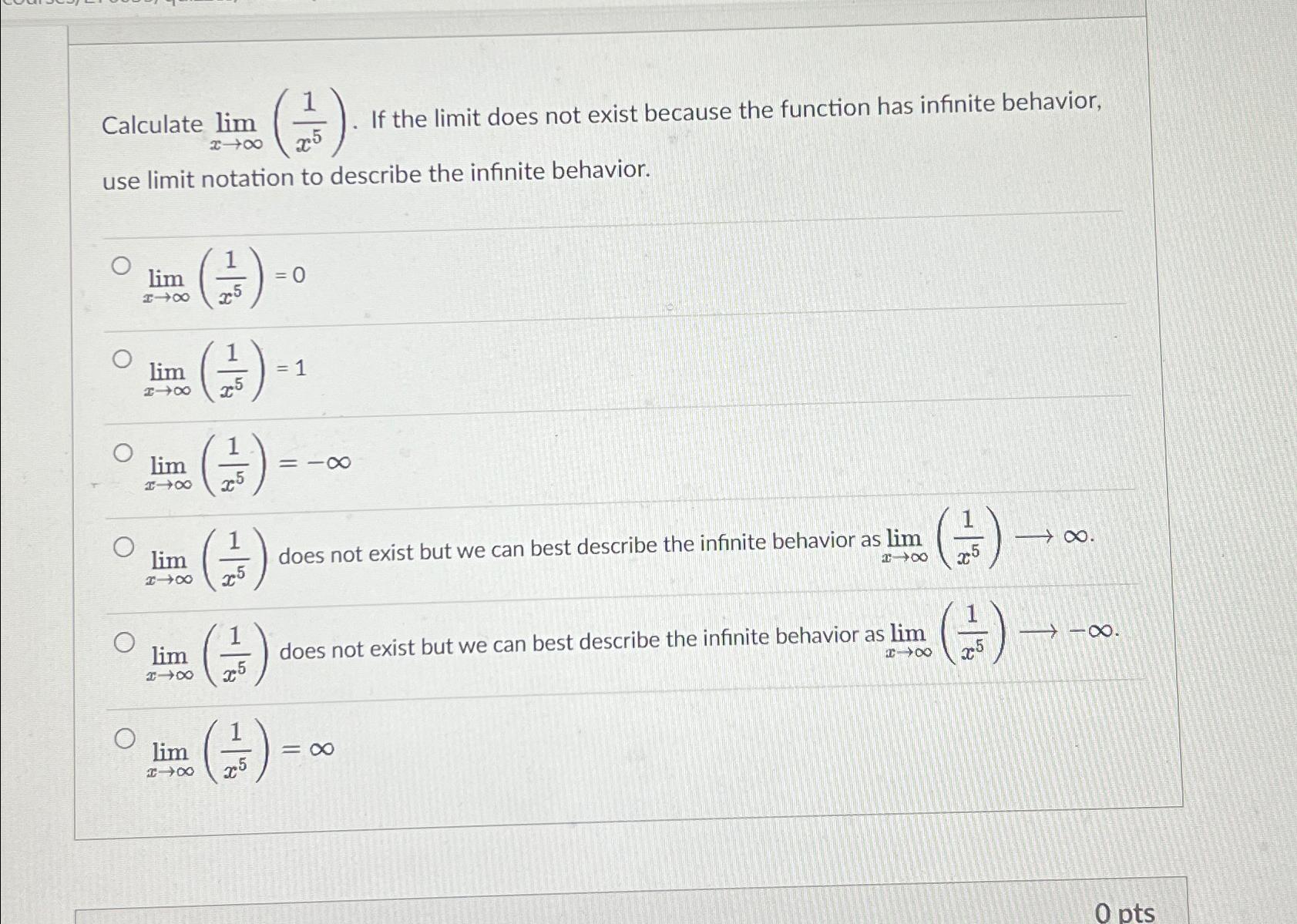
Calculate limx(x51). If the limit does not exist because the function has infinite behavior, use limit notation to describe the infinite behavior. limx(x51)=0 limx(x51)=1 limx(x51)= limx(x51) does not exist but we can best describe the infinite behavior as limx(x51). limx(x51) does not exist but we can best describe the infinite behavior as limx(x51). limx(x51)=
Step by Step Solution
There are 3 Steps involved in it

Get step-by-step solutions from verified subject matter experts
 Study Help