







Question: Calculus 2: Direction Field and Euler's methodPlease help solve 1-7. Please show your work.Answer Givens:2. (e) No.5. y(0.5) ? 2.224716. y(0.5) ? ?1.096717. y(1.8) ?
Calculus 2: Direction Field and Euler's methodPlease help solve 1-7. Please show your work.Answer Givens:2. (e) No.5. y(0.5) ? 2.224716. y(0.5) ? ?1.096717. y(1.8) ? 4.10958
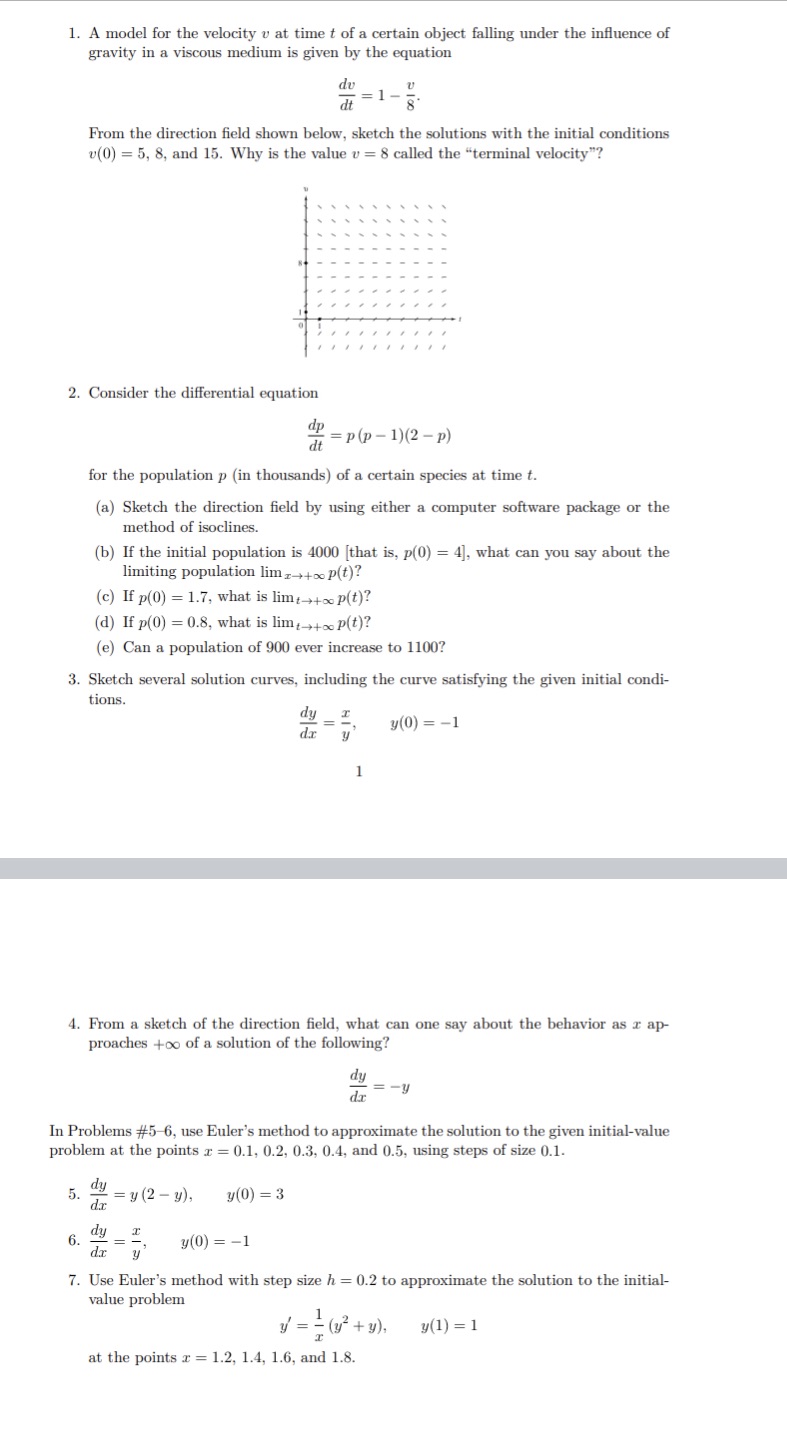
1. A model for the velocity v at time t of a certain object falling under the influence of gravity in a viscous medium is given by the equation du dt From the direction field shown below, sketch the solutions with the initial conditions v(0) = 5, 8, and 15. Why is the value v = 8 called the "terminal velocity"? 2. Consider the differential equation it = P(p -1)(2 - P) for the population p (in thousands) of a certain species at time t. (a) Sketch the direction field by using either a computer software package or the method of isoclines. (b) If the initial population is 4000 [that is, p(0) = 4], what can you say about the limiting population lim -+ +cop(t)? (c) If p(0) = 1.7, what is lim-+ +cop(t)? (d) If p(0) = 0.8, what is lim-+ +xx p(t)? (e) Can a population of 900 ever increase to 1100? 3. Sketch several solution curves, including the curve satisfying the given initial condi- tions. dy dx y(0) = -1 4. From a sketch of the direction field, what can one say about the behavior as a ap- proaches +oo of a solution of the following? dy dx In Problems #5-6, use Euler's method to approximate the solution to the given initial-value problem at the points x = 0.1, 0.2, 0.3, 0.4, and 0.5, using steps of size 0.1. 5. dy dr = y (2 - y), y(0) = 3 6. dy I d.x y(0) = -1 7. Use Euler's method with step size h = 0.2 to approximate the solution to the initial- value problem y' = = (y? +y). y(1) =1 at the points x = 1.2, 1.4, 1.6, and 1.8
Step by Step Solution
There are 3 Steps involved in it

Get step-by-step solutions from verified subject matter experts
 Study Help