Question: Calculus Based Physics Chapter 37 Relativity Question 2 ? Help Review | Constants Part A Suppose that you'd like to find out if a distant
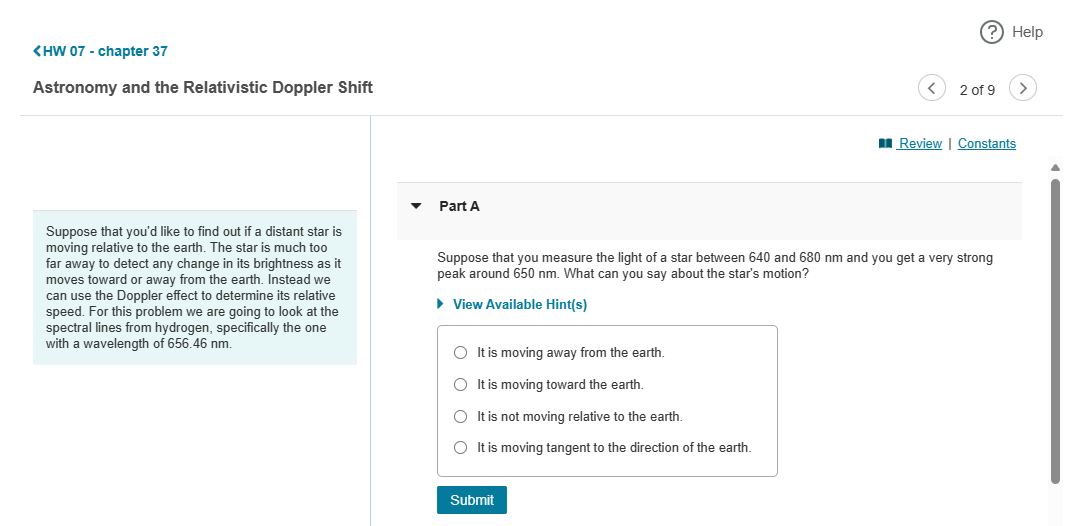
 Calculus Based Physics Chapter 37 Relativity Question 2 ? Help Review| Constants Part A Suppose that you'd like to find out ifa distant star is moving relative to the earth. The star ismuch too far away to detect any change in its brightness as

Calculus Based Physics Chapter 37 Relativity Question 2

it Suppose that you measure the light of a star between 640and 680 nm and you get a very strong moves toward oraway from the earth. Instead we peak around 650 nm. What canyou say about the star's motion? can use the Doppler effect todetermine its relative speed. For this problem we are going to look

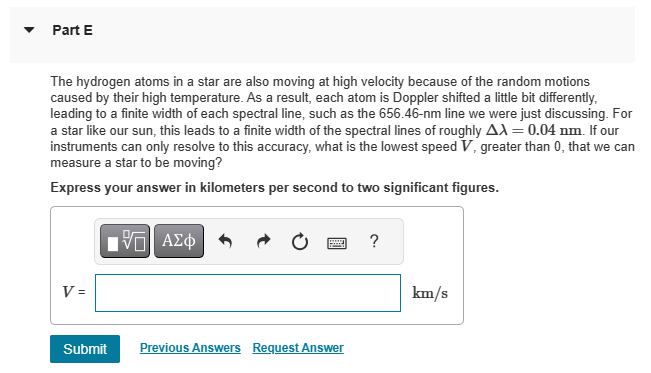
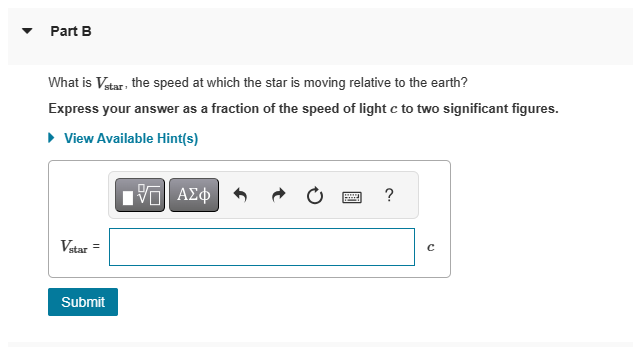
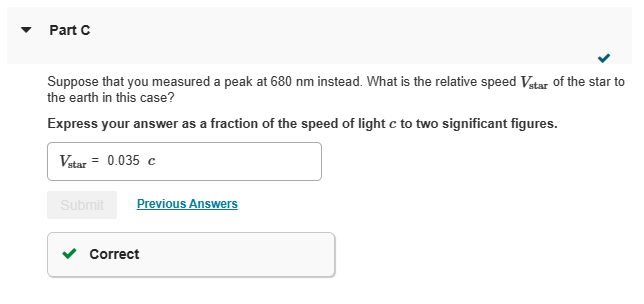
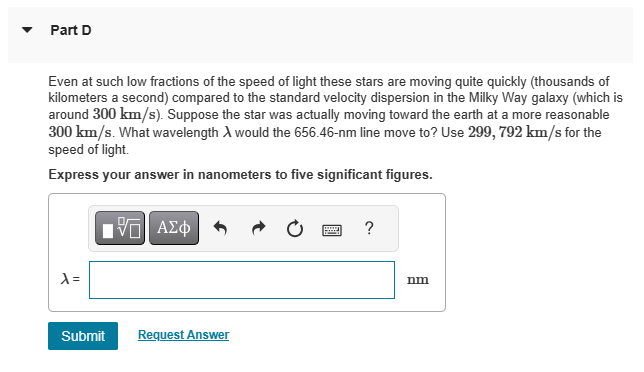
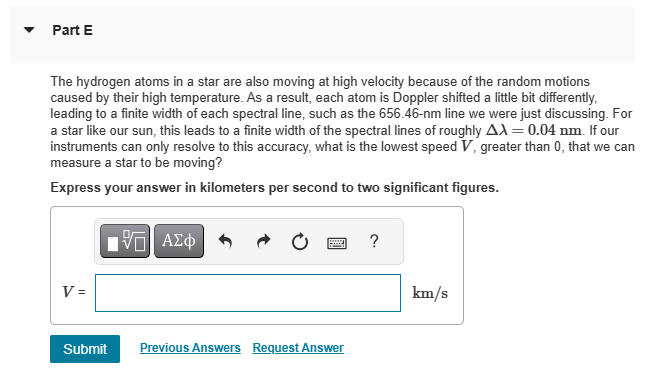
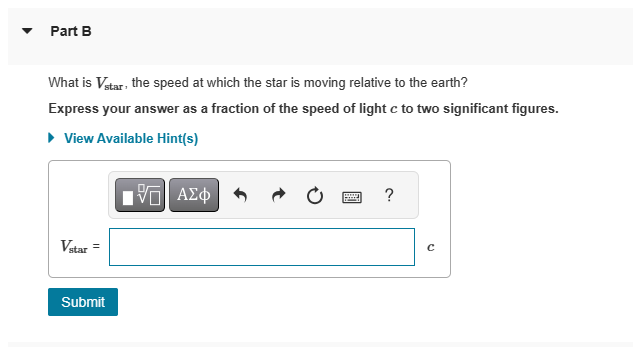
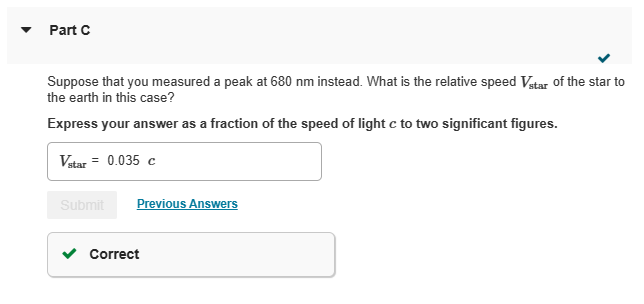
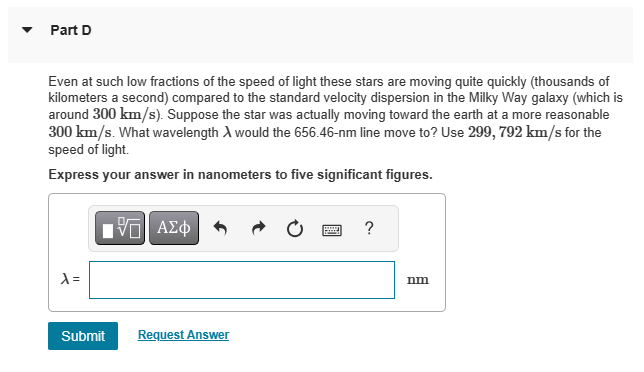
? Help Review | Constants Part A Suppose that you'd like to find out if a distant star is moving relative to the earth. The star is much too far away to detect any change in its brightness as it Suppose that you measure the light of a star between 640 and 680 nm and you get a very strong moves toward or away from the earth. Instead we peak around 650 nm. What can you say about the star's motion? can use the Doppler effect to determine its relative speed. For this problem we are going to look at the View Available Hint(s) spectral lines from hydrogen, specifically the one with a wavelength of 656.46 nm. O It is moving away from the earth. O It is moving toward the earth. It is not moving relative to the earth. O It is moving tangent to the direction of the earth. Submitv PartB What is Via,. the speed at which the star is moving relative to the earth? Express your answer as a fraction of the speed of light to two significant figures. View Available Hint(s) GEE& - - o * PartC v Suppose that you measured a peak at 680 nm instead. What is the relative speed Vi, of the star to the earth in this case? Express your answer as a fraction of the speed of light to two significant figures. Vigar = 0035 Previous Answers +" Correct * PartD Even at such low fractions of the speed of light these stars are moving quite quickly {thousands of kilometers a second) compared to the standard velocity dispersion in the Milky Way galaxy (which is around 300 km /s). Suppose the star was actually moving toward the earth at a more reasonable 300 km/'s. What wavelength A would the 656 46-nm line move to? Use 299, 792 km /s for the speed of light. Express your answer in nanometers to five significant figures. VY 6 O m 7 - m Request Answer v PartE The hydrogen atoms in a star are also moving at high velocity because of the random motions caused by their high temperature. As a result, each atom is Doppler shifted a little bit differently, leading to a finite width of each spectral line, such as the 656.46-nm line we were just discussing. For a star like our sun, this leads to a finite width of the spectral lines of roughly AX = 0.04 nm_ If our instruments can only resolve to this accuracy, what is the lowest speed V', greater than 0, that we can measure a star to be moving? Express your answer in kilometers per second to two significant figures. \" 0@ 2 =l m Previous Answers Request
Step by Step Solution

There are 3 Steps involved in it

1 Expert Approved Answer
Step: 1 Unlock blur-text-image
Question Has Been Solved by an Expert!

Get step-by-step solutions from verified subject matter experts

Step: 2 Unlock
Step: 3 Unlock

Students Have Also Explored These Related Physics Questions!