







Question: Calculus please answer the following problems. final result only is okay. Section 4.3: Problem 1 (1 point) Previous Problem Problem List Next Problem Below is
Calculus
please answer the following problems.
final result only is okay.
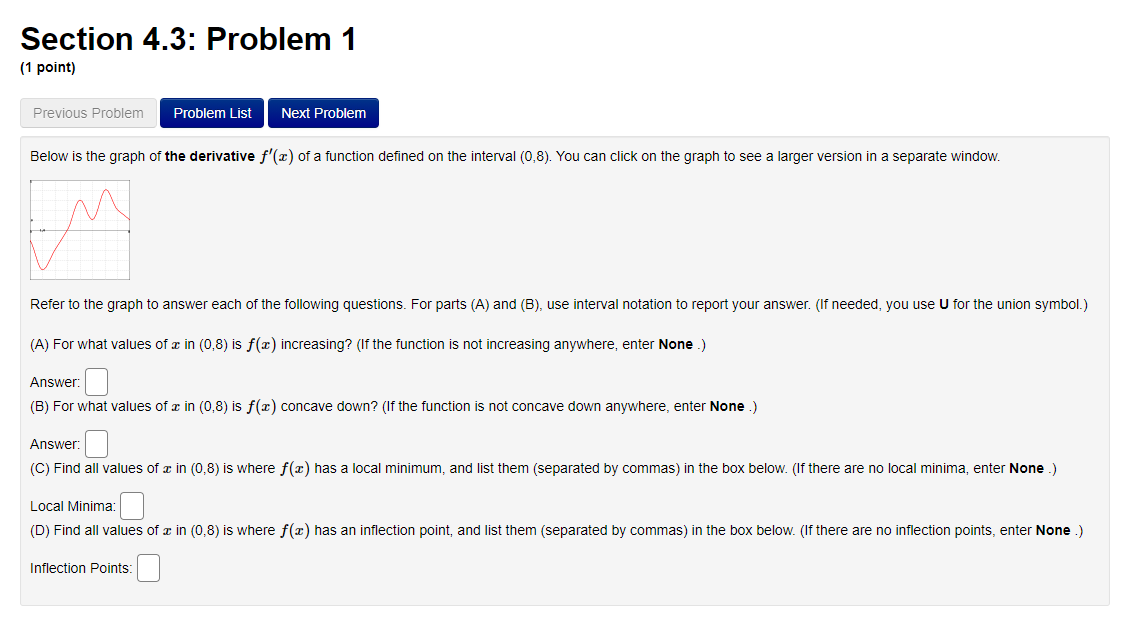
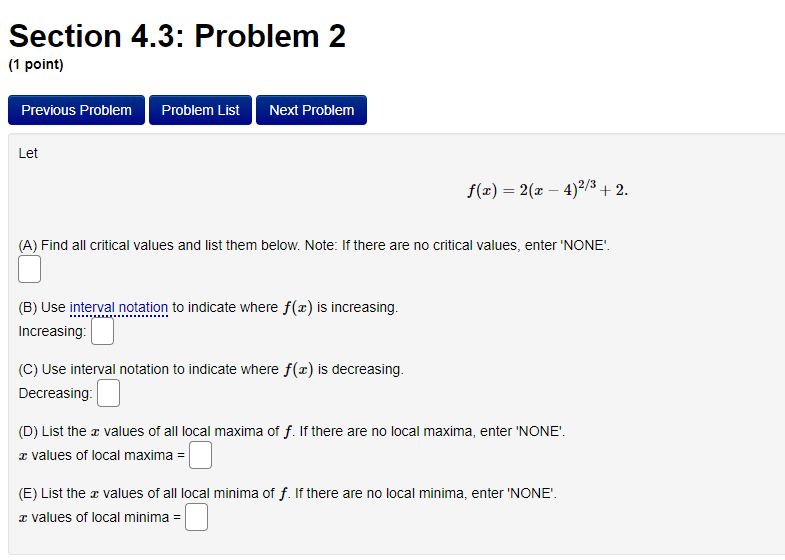
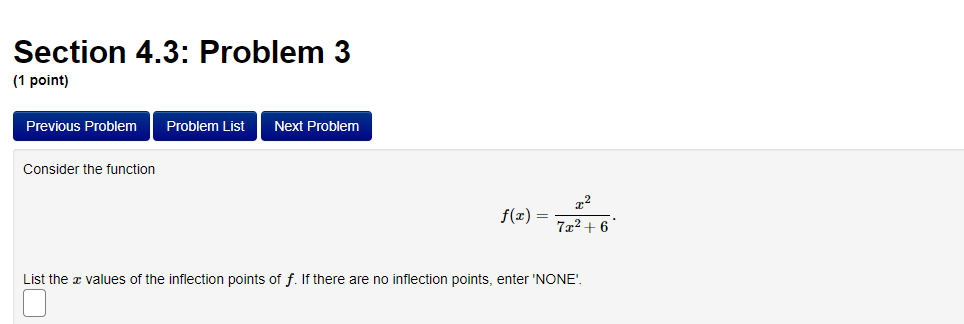
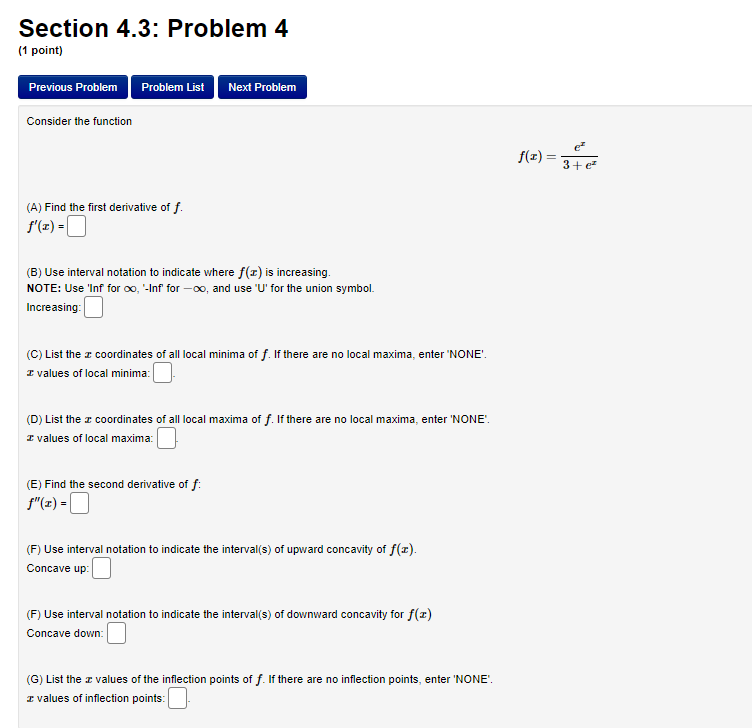
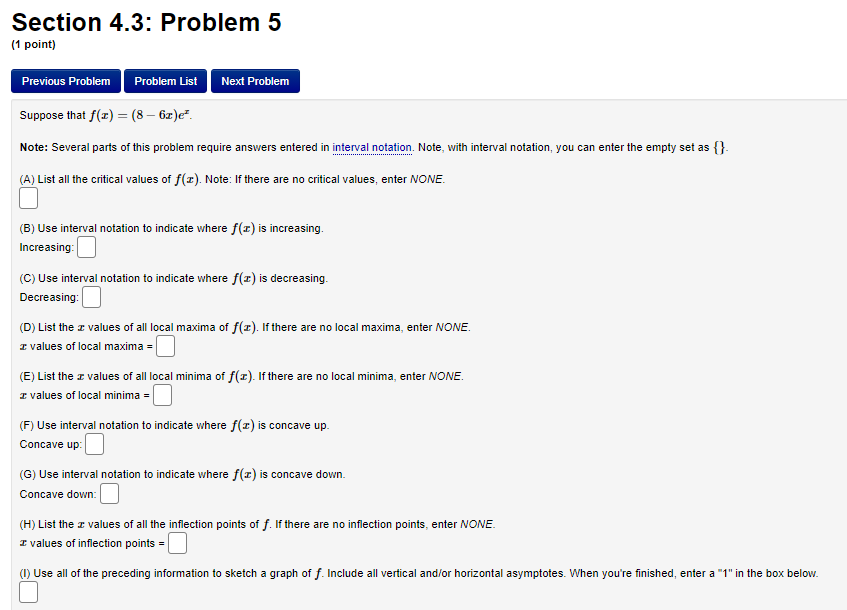
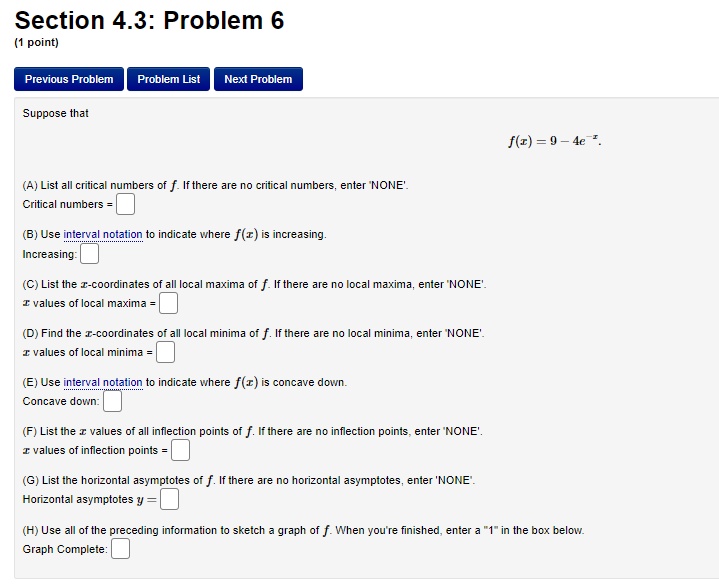
Section 4.3: Problem 1 (1 point) Previous Problem Problem List Next Problem Below is the graph of the derivative f'(x) of a function defined on the interval (0,8). You can click on the graph to see a larger version in a separate window. Refer to the graph to answer each of the following questions. For parts (A) and (B), use interval notation to report your answer. (If needed, you use U for the union symbol.) (A) For what values of a in (0,8) is f() increasing? (If the function is not increasing anywhere, enter None .) Answer: (B) For what values of a in (0,8) is f(x) concave down? (If the function is not concave down anywhere, enter None .) Answer: (C) Find all values of a in (0,8) is where f() has a local minimum, and list them (separated by commas) in the box below. (If there are no local minima, enter None .) Local Minima: (D) Find all values of a in (0,8) is where f() has an inflection point, and list them (separated by commas) in the box below. (If there are no inflection points, enter None .) Inflection Points:Section 4.3: Problem 2 (1 point) Previous Problem Problem List Next Problem Let f(x) = 2(x - 4)2/3 + 2. (A) Find all critical values and list them below. Note: If there are no critical values, enter 'NONE". (B) Use interval notation to indicate where f(x) is increasing. Increasing: (C) Use interval notation to indicate where f(x) is decreasing. Decreasing: (D) List the x values of all local maxima of f. If there are no local maxima, enter 'NONE'. I values of local maxima = (E) List the x values of all local minima of f. If there are no local minima, enter 'NONE'. c values of local minima =Section 4.3: Problem 3 (1 point) Previous Problem Problem List Next Problem Consider the function f(I) = 7x2 + 6 List the x values of the inflection points of f. If there are no inflection points, enter 'NONE".Section 4.3: Problem 4 (1 point) Previous Problem Problem List Next Problem Consider the function f( I) = 3tex (A) Find the first derivative of f. f'(z) = (B) Use interval notation to indicate where f (I) is increasing. NOTE: Use 'Inf for oo, '-Inf for -oo, and use "U' for the union symbol. Increasing: (C) List the c coordinates of all local minima of f. If there are no local maxima, enter "NONE'. I values of local minima:- (D) List the c coordinates of all local maxima of f. If there are no local maxima, enter 'NONE". I values of local maxima: (E) Find the second derivative of f: f"(I) = (F) Use interval notation to indicate the interval(s) of upward concavity of f(I). Concave up: (F) Use interval notation to indicate the interval(s) of downward concavity for f (I) Concave down: (G) List the I values of the inflection points of f. If there are no inflection points, enter "NONE". I values of inflection points:-Section 4.3: Problem 5 (1 point) Previous Problem Problem List Next Problem Suppose that f (x) = (8 -6x)e]. Note: Several parts of this problem require answers entered in interval notation. Note, with interval notation, you can enter the empty set as { } (A) List all the critical values of f(I). Note: If there are no critical values, enter NONE. (B) Use interval notation to indicate where f(I) is increasing. Increasing: (C) Use interval notation to indicate where f(I) is decreasing- Decreasing: (D) List the z values of all local maxima of f(I). If there are no local maxima, enter NONE. r values of local maxima = (E) List the c values of all local minima of f(c). If there are no local minima, enter NONE. I values of local minima = (F) Use interval notation to indicate where f(I) is concave up. Concave up: (G) Use interval notation to indicate where f(I) is concave down. Concave down: (H) List the x values of all the inflection points of f. If there are no inflection points, enter NONE. I values of inflection points = (1) Use all of the preceding information to sketch a graph of f. Include all vertical and/or horizontal asymptotes. When you're finished, enter a "1" in the box below.Section 4.3: Problem 6 (1 point) Previous Problem Problem List Next Problem Suppose that f(I) =9-4e-. (A) List all critical numbers of f. If there are no critical numbers, enter "NONE' Critical numbers = (B) Use interval notation to indicate where f(I) is increasing. Increasing: (C) List the x-coordinates of all local maxima of f. If there are no local maxima, enter "NONE' I values of local maxima = (D) Find the c-coordinates of all local minima of f. If there are no local minima, enter "NONE'. I values of local minima = (E) Use interval notation to indicate where f(x) is concave down. Concave down: (F) List the c values of all inflection points of f. If there are no inflection points, enter "NONE'. I values of inflection points = (G) List the horizontal asymptotes of f. If there are no horizontal asymptotes, enter 'NONE". Horizontal asymptotes y =[ (H) Use all of the preceding information to sketch a graph of f. When you're finished, enter a "1" in the box below. Graph Complete
Step by Step Solution
There are 3 Steps involved in it

Get step-by-step solutions from verified subject matter experts
 Study Help