







Question: can anyone please answer question c it's urgent Consider a rectangular kids pool of dimensions L(m) x W(m) x H(m) that stands on the grass

can anyone please answer question c it's urgent
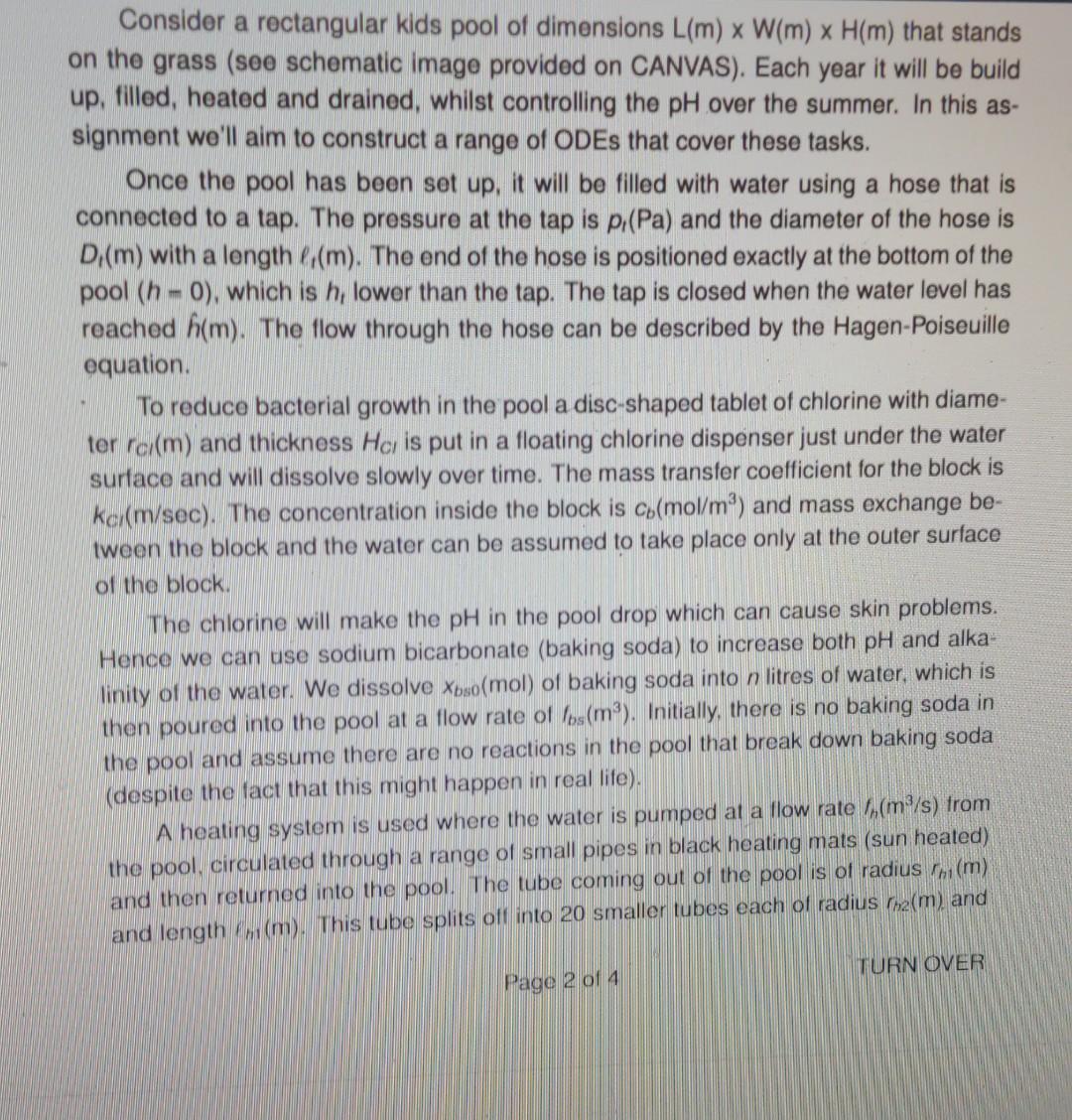
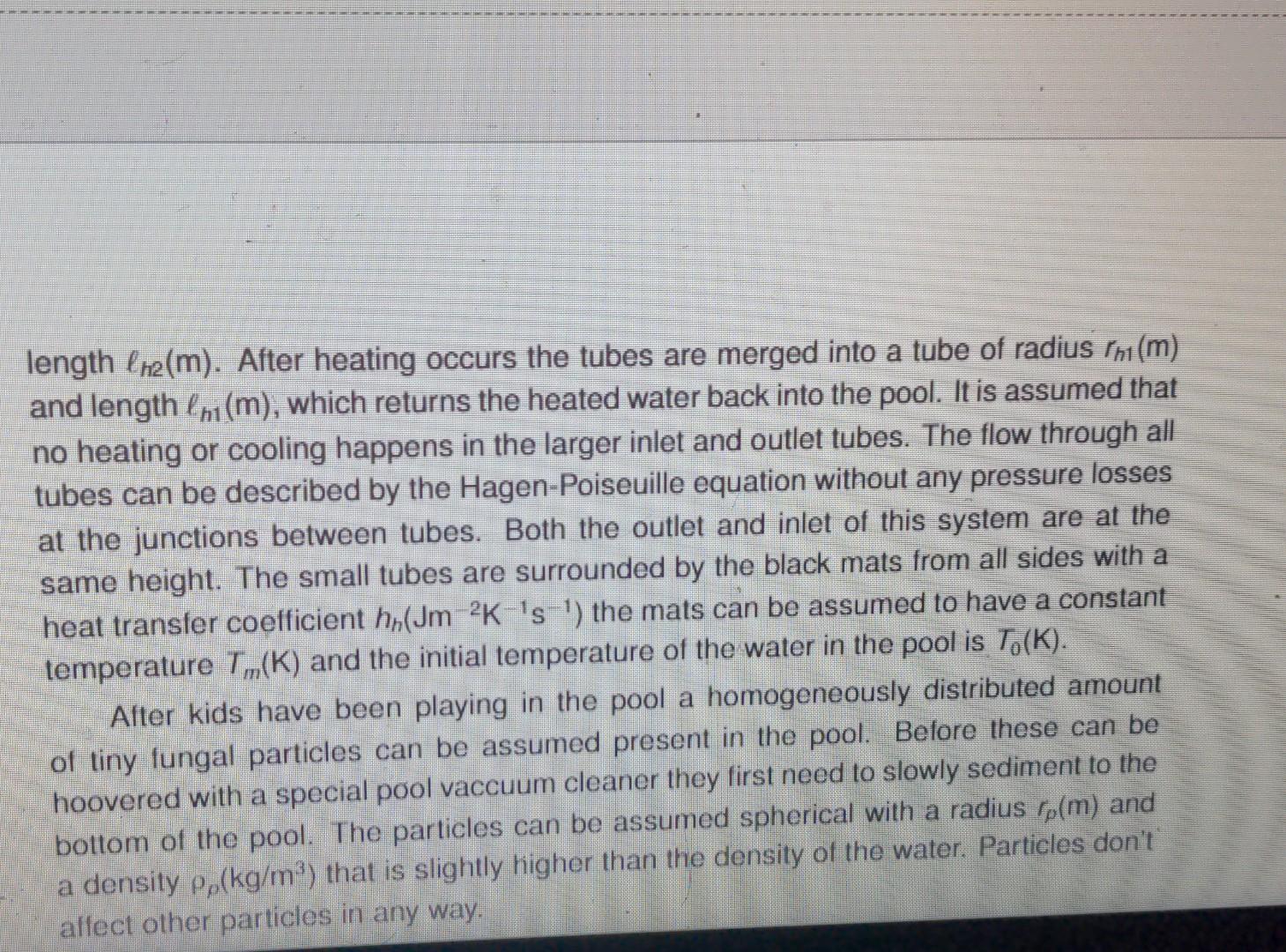
Consider a rectangular kids pool of dimensions L(m) x W(m) x H(m) that stands on the grass (soo schematic image provided on CANVAS). Each year it will be build up, filled, heated and drained, whilst controlling the pH over the summer. In this as- signment we'll aim to construct a range of ODEs that cover these tasks. Once the pool has been set up, it will be filled with water using a hose that is connected to a tap. The pressure at the tap is p (Pa) and the diameter of the hose is D (m) with a length 4.(m). The end of the hose is positioned exactly at the bottom of the pool (h- 0), which is h, lower than the tap. The tap is closed when the water level has reached him). The flow through the hose can be described by the Hagen-Poiseuille equation. To reduce bacterial growth in the pool a disc-shaped tablet of chlorine with diame- ter re(m) and thickness Ha, is put in a floating chlorine dispenser just under the water surface and will dissolve slowly over time. The mass transfer coefficient for the block is ke/(m/sec). The concentration inside the block is co(mol/m) and mass exchange be- tween the block and the water can be assumed to take place only at the outer surface of the block. The chlorine will make the pH in the pool drop which can cause skin problems. Hence we can use sodium bicarbonate (baking soda) to increase both pH and alka- linity of the water. We dissolve Xbso(mol) of baking soda into n litres of water, which is then poured into the pool at a flow rate of los(m). Initially, there is no baking soda in the pool and assume there are no reactions in the pool that break down baking soda (despite the fact that this might happen in real life). A heating system is used where the water is pumped at a flow rate (m/s) from the pool. circulated through a range of small pipes in black heating mats (sun heated) and then returned into the pool. The tube coming out of the pool is of radius Thi(m) and length int(m). This tube splits off into 20 smaller tubes each of radius ne(m) and TURN OVER Page 2 of 4 length (ne(m). After heating occurs the tubes are merged into a tube of radius int(m) and length Int(m), which returns the heated water back into the pool. It is assumed that no heating or cooling happens in the larger inlet and outlet tubes. The flow through all tubes can be described by the Hagen-Poiseuille equation without any pressure losses at the junctions between tubes. Both the outlet and inlet of this system are at the same height. The small tubes are surrounded by the black mats from all sides with a heat transfer coefficient hn(Jm 2K-'s-1) the mats can be assumed to have a constant temperature T, (K) and the initial temperature of the water in the pool is To(K), After kids have been playing in the pool a homogeneously distributed amount of tiny fungal particles can be assumed present in the pool. Before these can be hoovered with a special pool vaccuum cleaner they first need to slowly sediment to the bottom of the pool. The particles can be assumed spherical with a radius fp(m) and a density po(kg/m) that is slightly higher than the density of the water. Particles don't affect other particles in any way. (c) Derive an ODE describing the concentration of chloride as a function of time, Cc/(mol/m). The tablet size can be assumed constant during this process. [10 marks]
Step by Step Solution
There are 3 Steps involved in it

Get step-by-step solutions from verified subject matter experts
 Study Help