







Question: Can anyone suggest 2 alternative solutions for this case? Which actions should Dickens and Puyanic take? By opening there, we knew we could create a
Can anyone suggest 2 alternative solutions for this case? Which actions should Dickens and Puyanic take?
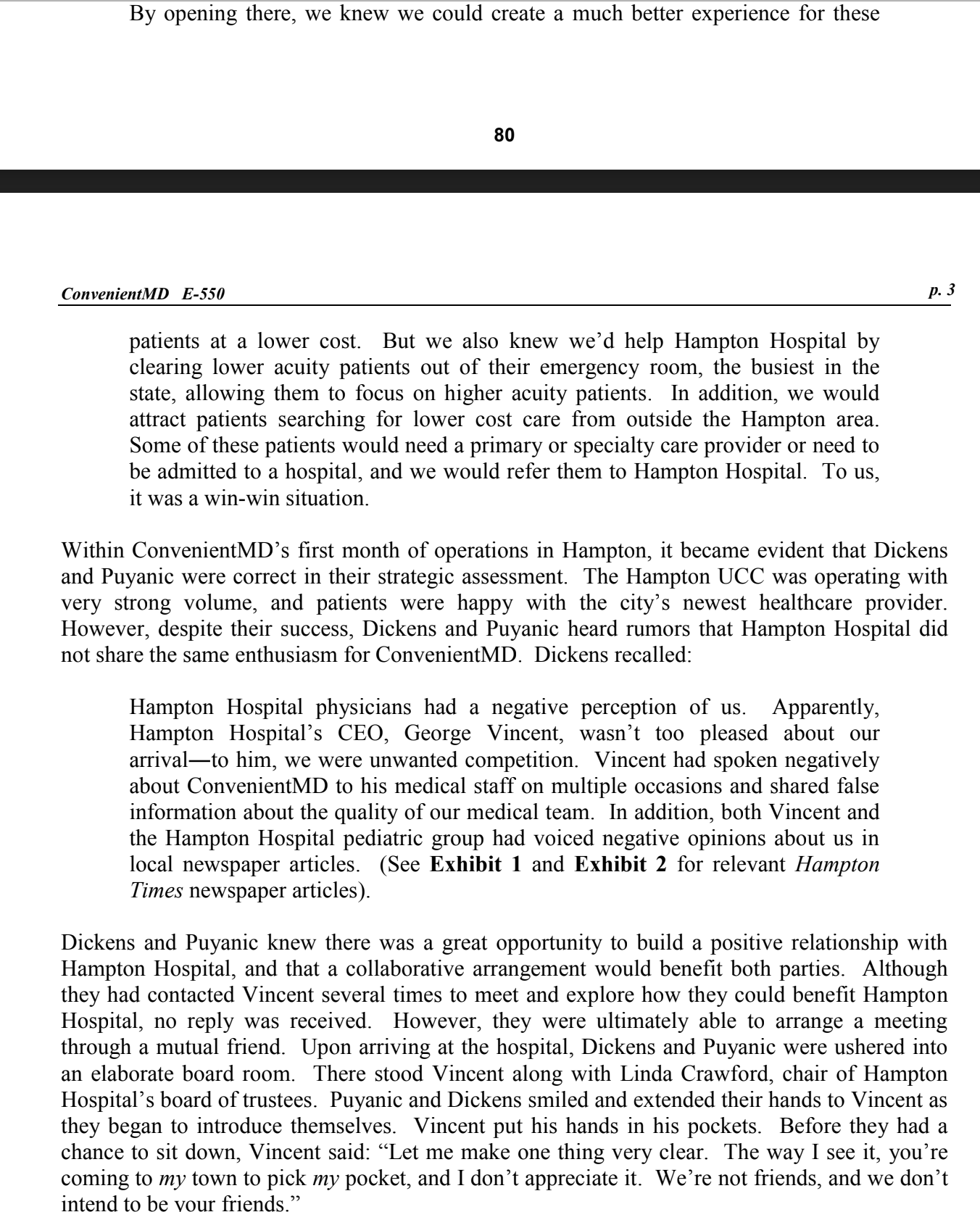
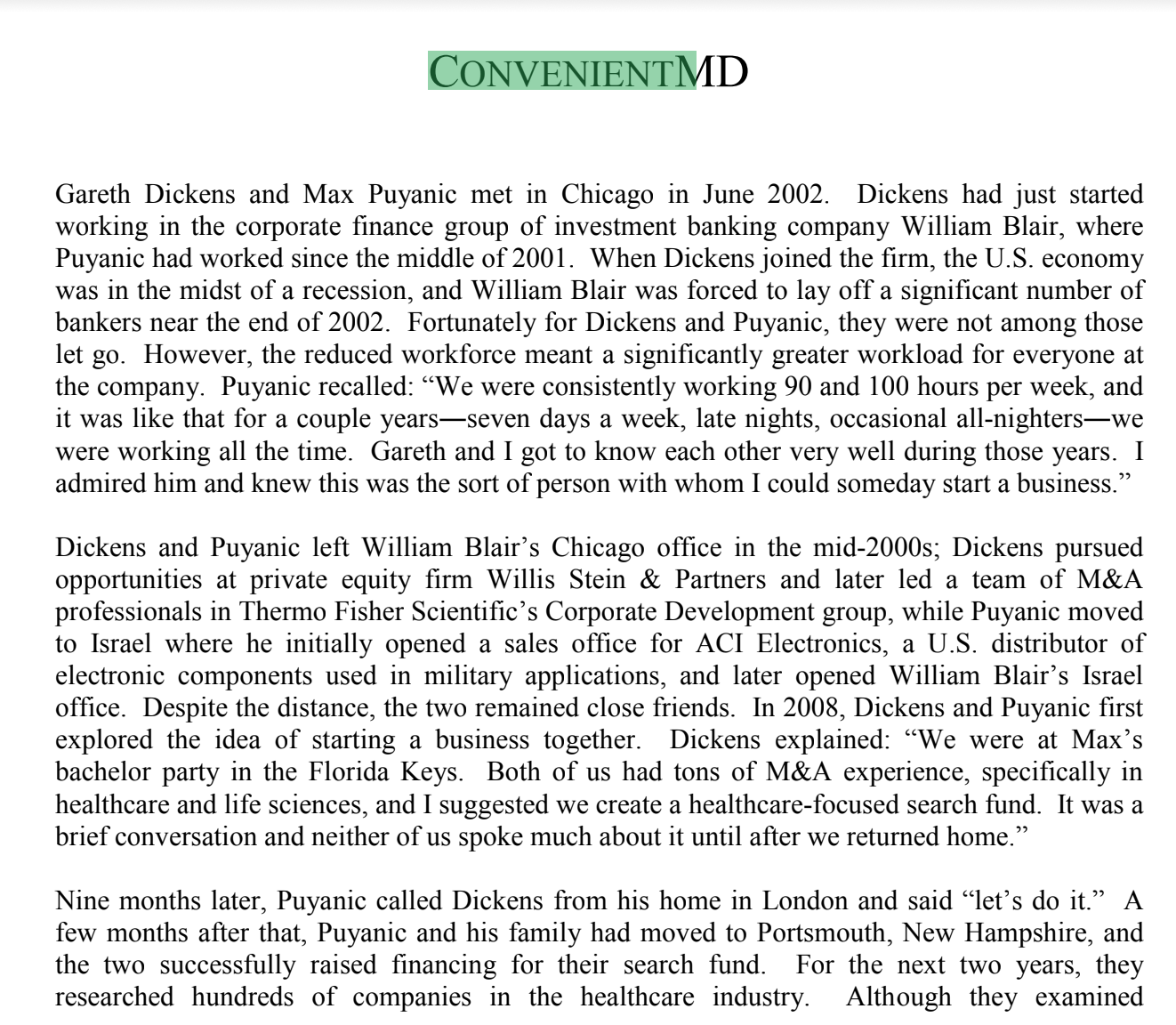
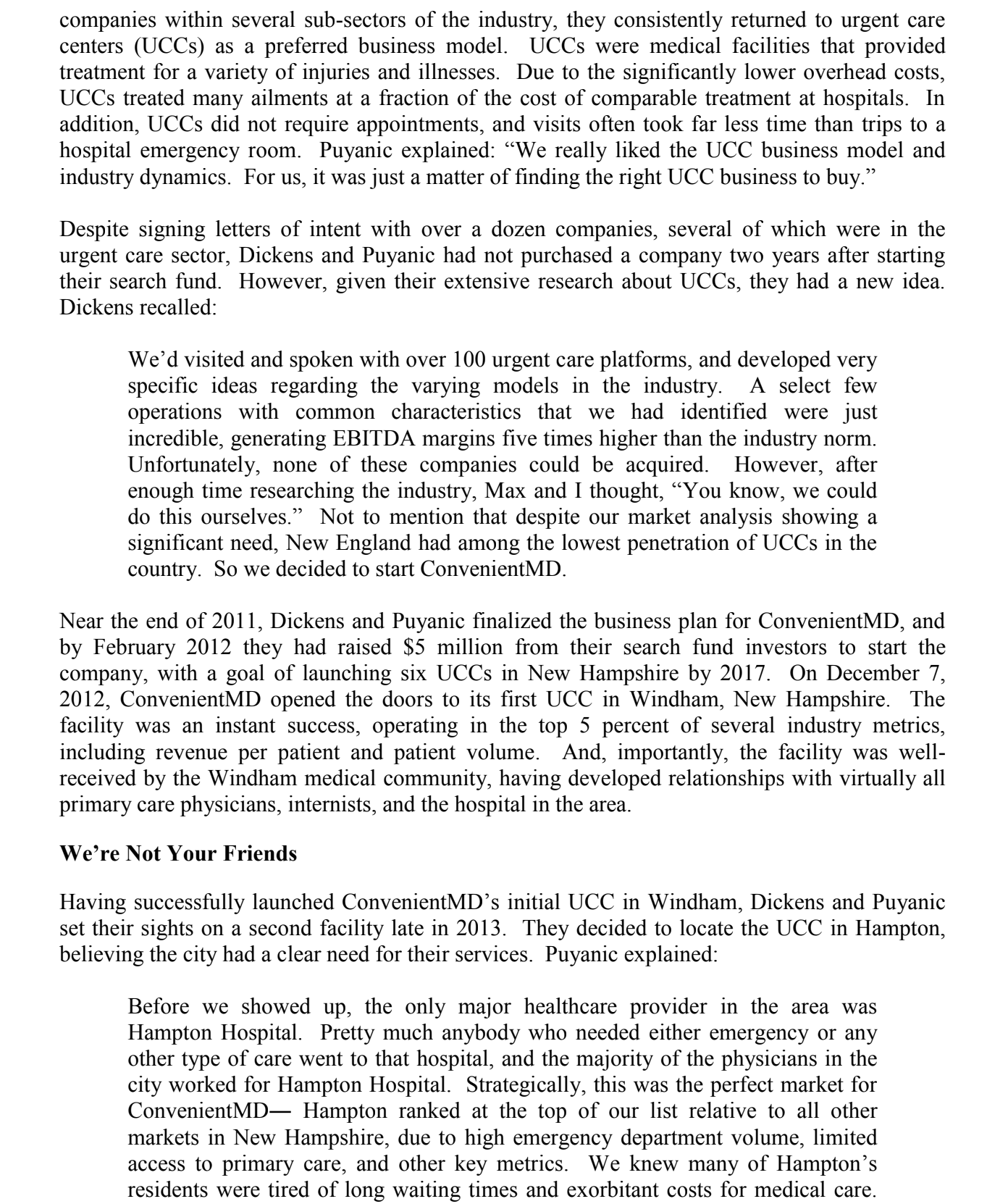
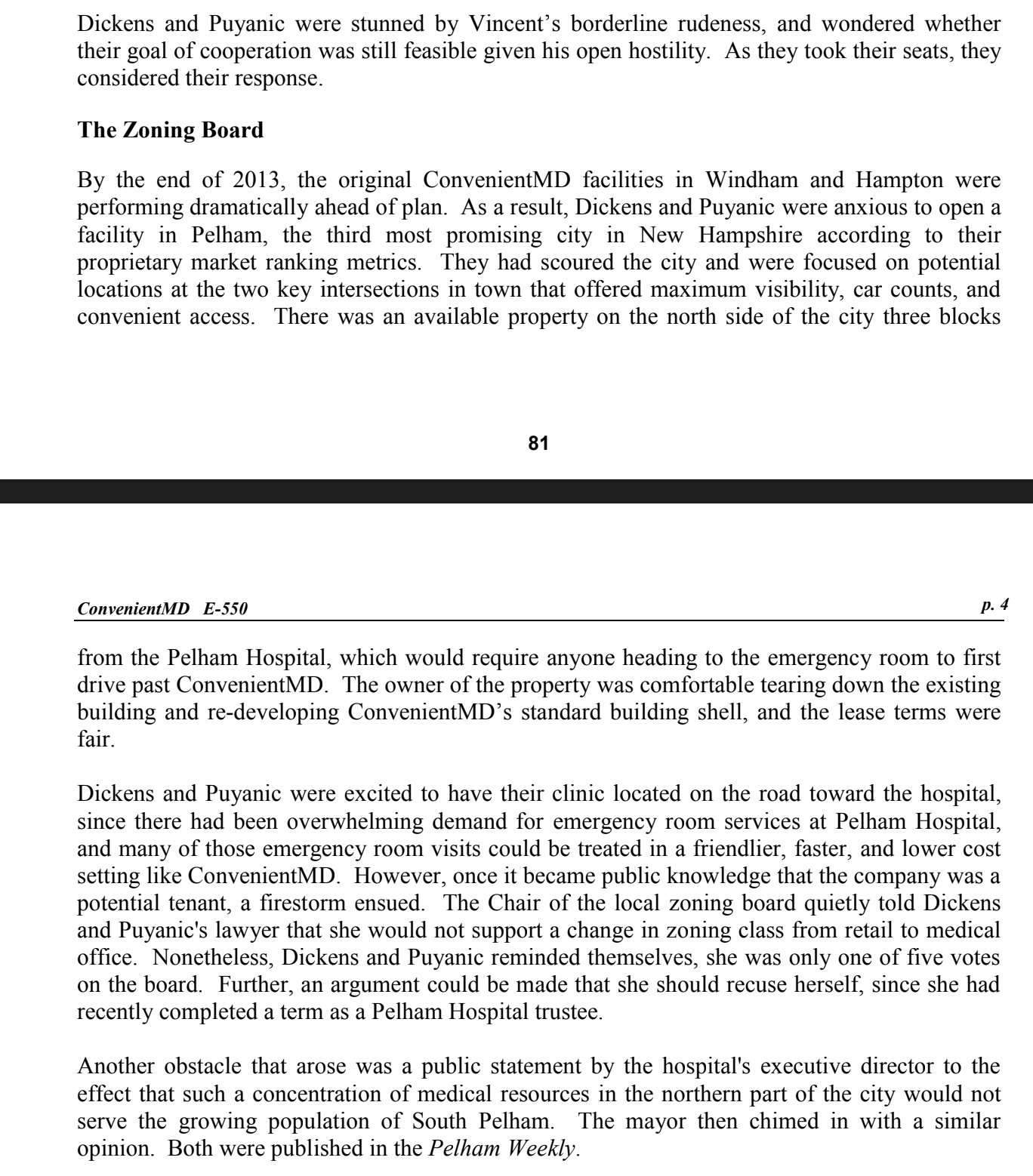
By opening there, we knew we could create a much better experience for these 80 patients at a lower cost. But we also knew we'd help Hampton Hospital by clearing lower acuity patients out of their emergency room, the busiest in the state, allowing them to focus on higher acuity patients. In addition, we would attract patients searching for lower cost care from outside the Hampton area. Some of these patients would need a primary or specialty care provider or need to be admitted to a hospital, and we would refer them to Hampton Hospital. To us, it was a win-win situation. Within ConvenientMD's rst month of operations in Hampton, it became evident that Dickens and Puyanic were correct in their strategic assessment. The Hampton UCC was operating with very strong volume, and patients were happy with the city's newest healthcare provider. However, despite their success, Dickens and Puyanic heard rumors that Hampton Hospital did not share the same enthusiasm for ConvenientMD. Dickens recalled: Hampton Hospital physicians had a negative perception of us. Apparently, Hampton Hospital's CEO, George Vincent, wasn't too pleased about our arrivalto him, we were unwanted competition. Vincent had spoken negatively about ConvenientMD to his medical staff on multiple occasions and shared false information about the quality of our medical team. In addition, both Vincent and the Hampton Hospital pediatric group had voiced negative opinions about us in local newspaper articles. (See Exhibit 1 and Exhibit 2 for relevant Hampton Times newspaper articles). Dickens and Puyanic knew there was a great opportunity to build a positive relationship with Hampton Hospital, and that a collaborative arrangement would benet both parties. Although they had contacted Vincent several times to meet and explore how they could benet Hampton Hospital, no reply was received. However, they were ultimately able to arrange a meeting through a mutual friend. Upon arriving at the hospital, Dickens and Puyanic were ushered into an elaborate board room. There stood Vincent along with Linda Crawford, chair of Hampton Hospital's board of trustees. Puyanic and Dickens smiled and extended their hands to Vincent as they began to introduce themselves. Vincent put his hands in his pockets. Before they had a chance to sit down, Vincent said: \"Let me make one thing very clear. The way I see it, you're coming to my town to pick my pocket, and I don't appreciate it. We're not friends, and we don't intend to be your friends.\" CONVENIENTMD Gareth Dickens and Max Puyanic met in Chicago in June 2002. Dickens had just started working in the corporate finance group of investment banking company William Blair, where Puyanic had worked since the middle of 2001. When Dickens joined the firm, the U.S. economy was in the midst of a recession, and William Blair was forced to lay off a significant number of bankers near the end of 2002. Fortunately for Dickens and Puyanic, they were not among those let go. However, the reduced workforce meant a significantly greater workload for everyone at the company. Puyanic recalled: "We were consistently working 90 and 100 hours per week, and it was like that for a couple years-seven days a week, late nights, occasional all-nighters-we were working all the time. Gareth and I got to know each other very well during those years. I admired him and knew this was the sort of person with whom I could someday start a business." Dickens and Puyanic left William Blair's Chicago office in the mid-2000s; Dickens pursued opportunities at private equity firm Willis Stein & Partners and later led a team of M&A professionals in Thermo Fisher Scientific's Corporate Development group, while Puyanic moved to Israel where he initially opened a sales office for ACI Electronics, a U.S. distributor of electronic components used in military applications, and later opened William Blair's Israel office. Despite the distance, the two remained close friends. In 2008, Dickens and Puyanic first explored the idea of starting a business together. Dickens explained: "We were at Max's bachelor party in the Florida Keys. Both of us had tons of M&A experience, specifically in healthcare and life sciences, and I suggested we create a healthcare-focused search fund. It was a brief conversation and neither of us spoke much about it until after we returned home." Nine months later, Puyanic called Dickens from his home in London and said "let's do it." A few months after that, Puyanic and his family had moved to Portsmouth, New Hampshire, and the two successfully raised financing for their search fund. For the next two years, they researched hundreds of companies in the healthcare industry. Although they examinedcompanies within several sub-sectors of the industry, they consistently returned to urgent care centers (UCCs) as a preferred business model. UCCs were medical facilities that provided treatment for a variety of injuries and illnesses. Due to the signicantly lower overhead costs, UCCs treated many ailments at a fraction of the cost of comparable treatment at hospitals. In addition, UCCs did not require appointments, and visits often took far less time than trips to a hospital emergency room. Puyanic explained: \"We really liked the UCC business model and industry dynamics. For us, it was just a matter of nding the right UCC business to buy.\" Despite signing letters of intent with over a dozen companies, several of which were in the urgent care sector, Dickens and Puyanic had not purchased a company two years after starting their search fund. However, given their extensive research about UCCs, they had a new idea. Dickens recalled: We'd visited and spoken with over 100 urgent care platforms, and developed very specic ideas regarding the varying models in the industry. A select few operations with common characteristics that we had identied were just incredible, generating EBITDA margins ve times higher than the industry norm. Unfortunately, none of these companies could be acquired. However, after enough time researching the industry, Max and I thought, \"You know, we could do this ourselves.\" Not to mention that despite our market analysis showing a signicant need, New England had among the lowest penetration of UCCs in the country. So we decided to start ConvenientMD. Near the end of 2011, Dickens and Puyanic nalized the business plan for ConvenientMD, and by February 2012 they had raised $5 million from their search fund investors to start the company, with a goal of launching six UCCs in New Hampshire by 2017. On December 7, 2012, ConvenientMD opened the doors to its rst UCC in Windham, New Hampshire. The facility was an instant success, operating in the top 5 percent of several industry metrics, including revenue per patient and patient volume. And, importantly, the facility was well- received by the Windham medical community, having developed relationships with virtually all primary care physicians, internists, and the hospital in the area. We're Not Your Friends Having successfully launched ConvenientMD's initial UCC in Windham, Dickens and Puyanic set their sights on a second facility late in 2013. They decided to locate the UCC in Hampton, believing the city had a clear need for their services. Puyanic explained: Before we showed up, the only major healthcare provider in the area was Hampton Hospital. Pretty much anybody who needed either emergency or any other type of care went to that hospital, and the majority of the physicians in the city worked for Hampton Hospital. Strategically, this was the perfect market for ConvenientMD Hampton ranked at the top of our list relative to all other markets in New Hampshire, due to high emergency department volume, limited access to primary care, and other key metrics. We knew many of Hampton's residents were tired of long waiting times and exorbitant costs for medical care. Dickens and Puyanic were stunned by Vincent's borderline rudeness, and wondered whether their goal of cooperation was still feasible given his open hostility. As they took their seats, they considered their response. The Zoning Board By the end of 2013, the original ConvenientMD facilities in Windham and Hampton were performing dramatically ahead of plan. As a result, Dickens and Puyanic were anxious to open a facility in Pelham, the third most promising city in New Hampshire according to their proprietary market ranking metrics. They had scoured the city and were focused on potential locations at the two key intersections in town that offered maximum visibility, car counts, and convenient access. There was an available property on the north side of the city three blocks 81 ConvenienrMD E550 P 4 from the Pelham Hospital, which would require anyone heading to the emergency room to rst drive past ConvenientMD. The owner of the property was comfortable tearing down the existing building and re-developing ConvenientMD's standard building shell, and the lease terms were fair. Dickens and Puyanic were excited to have their clinic located on the road toward the hospital, since there had been overwhelming demand for emergency room services at Pelham Hospital, and many of those emergency room visits could be treated in a friendlier, faster, and lower cost setting like ConvenientMD. However, once it became public knowledge that the company was a potential tenant, a restorm ensued. The Chair of the local zoning board quietly told Dickens and Puyanic's lawyer that she would not support a change in zoning class from retail to medical ofce. Nonetheless, Dickens and Puyanic reminded themselves, she was only one of ve votes on the board. Further, an argument could be made that she should recuse herself, since she had recently completed a term as a Pelham Hospital trustee. Another obstacle that arose was a public statement by the hospital's executive director to the effect that such a concentration of medical resources in the northern part of the city would not serve the growing population of South Pelham. The mayor then chimed in with a similar opinion. Both were published in the Pelham Weekly. A second alternative began to take shape when another zoning board member, Peter Thorbjorn, approached Dickens and Puyanic regarding a pad site at the intersection they were interested in in South Pelham that had previously been described as unavailable. The prospective tenant that had signed a letter of intent had withdrawn for nancial reasons. Situated on the busiest intersection in the city, the site's location was good for ConvenientMD, although less desirable than the rst option due to its distance from the hospital. The landlord was comfortable developing ConvenientMD's standard building shell, and the proposed rent was less expensive than at the alternative location. When asked how he knew about the availability of the property before it had been advertised, Thorbjorn replied that his wife was a small shareholder in the real estate trust that owned the building. However, he was quick to add that she had no control over trust decisions, and that her surname was different from his. He emphasized that, while his family's involvement was not widely known in town due to his desire to keep a low public prole, all of the relevant ownership facts had been provided to each zoning board member. His nal comment was a stunner: "If you do decide to lease this property, you will have no trouble getting zoning board approval for a change to medical office zoning. However, since I have another prospective tenant, you will need to make a decision by the end of the day tomorrow." Dickens and Puyanic desperately wanted to occupy the newly available South Pelham pad site, particularly after reviewing a lease term sheet that appeared to be consistent with market pricing and conditions. However, they felt somewhat uncomfortable about proceeding. They decided to check property records at the Pelham Town Hall. The site in question was owned by a trust controlled by a married couple listed as Shannon T. and Terrence M. O'Leary. 82 Dickens and Puyanic called Thorbjorn to ask about these two people. The conversation went as follows: Dickens/Puyanic: \"We did some research and learned that Shannon and Terrence O'Leary are the controlling shareholders of the trust that would become our lessor. Can you please tell us who they are?\" Thorbjorn: \"Why yes, Shannon is my daughter and Terrence is my son-in-law. He is in the real estate business.\" Dickens/Puyanic: \"Are you at all concerned about a potential conict of interest when this matter reaches the zoning board?\" Thorbjorn: \"Absolutely not. I will recuse myself, so only four people will be voting. However, if you take the right steps, your re-zoning request will probably pass by either a 4-0 or 3-1 vote.\" Dickens/Puyanic: \"The right steps? What do you mean?\" Thorbjorn: \"I recommend that you retain Phyllis Rozier as your lawyer. She frequently appears before our board and has quite a successful record. If you want to call her ofce, this is her telephone number. You may use the conference room down the hall. I'll be here for the rest of the afternoon.\" Dickens and Puyanic thanked Thorbjom, headed into the conference room, and placed the call. To their surprise, a voice answered, \"This is Phyllis Rozier.\" \"Oh, Attorney Rozier,\" Puyanic responded, \"I am surprised to reach you directly. This is Max Puyanic and my partner, Gareth Dickens, calling at the suggestion of Peter Thorbjorn.\" \"Well,\" she replied, \"My Assistant is off today, so I am answering the phones. Are you the young men Peter mentioned to me who have the urgent care center business?\" \"Yes, indeed, we are,\" Dickens answered. \"Good,\" Rozier said. \"I am happy to talk about representing you, but I want to be clear about my fee structure. You see, some potential clients balk at my approach. My stande legal fee for representing clients before the zoning board is $3,000 if unsuccessful and $40,000 if successful. A deposit of $3,000 is required. I charge these fees because it is not easy to get zoning changes in Pelham. The board rejects far more requests than it approves. My fees also reect the fact that I am not selling billable hours, but rather lending you my credibility. I have already checked you both out with my law school classmate who represented you in Windham. So give it some thought, and then stop by my office at nine o'clock tomorrow morning to let me know where you have come out. I must run now to answer the other phone, but I look forward to talking irther.\" In partial shock, Dickens and Puyanic returned to Thorbjom's outer ofce and took their seats. As they waited they agreed that, while $40,000 seemed like a steep legal fee, the value to In partial shock, Dickens and Puyanic returned to Thorbjorn's outer office and took their seats. As they waited they agreed that, while $40,000 seemed like a steep legal fee, the value to 83 ConvenientMD E-550 p. 6 ConvenientMD of zoning board approval would add up to several times that amount over the next few years. Then Thorbjorn welcomed them into his private office, asking "how can I help you?"
Step by Step Solution
There are 3 Steps involved in it

Get step-by-step solutions from verified subject matter experts
 Study Help