







Question: Can get the solution for these engineering physics problems? The subject is thermodynamics. Recommended Text: Finn's Thermal Physics, third edition (CRC Press, 2017) 450321_1&course_id=_53795_1 Help
Can get the solution for these engineering physics problems? The subject is thermodynamics.
Recommended Text: Finn's Thermal Physics, third edition (CRC Press, 2017)
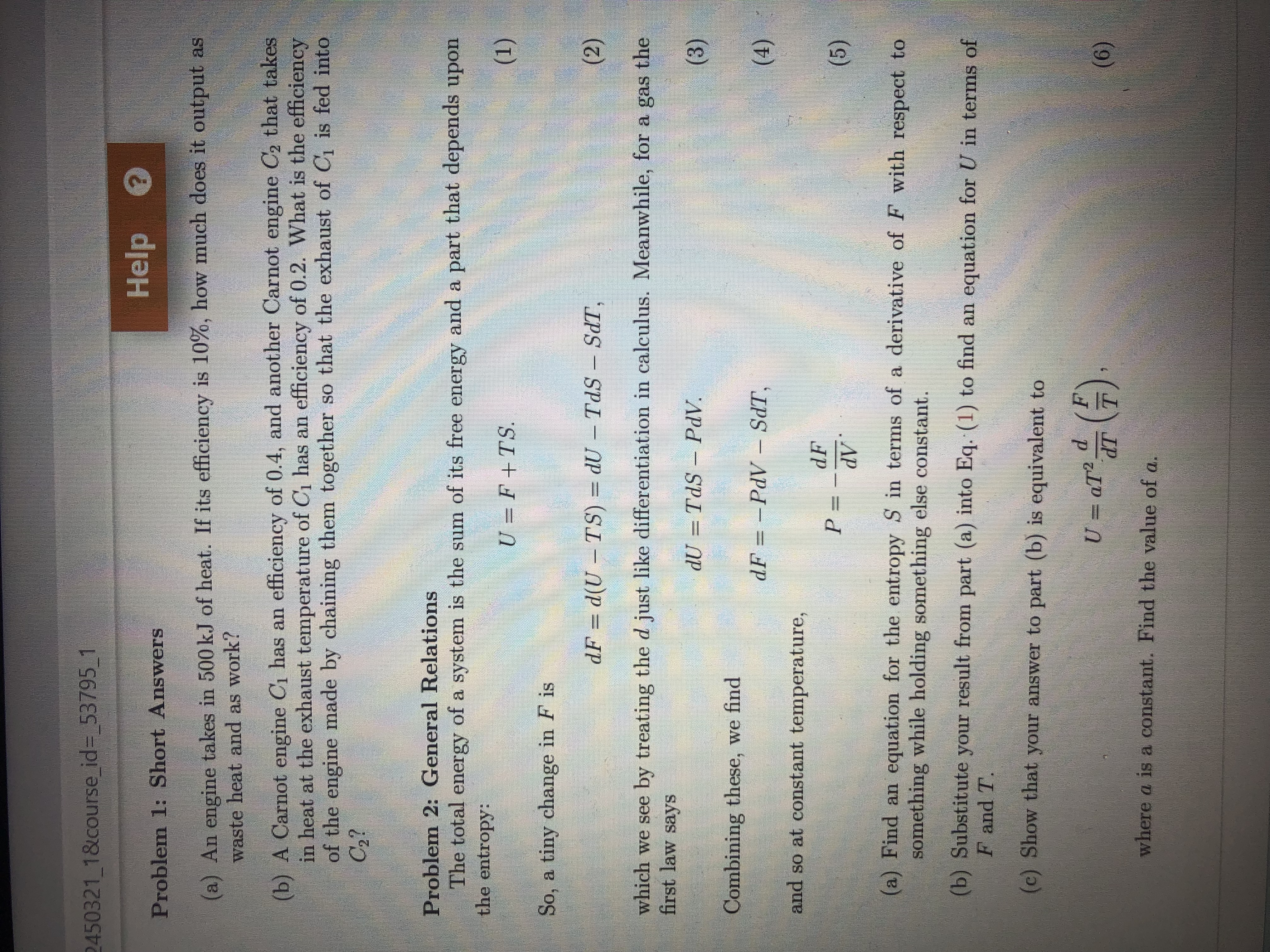
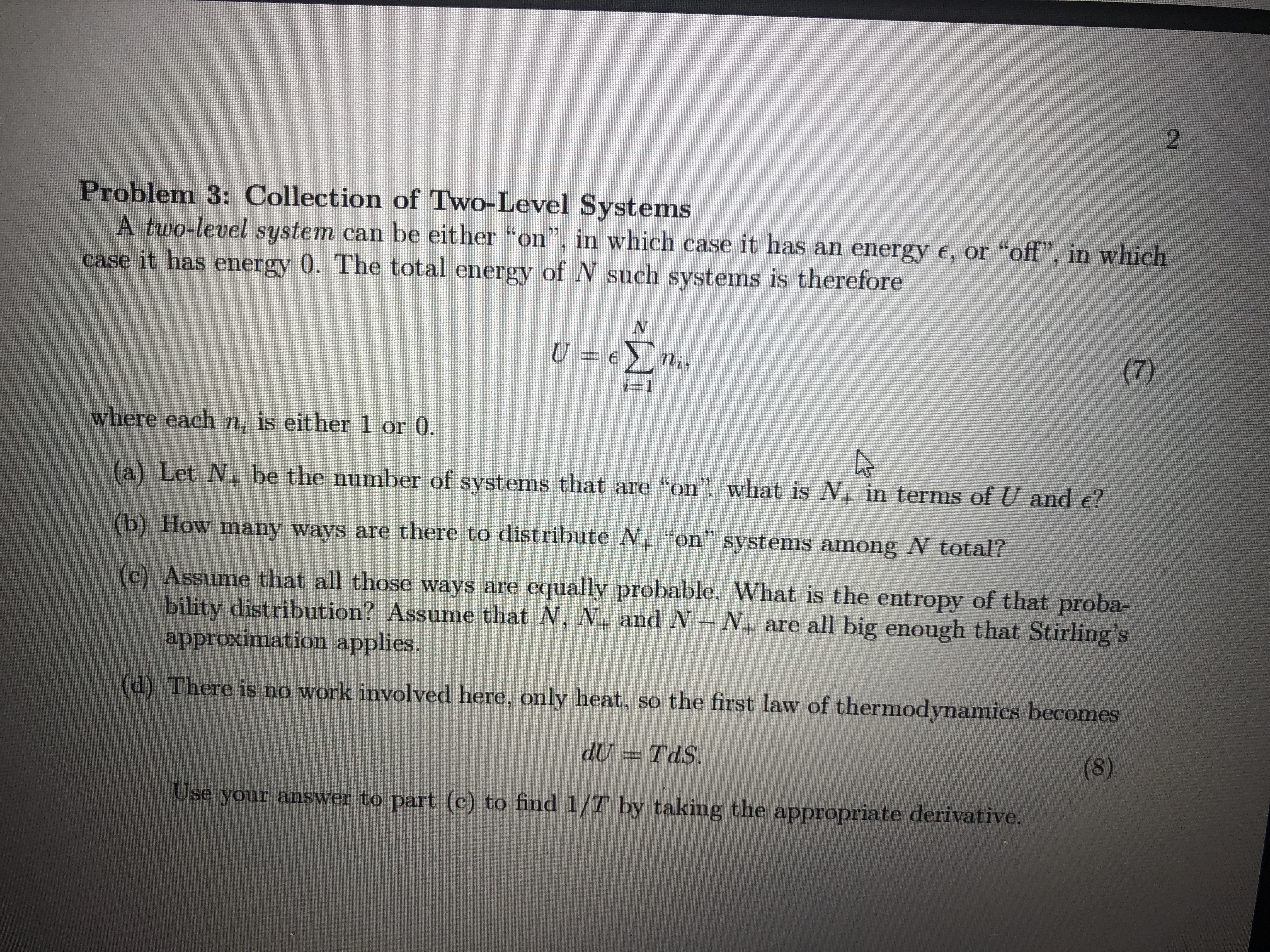
450321_1&course_id=_53795_1 Help ? Problem 1: Short Answers (a) An engine takes in 500 kJ of heat. If its efficiency is 10%, how much does it output as waste heat and as work? (b) A Carnot engine Ci has an efficiency of 0.4, and another Carnot engine C2 that takes in heat at the exhaust temperature of C1 has an efficiency of 0.2. What is the efficiency of the engine made by chaining them together so that the exhaust of C, is fed into C2? Problem 2: General Relations The total energy of a system is the sum of its free energy and a part that depends upon the entropy: U =F+TS. So, a tiny change in F is dF = d(U - TS) = du - TaS - SdT, (2) which we see by treating the d just like differentiation in calculus. Meanwhile, for a gas the first law says dU = TdS - Pdv. (3 Combining these, we find dF = -PdV - ST, (4) and so at constant temperature, dF P = av (5 (a) Find an equation for the entropy S in terms of a derivative of F with respect to something while holding something else constant. (b) Substitute your result from part (a) into Eq. (1) to find an equation for U in terms of F and T. (c) Show that your answer to part (b) is equivalent to U = aT?_ 6) where a is a constant. Find the value of a.Problem 3: Collection of Two-Level Systems A two-level system can be either "on", in which case it has an energy e, or "off", in which case it has energy 0. The total energy of / such systems is therefore N U = =_ni, (7) where each n; is either 1 or 0. (a) Let N. be the number of systems that are "on". what is N. in terms of U and e? (b) How many ways are there to distribute N. "on" systems among A total? (c) Assume that all those ways are equally probable. What is the entropy of that proba- bility distribution? Assume that N, N, and N - N. are all big enough that Stirling's approximation applies. (d) There is no work involved here, only heat, so the first law of thermodynamics becomes du = Tds. (8) Use your answer to part (c) to find 1/7 by taking the appropriate derivative
Step by Step Solution
There are 3 Steps involved in it

Get step-by-step solutions from verified subject matter experts
 Study Help