







Question: Can get the solution for these physics problems? The subject is thermodynamics. Recommended Text: Finn's Thermal Physics, third edition (CRC Press, 2017) Help (? Problem
Can get the solution for these physics problems? The subject is thermodynamics.
Recommended Text: Finn's Thermal Physics, third edition (CRC Press, 2017)
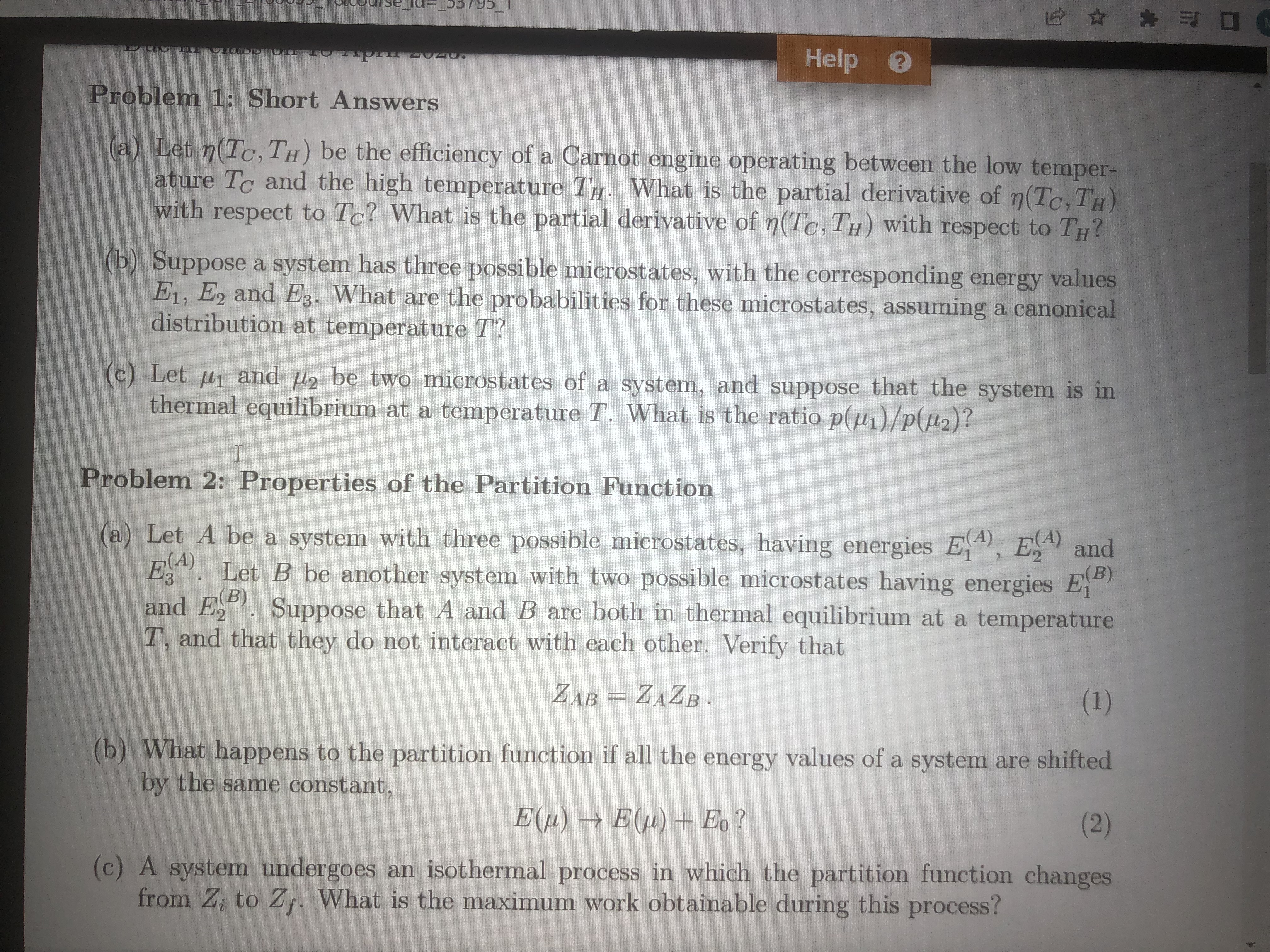
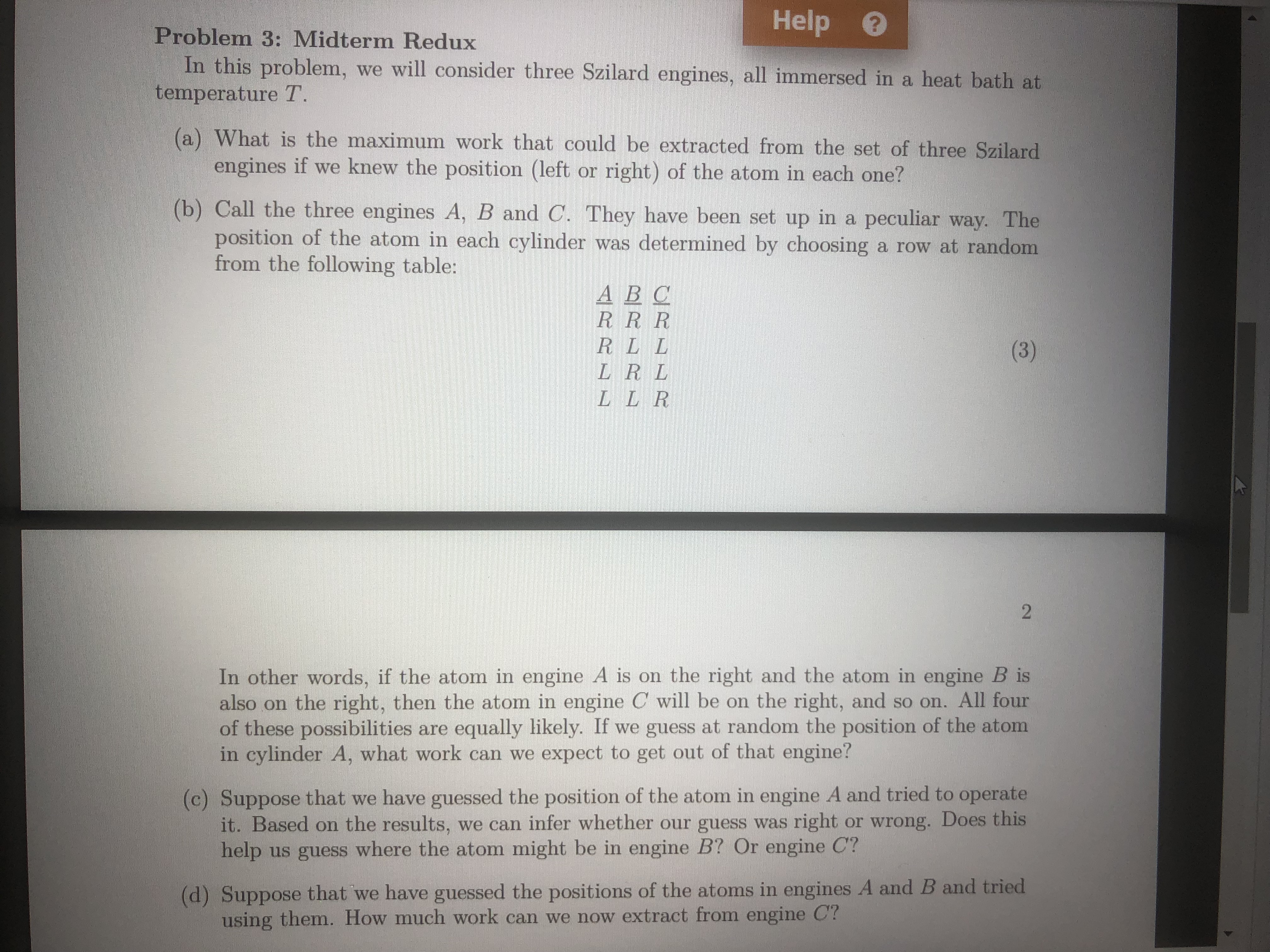
Help (? Problem 1: Short Answers (a) Let n(To, TH) be the efficiency of a Carnot engine operating between the low temper- ature To and the high temperature TH. What is the partial derivative of n(To, TH) with respect to To? What is the partial derivative of n(To, TH) with respect to TH? (b) Suppose a system has three possible microstates, with the corresponding energy values E1, E2 and E3. What are the probabilities for these microstates, assuming a canonical distribution at temperature T? (c) Let #1 and /2 be two microstates of a system, and suppose that the system is in thermal equilibrium at a temperature T. What is the ratio p(/1) /P(M2)? Problem 2: Properties of the Partition Function (a) Let A be a system with three possible microstates, having energies E,", E2" and Ed. Let B be another system with two possible microstates having energies E and E2". Suppose that A and B are both in thermal equilibrium at a temperature T, and that they do not interact with each other. Verify that ZAB = ZAZB. (1) (b) What happens to the partition function if all the energy values of a system are shifted by the same constant, E(M) - E(M) + Eo ? (2) (c) A system undergoes an isothermal process in which the partition function changes from Zi to Zy. What is the maximum work obtainable during this process?Help (?) Problem 3: Midterm Redux In this problem, we will consider three Szilard engines, all immersed in a heat bath at temperature T. (a) What is the maximum work that could be extracted from the set of three Szilard engines if we knew the position (left or right) of the atom in each one? (b) Call the three engines A, B and C. They have been set up in a peculiar way. The position of the atom in each cylinder was determined by choosing a row at random from the following table: ABC RRR RLL (3) LRL L LR 2 In other words, if the atom in engine A is on the right and the atom in engine B is also on the right, then the atom in engine C will be on the right, and so on. All four of these possibilities are equally likely. If we guess at random the position of the atom in cylinder A, what work can we expect to get out of that engine? (c) Suppose that we have guessed the position of the atom in engine A and tried to operate it. Based on the results, we can infer whether our guess was right or wrong. Does this help us guess where the atom might be in engine B? Or engine C? (d) Suppose that we have guessed the positions of the atoms in engines A and B and tried using them. How much work can we now extract from engine C
Step by Step Solution
There are 3 Steps involved in it

Get step-by-step solutions from verified subject matter experts
 Study Help