Question: can i get clear solutions QUESTION 5 5.1 An operator working on a forging press produces 710 pieces in an eight hour shift. The company

can i get clear solutions can i get clear solutions QUESTION 5 5.1 An
can i get clear solutions QUESTION 5 5.1 An
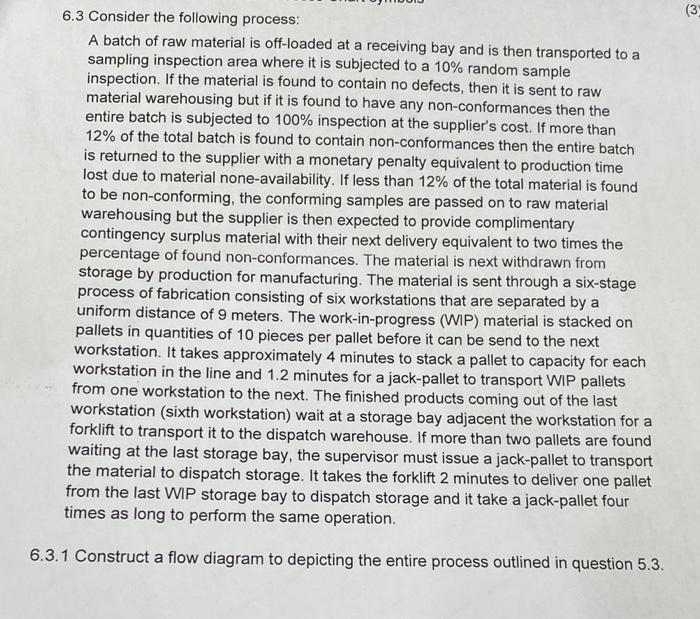
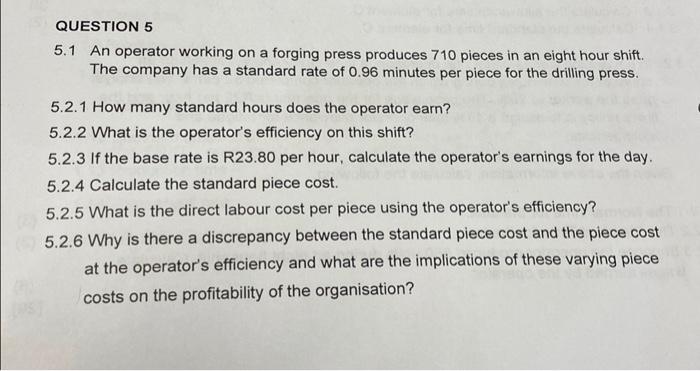
QUESTION 5 5.1 An operator working on a forging press produces 710 pieces in an eight hour shift. The company has a standard rate of 0.96 minutes per piece for the drilling press. 5.2.1 How many standard hours does the operator earn? 5.2.2 What is the operator's efficiency on this shift? 5.2.3 If the base rate is R23.80 per hour, calculate the operator's earnings for the day. 5.2.4 Calculate the standard piece cost. 5.2.5 What is the direct labour cost per piece using the operator's efficiency? 5.2.6 Why is there a discrepancy between the standard piece cost and the piece cost at the operator's efficiency and what are the implications of these varying piece costs on the profitability of the organisation? 6.3 Consider the following process: A batch of raw material is off-loaded at a receiving bay and is then transported to a sampling inspection area where it is subjected to a 10% random sample inspection. If the material is found to contain no defects, then it is sent to raw material warehousing but if it is found to have any non-conformances then the entire batch is subjected to 100% inspection at the supplier's cost. If more than 12% of the total batch is found to contain non-conformances then the entire batch is returned to the supplier with a monetary penalty equivalent to production time lost due to material none-availability. If less than 12% of the total material is found to be non-conforming, the conforming samples are passed on to raw material warehousing but the supplier is then expected to provide complimentary contingency surplus material with their next delivery equivalent to two times the percentage of found non-conformances. The material is next withdrawn from storage by production for manufacturing. The material is sent through a six-stage process of fabrication consisting of six workstations that are separated by a uniform distance of 9 meters. The work-in-progress (WIP) material is stacked on pallets in quantities of 10 pieces per pallet before it can be send to the next workstation. It takes approximately 4 minutes to stack a pallet to capacity for each workstation in the line and 1.2 minutes for a jack-pallet to transport WIP pallets from one workstation to the next. The finished products coming out of the last workstation (sixth workstation) wait at a storage bay adjacent the workstation for a forklift to transport it to the dispatch warehouse. If more than two pallets are found waiting at the last storage bay, the supervisor must issue a jack-pallet to transport the material to dispatch storage. It takes the forklift 2 minutes to deliver one pallet from the last WIP storage bay to dispatch storage and it take a jack-pallet four times as long to perform the same operation. 6.3.1 Construct a flow diagram to depicting the entire process outlined in question 5.3. (3)

Step by Step Solution

There are 3 Steps involved in it

1 Expert Approved Answer
Step: 1 Unlock blur-text-image

Question Has Been Solved by an Expert!

Get step-by-step solutions from verified subject matter experts

Step: 2 Unlock
Step: 3 Unlock

Students Have Also Explored These Related General Management Questions!