







Question: Can I have help with problem 2.1 + (2.1) Consider the following reaction, in which a particle of species A and a particle of species
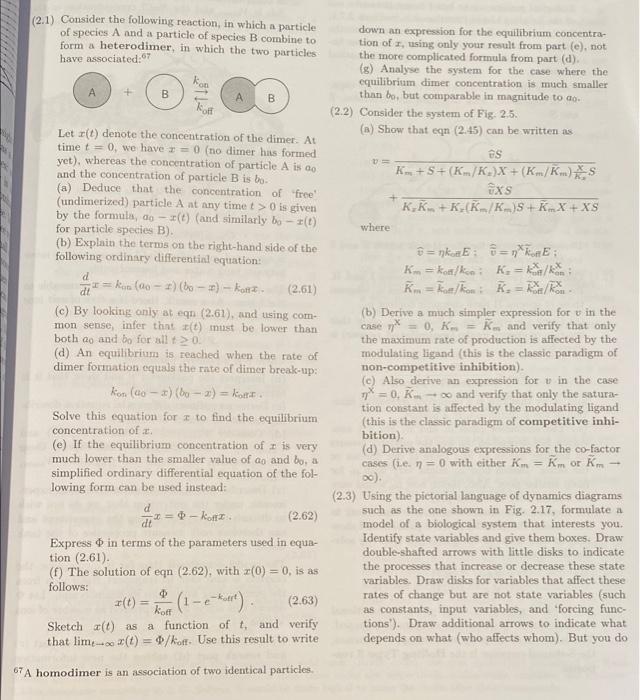
+ (2.1) Consider the following reaction, in which a particle of species A and a particle of species B combine to down an expression for the equilibrium concentra form a heterodimer, in which the two particles tion of I, using only your result from part (e), not have associated:07 the more complicated formula from part (d), (g) Analyse the system for the case where the koo equilibrium dimer concentration is much smaller B B than bo, but comparable in magnitude to go (2.2) Consider the system of Fig. 2.5. Let r(t) denote the concentration of the dimer. At (a) Show that eqn (2.45) can be written as time t = 0, we have 1 = 0 (no dimner his formed es yet), whereas the concentration of particle A is 0 = and the concentration of particle B is bo Km+S+ (K./K.)X + (Km./KS (a) Deduce that the concentration of free! Xs (undimerized) particle A at any time t > 0 is given K.K. +K (Km/...)S+K.X+XS by the formulas, do r(t) (and similarly bo - r(t) for particle species B). where (b) Explain the terms on the right-hand side of the following ordinary differential equation: 8 = nkon: =E: Km = kout/kon: K. =/ d dt T = Ron (0 - 1) (0 - 1) -kort. (261) K = KattkomKEPRI (c) By looking only at egn (2.61), and using com- (b) Derive a much simpler expression for u in the mon sense, infer that t() must be lower than case y* = 0, K. = K and verify that only both do and bo for allt > 0 the maximum rate of production is affected by the (d) An equilibrium is reached when the rate of modulating ligand (this is the classic paradigm of dimer formation equals the rate of dimer break-up: non-competitive inhibition). (c) Also derive an expression for u in the case kon (0 - 3) (0 - 3) = kort 7* = 0. - and verify that only the satura- tion constant is affected by the modulating ligand Solve this equation for to find the equilibrium (this is the classic paradigm of competitive inhi- concentration of bition) (e) If the equilibrium concentration of is very (d) Derive analogous expressions for the co-factor much lower than the smaller value of an and bo, a cases (1.0. n = 0 with either Kim = Km or Km simplified ordinary differential equation of the fol- 00). lowing form can be used instead: (2.3) Using the pictorial language of dynamics diagrams d (2.62) such as the one shown in Fig. 2.17, formulate a x = 0 - kort dt model of a biological system that interests you. Identify state variables and give them boxes. Draw Express o in terms of the parameters used in equa- double-shafted arrows with little disks to indicate tion (2.61). the processes that increase or decrease these state (f) The solution of eqn (2.62), with (0) = 0, is as variables. Draw disks for variables that affect these follows: r(t) (2.63) rates of change but are not state variables (such kor as constants, input variables, and "forcing func- Sketch(t) as a function of t, and verify tions"). Draw additional arrows to indicate what that lime- + X(t) = /koff. Use this result to write depends on what (who affects whom). But you do 1 (1 - e kort) 67A homodimer is an association of two identical particles
Step by Step Solution
There are 3 Steps involved in it

Get step-by-step solutions from verified subject matter experts
 Study Help