







Question: Can I please get some help with this question? I appreciate it, thank you! Required: 1. Assume a 10-year forecasting horizon. Note that 20x3 return
Can I please get some help with this question? I appreciate it, thank you!
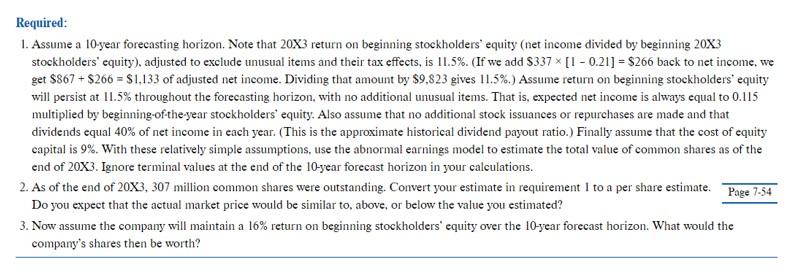
Required: 1. Assume a 10-year forecasting horizon. Note that 20x3 return on beginning stockholders' equity (net income divided by beginning 20X3 stockholders' equity), adjusted to exclude unusual items and their tax effects, is 11.5%. (If we add $337 *[1 -0.21] = $266 back to net income, we get $867 + $266 = $1,133 of adjusted net income. Dividing that amount by $9,823 gives 11.5%.) Assume return on beginning stockholders' equity will persist at 11.5% throughout the forecasting horizon, with no additional unusual items. That is expected net income is always equal to 0.115 multiplied by beginning-of-the-year stockholders' equity. Also assume that no additional stock issuances or repurchases are made and that dividends equal 40% of net income in each year. (This is the approximate historical dividend payout ratio.) Finally assume that the cost of equity capital is 9%. With these relatively simple assumptions, use the abnormal earnings model to estimate the total value of common shares as of the end of 20X3. Ignore terminal values at the end of the 10-year forecast horizon in your calculations. 2. As of the end of 20X3, 307 million common shares were outstanding. Convert your estimate in requirement I to a per share estimate. Page 7.54 Do you expect that the actual market price would be similar to, above, or below the value you estimated? 3. Now assume the company will maintain a 16% return on beginning stockholders' equity over the 10-year forecast horizon. What would the company's shares then be worth? Required: 1. Assume a 10-year forecasting horizon. Note that 20x3 return on beginning stockholders' equity (net income divided by beginning 20X3 stockholders' equity), adjusted to exclude unusual items and their tax effects, is 11.5%. (If we add $337 *[1 -0.21] = $266 back to net income, we get $867 + $266 = $1,133 of adjusted net income. Dividing that amount by $9,823 gives 11.5%.) Assume return on beginning stockholders' equity will persist at 11.5% throughout the forecasting horizon, with no additional unusual items. That is expected net income is always equal to 0.115 multiplied by beginning-of-the-year stockholders' equity. Also assume that no additional stock issuances or repurchases are made and that dividends equal 40% of net income in each year. (This is the approximate historical dividend payout ratio.) Finally assume that the cost of equity capital is 9%. With these relatively simple assumptions, use the abnormal earnings model to estimate the total value of common shares as of the end of 20X3. Ignore terminal values at the end of the 10-year forecast horizon in your calculations. 2. As of the end of 20X3, 307 million common shares were outstanding. Convert your estimate in requirement I to a per share estimate. Page 7.54 Do you expect that the actual market price would be similar to, above, or below the value you estimated? 3. Now assume the company will maintain a 16% return on beginning stockholders' equity over the 10-year forecast horizon. What would the company's shares then be worth
Step by Step Solution
There are 3 Steps involved in it
To estimate the value of the companys shares using the abnormal earnings model well follow these ste... View full answer

Get step-by-step solutions from verified subject matter experts
 Study Help