Question: Can someone help explain to me how to correctly do this data tree analysis. I would greatly appreciate it :) BACKGROUND: As a member of
Can someone help explain to me how to correctly do this data tree analysis. I would greatly appreciate it :)
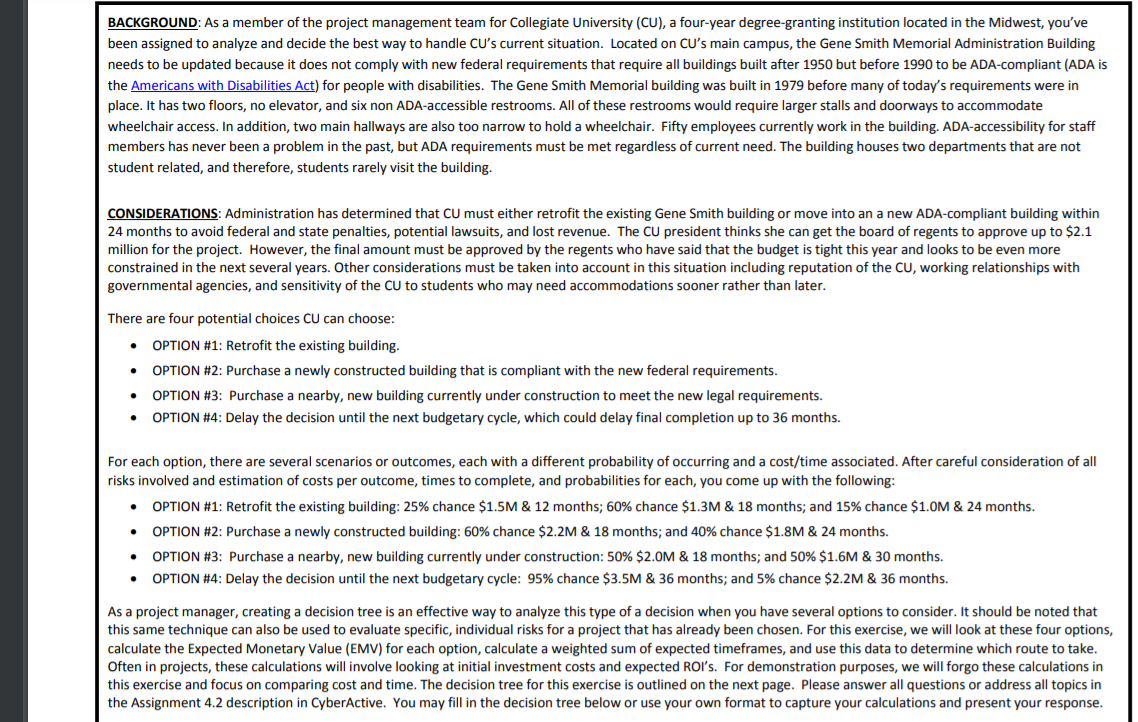
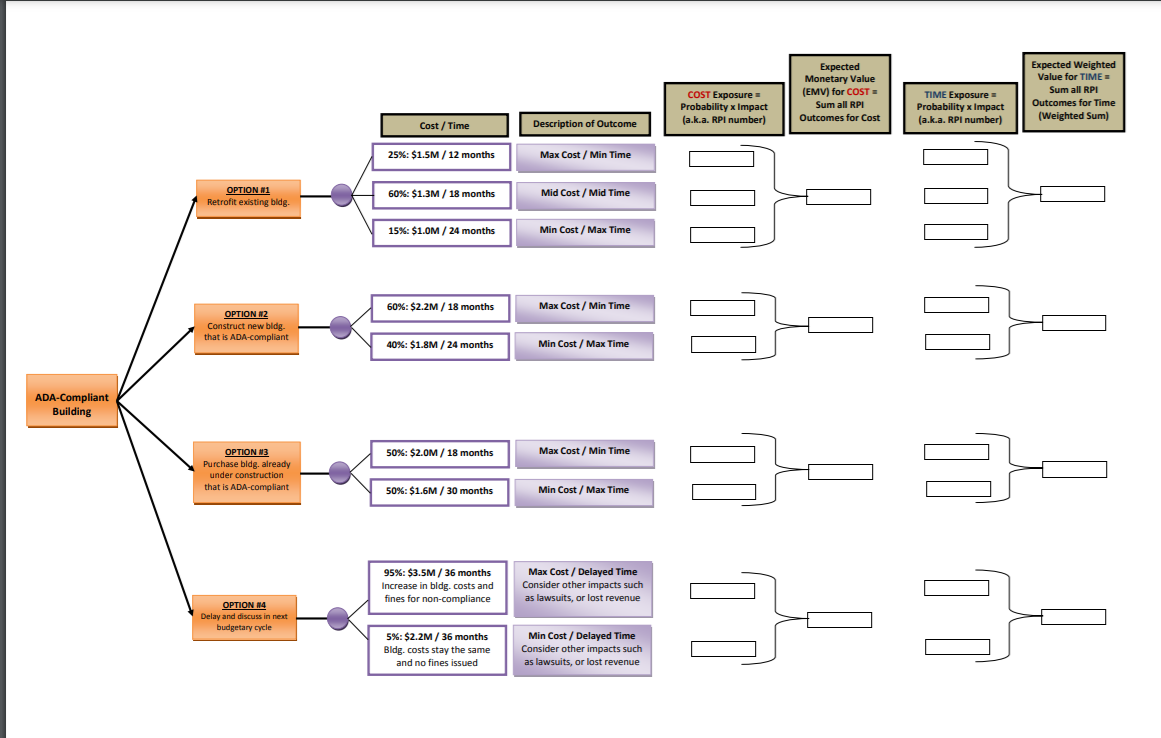
BACKGROUND: As a member of the project management team for Collegiate University (CU), a four-year degree-granting institution located in the Midwest, you've been assigned to analyze and decide the best way to handle CU's current situation. Located on CU's main campus, the Gene Smith Memorial Administration Building needs to be updated because it does not comply with new federal requirements that require all buildings built after 1950 but before 1990 to be ADA-compliant (ADA is the Americans with Disabilities Act) for people with disabilities. The Gene Smith Memorial building was built in 1979 before many of today's requirements were in place. It has two floors, no elevator, and six non ADA-accessible restrooms. All of these restrooms would require larger stalls and doorways to accommodate wheelchair access. In addition, two main hallways are also too narrow to hold a wheelchair. Fifty employees currently work in the building. ADA-accessibility for staff members has never been a problem in the past, but ADA requirements must be met regardless of current need. The building houses two departments that are not student related, and therefore, students rarely visit the building. CONSIDERATIONS: Administration has determined that CU must either retrofit the existing Gene Smith building or move into an a new ADA-compliant building within 24 months to avoid federal and state penalties, potential lawsuits, and lost revenue. The CU president thinks she can get the board of regents to approve up to $2.1 million for the project. However, the final amount must be approved by the regents who have said that the budget is tight this year and looks to be even more constrained in the next several years. Other considerations must be taken into account in this situation including reputation of the CU, working relationships with governmental agencies, and sensitivity of the CU to students who may need accommodations sooner rather than later. There are four potential choices CU can choose: OPTION #1: Retrofit the existing building. OPTION #2: Purchase a newly constructed building that is compliant with the new federal requirements. OPTION #3: Purchase a nearby, new building currently under construction to meet the new legal requirements. OPTION #4: Delay the decision until the next budgetary cycle, which could delay final completion up to 36 months. . . . For each option, there are several scenarios or outcomes, each with a different probability of occurring and a cost/time ciated. After careful consideration of all risks involved and estimation of costs per outcome, times to complete, and probabilities for each, you come up with the following: OPTION #1: Retrofit the existing building: 25% chance $1.5M & 12 months; 60% chance $1.3M & 18 months; and 15% chance $1.0M & 24 months. OPTION #2: Purchase a newly constructed building: 60% chance $2.2M & 18 months; and 40% chance $1.8M & 24 months. OPTION #3: Purchase a nearby, new building currently under construction: 50% $2.0M & 18 months; and 50% $1.6M & 30 months. OPTION #4: Delay the decision until the next budgetary cycle: 95% chance $3.5M & 36 months; and 5% chance $2.2M & 36 months. As a project manager, creating a decision tree is an effective way to analyze this type of a decision when you have several options to consider. It should be noted that this same technique can also be used to evaluate specific, individual risks for a project that has already been chosen. For this exercise, we will look at these four options, calculate the Expected Monetary Value (EMV) for each option, calculate a weighted sum of expected timeframes, and use this data to determine which route to take. Often in projects, these calculations will involve looking at initial investment costs and expected ROI's. For demonstration purposes, we will forgo these calculations in this exercise and focus on comparing cost and time. The decision tree for this exercise is outlined on the next page. Please answer all questions or address all topics in the Assignment 4.2 description in CyberActive. You may fill in the decision tree below or use your own format to capture your calculations and present your response. COST Exposure Probability x Impact (a.k.a. RPI number) Expected Monetary Value (EMV) for COST Sum all RPI Outcomes for Cost TIME Exposure Probability x Impact (a.k.a. RPI number) Expected Weighted Value for TIME Sum all RPI Outcomes for Time (Weighted Sum) Cost/Time Description of Outcome 25%: $1.5M / 12 months %/ Max Cost / Min Time OPTION 1 Retrofit existing bldg. 60%: $1.3M / 18 months Mid Cost/ Mid Time : / 15%: $1.0M / 24 months Min Cost / Max Time : / 60%: $2.2M / 18 months Max Cost/ Min Time / OPTION 2 Construct new bldg that is ADA-compliant 40%: $1.8M / 24 months Min Cost / Max Time ADA-Compliant - Building 50%: $2.0M / 18 months : $ Max Cost / Min Time OPTION N3 Purchase bldg. already under construction that is ADA-compliant 50%: $1.6M / 30 months $ Min Cost/ Max Time / 95%: $3.5M / 36 months %: / Increase in bldg. costs and fines for non-compliance Max Cost / Delayed Time Consider other impacts such as lawsuits, or lost revenue OPTION 14 Delay and discuss in next budgetary cycle 5%: $2.2M / 36 months Bldg. costs stay the same . and no fines issued Min Cost / Delayed Time Consider other impacts such as lawsuits, or lost revenue









 Study Help