Question: can someone help me summirize this article and help me answer these three questions please takes did Newberg an Discussion Questions 1. What mistakes did
can someone help me summirize this article and help me answer these three questions please
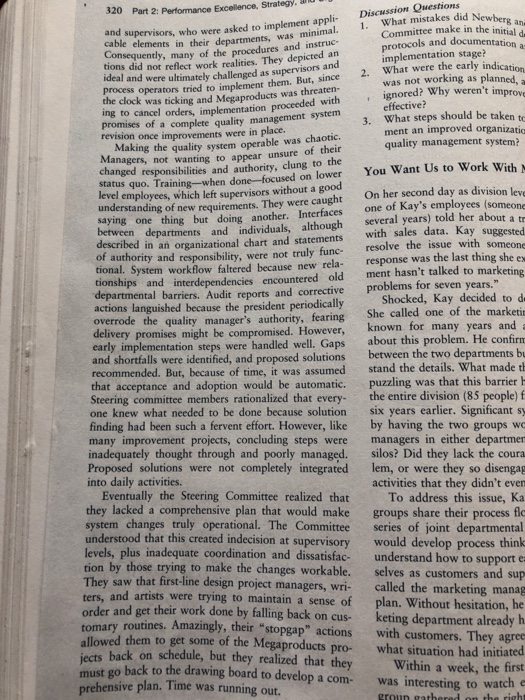
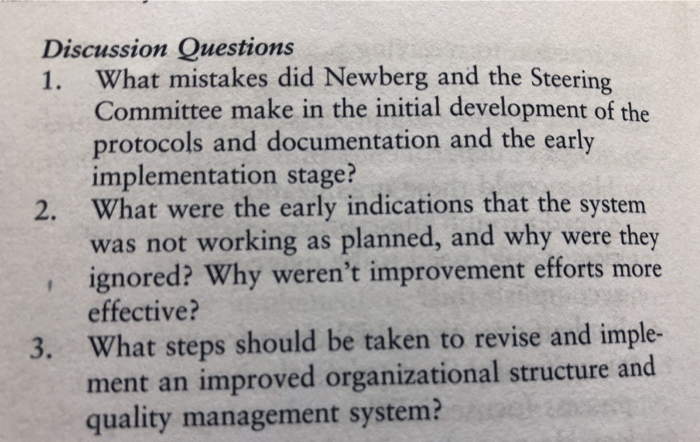
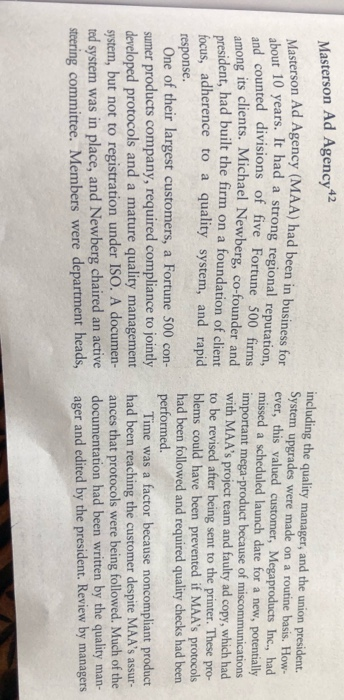
takes did Newberg an Discussion Questions 1. What mistakes did Newhere Committee make in the initiala rotocols and documentation implementation stage? What were the early indication was not working as planned, ignored? Why weren't improve effective? What steps should be taken to ment an improved organizatic quality management system? 320 Part 2: Performance Excellence, Strategy a and supervisors, who were asked to implement app cable elements in their departments, was minimal Consequently, many of the procedures and instruc tions did not reflect work realities. They depicted an ideal and were ultimately challenged as supervisors and process operators tried to implement them. But, since the clock was ticking and Megaproducts was threaten ing to cancel orders, implementation proceeded with promises of a complete quality management system revision once improvements were in place. Making the quality system operable was chaotic. Managers, not wanting to appear unsure of their changed responsibilities and authority, clung to the status quo. Training-when done focused on lower level employees, which left supervisors without a good understanding of new requirements. They were caught saying one thing but doing another. Interfaces between departments and individuals, although described in an organizational chart and statements of authority and responsibility, were not truly func- tional. System workflow faltered because new rela- tionships and interdependencies encountered old departmental barriers. Audit reports and corrective actions languished because the president periodically overrode the quality manager's authority, fearing delivery promises might be compromised. However, omised. However, early implementation steps were handled well. Gaps and shortfalls were identified, and proposed solutions recommended. But, because of time, it was assumed that acceptance and adoption would be automatic. Steering committee members rationalized that every- one knew what needed to be done because solution finding had been such a fervent effort. However, like many improvement projects, concluding steps were inadequately thought through and poorly managed. Proposed solutions were not completely integrated into daily activities. Eventually the Steering Committee realized that they lacked a comprehensive plan that would make system changes truly operational. The Committee understood that this created indecision at supervisory levels, plus inadequate coordination and dissatisfac- tion by those trying to make the changes workable. They saw that first-line design project managers, wri- ters, and artists were trying to maintain a sense of order and get their work done by falling back on cus- tomary routines. Amazingly, their stopgap" actions allowed them to get some of the Megaproducts pro- jects back on schedule, but they realized that they must go back to the drawing board to develop a com- prehensive plan. Time was running out. You Want Us to Work With On her second day as division leve one of Kay's employees (someone several years) told her about a tr with sales data. Kay suggested resolve the issue with someone response was the last thing she ex ment hasn't talked to marketing problems for seven years." Shocked, Kay decided to de She called one of the marketin known for many years and about this problem. He confirm between the two departments bu stand the details. What made the puzzling was that this barrier the entire division (85 people) f six years earlier. Significant sy by having the two groups we managers in either departmer silos? Did they lack the coura lem, or were they so disengag activities that they didn't even To address this issue, Ka groups share their process flo series of joint departmental would develop process think understand how to support e selves as customers and sup called the marketing manag plan. Without hesitation, he keting department already h with customers. They agree what situation had initiated Within a week, the first was interesting to watch groun gathered the right Discussion Questions 1. What mistakes did Newberg and the Steering Committee make in the initial development of the protocols and documentation and the early implementation stage? 2. What were the early indications that the system was not working as planned, and why were they ignored? Why weren't improvement efforts more effective? What steps should be taken to revise and imple- ment an improved organizational structure and quality management system? Masterson Ad Agency 42 sterson Ad Agency (MAA) had been in business for hout 10 years. It had a strong regional reputation, and counted divisions of five Fortune 500 firms among its clients. Michael Newberg, co-founder and president, had built the firm on a foundation of client focus, adherence to a quality system, and rapid response. One of their largest customers, a Fortune 500 con- sumer products company, required compliance to jointly developed protocols and a mature quality management system, but not to registration under ISO. A documen- ted system was in place, and Newberg chaired an active steering committee. Members were department heads, including the quality manager, and the union president. System upgrades were made on a routine basis. How- ever, this valued customer, Megaproducts Inc., had missed a scheduled launch date for a new, potentially important mega-product because of miscommunications with MAA's project team and faulty ad copy, which had to be revised after being sent to the printer. These pro- blems could have been prevented if MAA's protocols had been followed and required quality checks had been performed. Time was a factor because noncompliant product had been reaching the customer despite MAA's assur- ances that protocols were being followed. Much of the documentation had been written by the quality man- ager and edited by the president. Review by managers









 Study Help