



Question: can someone help me with question 12 please? 12. Ship passing through locks-M. A ship of mass M travels uphill through a series of identical
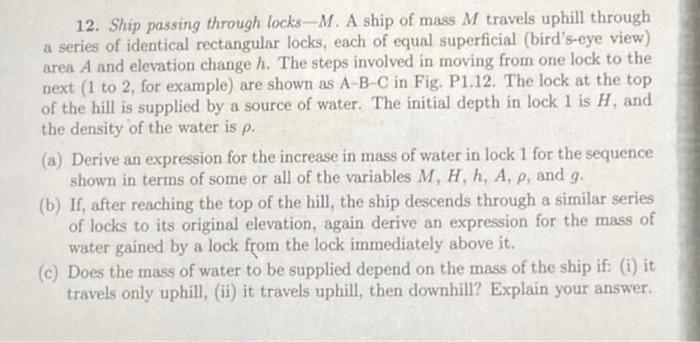
12. Ship passing through locks-M. A ship of mass M travels uphill through a series of identical rectangular locks, each of equal superficial (bird's-eye view) area A and elevation change h. The steps involved in moving from one lock to the next (1 to 2, for example) are shown as A-B-C in Fig. P1.12. The lock at the top of the hill is supplied by a source of water. The initial depth in lock 1 is H, and the density of the water is p. (a) Derive an expression for the increase in mass of water in lock 1 for the sequence shown in terms of some or all of the variables M, H, h, A, p, and g. (b) If, after reaching the top of the hill, the ship descends through a similar series of locks to its original elevation, again derive an expression for the mass of water gained by a lock from the lock immediately above it. (c) Does the mass of water to be supplied depend on the mass of the ship if (i) it travels only uphill, (ii) it travels uphill, then downhill? Explain your answer. 12. Ship passing through locks-M. A ship of mass M travels uphill through a series of identical rectangular locks, each of equal superficial (bird's-eye view) area A and elevation change h. The steps involved in moving from one lock to the next (1 to 2, for example) are shown as A-B-C in Fig. P1.12. The lock at the top of the hill is supplied by a source of water. The initial depth in lock 1 is H, and the density of the water is p. (a) Derive an expression for the increase in mass of water in lock 1 for the sequence shown in terms of some or all of the variables M, H, h, A, p, and g. (b) If, after reaching the top of the hill, the ship descends through a similar series of locks to its original elevation, again derive an expression for the mass of water gained by a lock from the lock immediately above it. (c) Does the mass of water to be supplied depend on the mass of the ship if (i) it travels only uphill, (ii) it travels uphill, then downhill? Explain your
Step by Step Solution
There are 3 Steps involved in it

Get step-by-step solutions from verified subject matter experts