







Question: Can someone help with part (b)(c)(d)? There is a solution for part(a) so you may read that post first to get some additional info for
Can someone help with part (b)(c)(d)? There is a solution for part(a) so you may read that post first to get some additional info for this question.
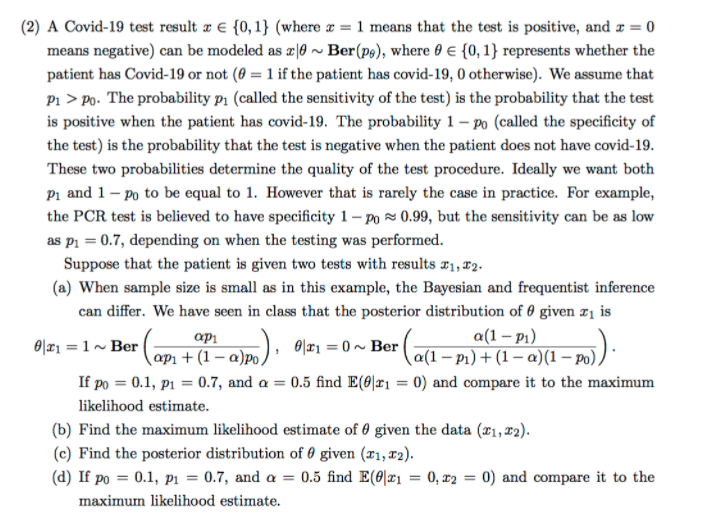
(2) A Covid-19 test result x {0,1} (where x = 1 means that the test is positive, and x = 0 means negative) can be modeled as 20 ~ Ber(pe), where 8 {0,1} represents whether the patient has Covid-19 or not (0 = 1 if the patient has covid-19, 0 otherwise). We assume that P1 > Po. The probability P1 (called the sensitivity of the test) is the probability that the test is positive when the patient has covid-19. The probability 1 Po (called the specificity of the test) is the probability that the test is negative when the patient does not have covid-19. These two probabilities determine the quality of the test procedure. Ideally we want both P1 and 1 po to be equal to 1. However that is rarely the case in practice. For example, the PCR test is believed to have specificity 1 - Po 0.99, but the sensitivity can be as low as p = 0.7, depending on when the testing was performed. Suppose that the patient is given two tests with results 11,12. (a) When sample size is small as in this example, the Bayesian and frequentist inference can differ. We have seen in class that the posterior distribution of @given 21 is a(1-P) 0|11 = 0 ~ Ber a(1 P1)+ (1 - a)(1 Po) If po = 0.1, p1 = 0.7, and a = 0.5 find E(0|21 = 0) and compare it to the maximum likelihood estimate. (b) Find the maximum likelihood estimate of 8 given the data (21, 22). (e) Find the posterior distribution of 6 given (11,12). (d) If po = 0.1, P1 = 0.7, and a = 0.5 find E(C x1 = 0, x2 = 0) and compare it to the maximum likelihood estimate. apo) (
Step by Step Solution
There are 3 Steps involved in it

Get step-by-step solutions from verified subject matter experts
 Study Help