







Question: can someone please explain how to solve these problems 8. 10. 11. A boy places his ear on an iron railway line (together with his
can someone please explain how to solve these problems
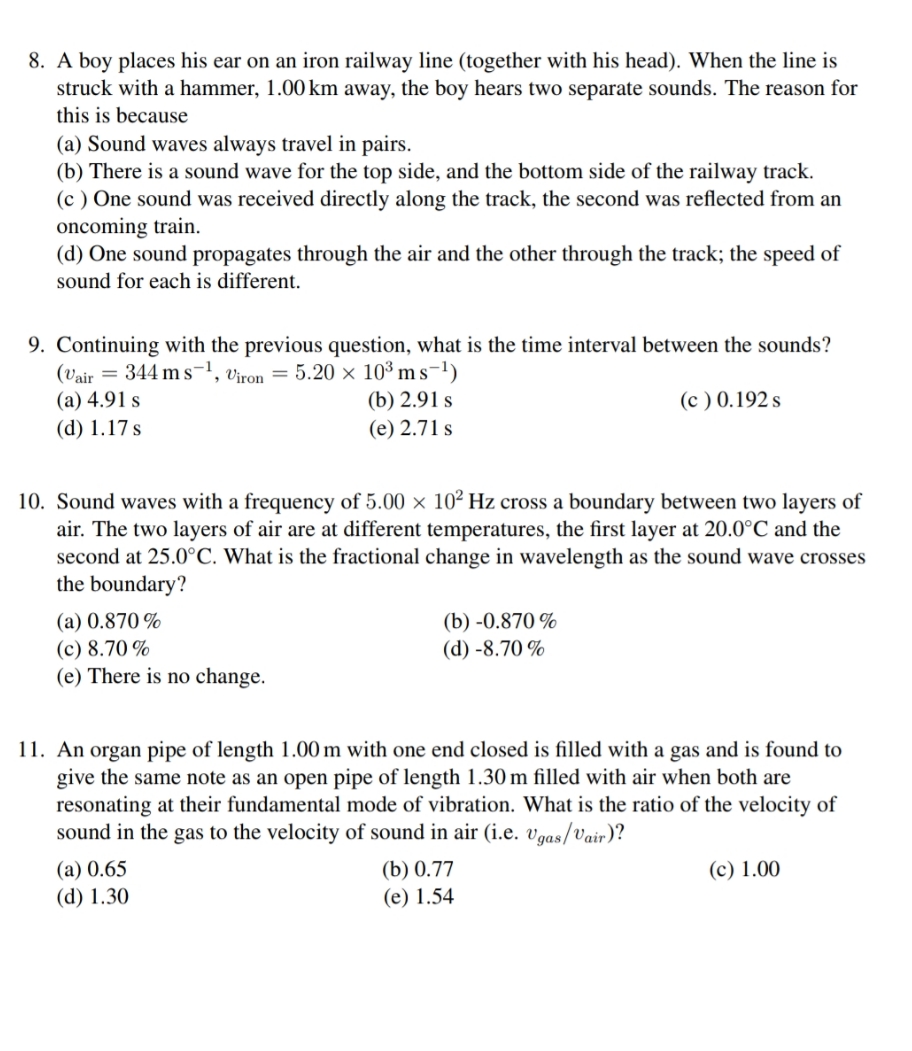
8. 10. 11. A boy places his ear on an iron railway line (together with his head). When the line is struck with a hammer, 1.00km away. the boy hears two separate sounds. The reason for this is because (a) Sound waves always travel in pairs. (b) There is a sound wave for the top side, and the bottom side of the railway track. (c ) One sound was received directly along the track, the second was reected from an oncoming train. (d) One sound propagates through the air and the other through the track; the speed of sound for each is different. Continuing with the previous question, what is the time interval between the sounds?I (val, : 34411154, aim : 5.20 x 10311181) (a) 4.91 s (h) 2.91 s (e ) 0.192 s (d) 1.17s (e) 2.715 Sound waves with a frequency of 5.00 X 10² Hz cross a boundary between two layers of air. The two layers of air are at different temperatures. the rst layer at 200C and the second at 210C. What is the fractional change in wavelength as the sound wave crosses the boundary? (a) 0.810 % (b) -0.870 % (c) 8.70 % (d) -8.70 % (e) There is no change. An organ pipe of length 1.00 in with one end closed is lled with a gas and is found to give the same note as an open pipe of length 1.30m lled with air when both are resonating at their fundamental mode of vibration. What is the ratio of the velocity of sound in the gas to the velocity of sound in air (i.e. as.\" firm)? (a) 0.65 (b) 0.77 (c) 1.00 (d) 1.30 (e) 1.54
Step by Step Solution
There are 3 Steps involved in it

Get step-by-step solutions from verified subject matter experts
 Study Help