







Question: can someone please solve this question please: question :- what should CEO do to create the culture change in the Wings? help him by coming
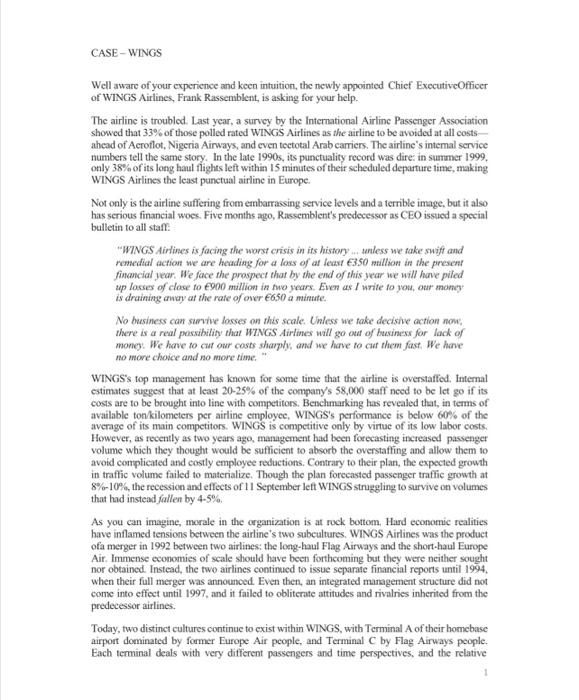
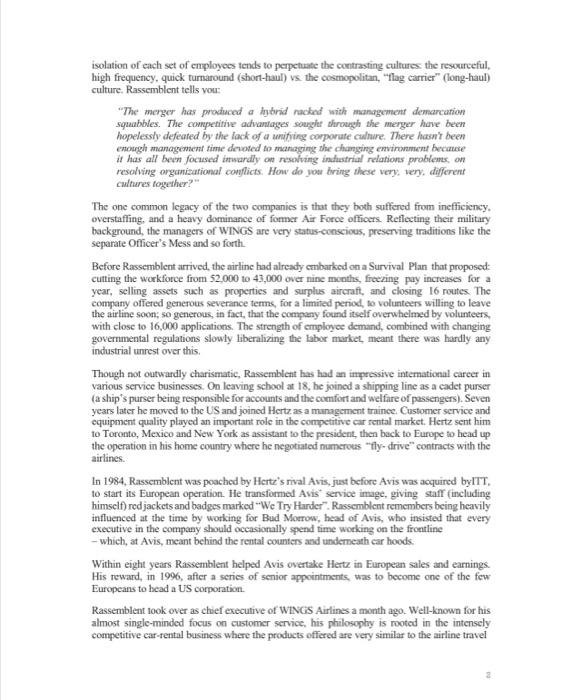
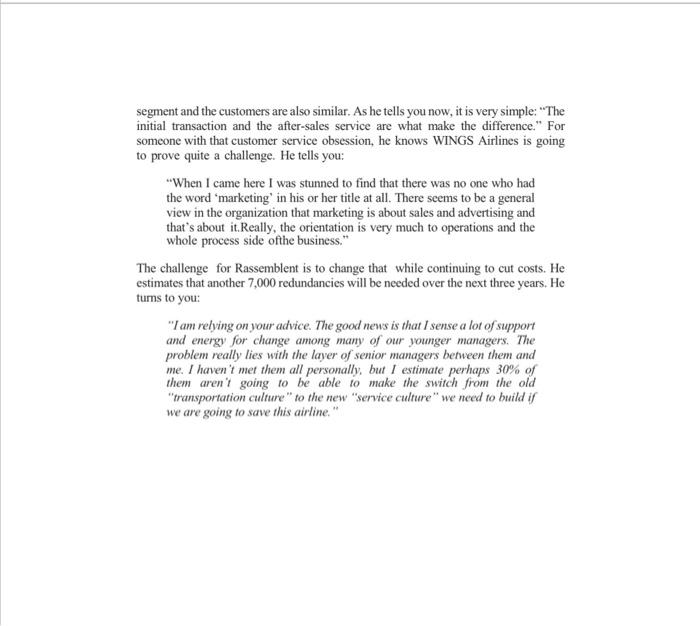
CASE - WINGS Well aware of your experience and keen intuition, the newly appointed Chief ExecutiveOfficer of WINGS Airlines, Frank Rassemblent, is asking for your belp. The airline is troubled. Last year, a survey by the International Airline Passenger Association showed that 33% of those polled rated WINGS Airlines as the airline to be avoided at all costsahead of Aeroflot, Nigeria Airways, and cven teetotal Arab carriers. The airline's intemal service numbers tell the same story. In the late 1990s, its punctuality record was dire: in summer 1999. only 38% of its long haul fights left within 15 minutes of their scheduled departure time, making WINGS Airlines the least punctual airline in Europe. Not only is the airline suffering from embarrassing service levels and a terrible image, but it also has serious financial woes. Five months ago, Rassemblent's predecessor as CEO issued a special bulletin to all staff: "WINGS Airlines is facing the wort crisis in its history ".. unless we take swiff and romedial action we are heading for a loss of at leaxt 6350 million in the present financial year. We face the prospect that by the end of this year we will have piled up losse of close to e900 million in two years. Even as I write to you, our money is draining away at the rate of oner 6650 a minute. No busines can survive losses on this scale. Unless we take decisive action now. there is a real possibility that WINGS Airlimes will go out of business for lack of money. We have to cut our casts sharply, and we have to cut them fast. We have no more choice and no more time." WINGS's top management has known for some time that the airline is overstalfed. Internal estimates suggest that at least 2025% of the company's 58,000 staff need to be let go if its costs are to be brought into line with competitors. Benchmarking has revealed that, in terms of available ton/kilometers per airline employee, WINGS's performanee is below 60% of the average of its main competitors. WINGS is competitive only by virtue of its low labor costs. However, as recently as two years ago, management had been forecasting increased passenger volume which they thought would be sufficient to absorb the overstaffing and allow them to avoid conplicated and costly employee reductions, Contrary to their plan, the expected growh in traffic volume failed to materialize. Though the plan forecasted passenger traffic growth at 8%10%, the recession and effects of 11 September left WINGS struggling to survive on volumes that had instead fallen by 45%, As you can imagine, morale in the organization is at rock bottom. Hard economic realities have inflamed tensions between the airline's two subeultures. WINGS Airlines was the product ofa merger in 1992 between two airlines; the long-haul Flag Airways and the short-haul Europe Air. Immense economies of scale should have been forthcoming but they were neither sought nor obtained. Instead, the two airlines continued to issue separate financial reports until 1994 , when their full merger was announced. Even then, an integrated management structure did not cone into effect until 1997, and it failed to obliterate attitudes and rivalries inherited from the predecessor airlines. Today, two distinct cultures continue to exist within WINGS, with Terminal A of their homebase airport dominated by former Europe Air people, and Terminal C by Flag Airways people. Each terminal deals with very different passengers and time perspectives, and the relative isolation of each set of employees tends to perpetuate the contrasting cultures: the resourceful, high frequency, quick turnaround (short-haul) vs. the cosmopolitan, "flag carrier" (long-haul) culture. Rassemblent tells you: "The merger has produced a hybrid nacknd with management demancunion squabbles. The conpetitive advantages sougglt throtghe the merger have been hopelessly defeated by the lack of a anifying corporate culhure. There hasn' been enotght management timie denoted to managing she changing environment becancie it has all been focused inwaraly on reseving industrial relations problems, on resolving orgunizational conflicts. How do you bving these very, wery. difenent cultures together?" The one common legacy of the two companics is that they both suffened from inefficiency. overstafting, and a heavy dominance of former Air Force officers. Reflecting their military background, the managers of WINGS are very status-conscious, preserving traditions like the separate Officer's Mess and so forth. Before Rassemblent arrived, the airline had already cmbarked on a Survival Plan that proposed: cutting the workforce from 52,000 to 43,000 over nine menths, freeding pay increases for a year, selling assets such as properties and surplus aircraft, and closing 16 routes. The company offered generots severance tems, for a limited period, to volunteers willing to leave the airline soon; so generous, in fact, that the company found itself overwhelmed by volunteers. with close to 16,000 applications. The strength of employee demand, combined with changing governmental regulations slowly liberalizing the labor markel, meant there was hardly any industrial unrest over this. Though not outwardly charismatic, Rassemblent has had an impressive intemational carcer in various service businesses. On leaving school at 18 , he joined a shipping line as a cadet purser (a ship's purser being responsible for accounts and the comfort and welfare of passengers). Seven years later he moved to the US and joined Hertz as a mungement trainee. Customer service and equipment quality played an important role in the competitive car rental market. Hertz sent him to Toronto, Mexico and New York as assistant to the president, then beck to Europe so head up the operation in his home country where he negotiated numeroes "fly-drive" contracts with the airlines. In 1984, Rassemblent was poached by Hertz's rival Avis, just before Avis was acquired byITT. to start its European operation. Ife transformed Avis' servioe image, giving staff (including himself) red jackets and badges marked "We Try Harder". Rnssemblent remembers being heavily influenced at the time by working for Bud Morrow, head of Avis, who insisted that every executive in the company should occasionally spend time working on the frontline - which, at Avis, meant behind the rental counters and undemeath car hoods. Within eight years Rassemblent helped Avis overtake Herte in European sales and earnings. His reward, in 1996, after a series of senior appointments, was to become one of the few Europeans to head a US corporation. Rassemblent look over as chef executive of WINGiS Airlines a month ago. Well-known for his almost single-minded focus on customer service, his philosophy is rooted in the intensely competitive car-rental business where the products offered are very similar to the airline travel 3 segment and the customers are also similar. As he tells you now, it is very simple: "The initial transaction and the after-sales service are what make the difference." For someone with that customer service obsession, he knows WINGS Airlines is going to prove quite a challenge. He tells you: "When I came here I was stunned to find that there was no one who had the word 'marketing' in his or her title at all. There seems to be a general view in the organization that marketing is about sales and advertising and that's about it.Really, the orientation is very much to operations and the whole process side ofthe business." The challenge for Rassemblent is to change that while continuing to cut costs. He estimates that another 7,000 redundancies will be needed over the next three years. He turns to you: "I am relying on your advice. The good news is that I sense a lot of support and energy for change among many of our younger managers. The problem really lies with the layer of senior managers between them and me. I haven't met them all personally. but I estimate perhaps 30% of them aren't going to be able to make the switch from the old "transportation culture" to the new "service culture" we need to build if we are going to save this airline
Step by Step Solution
There are 3 Steps involved in it

Get step-by-step solutions from verified subject matter experts
 Study Help