Question: can u please summray and analyz this. Thank you Classification approaches to organizational culture A number of authors have proposed that corporate cultures correspond to
can u please summray and analyz this. Thank you
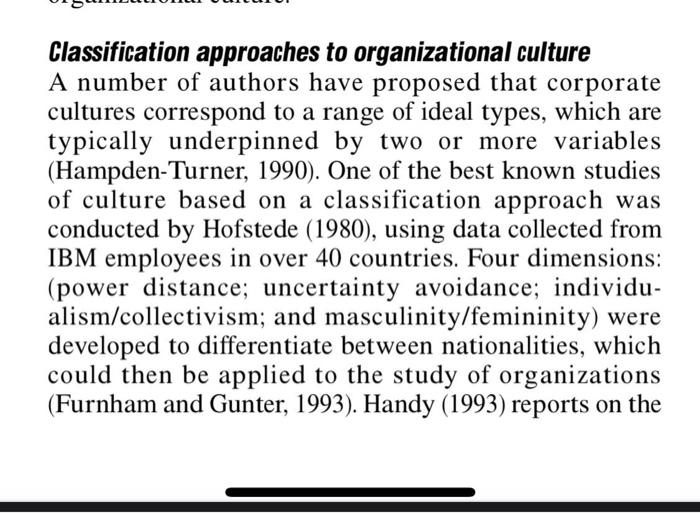
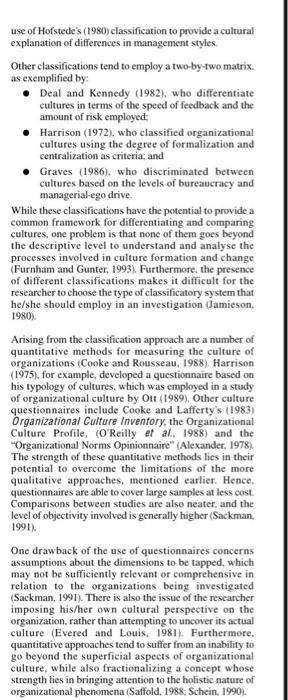
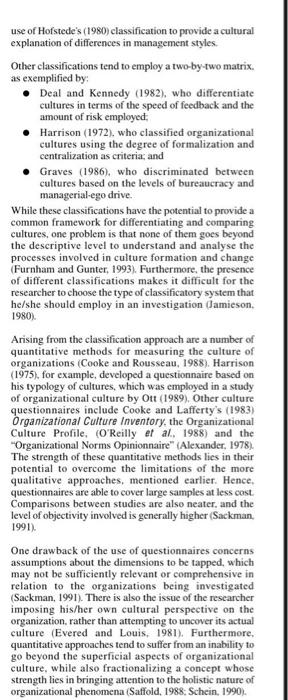
Classification approaches to organizational culture A number of authors have proposed that corporate cultures correspond to a range of ideal types, which are typically underpinned by two or more variables (Hampden-Turner, 1990). One of the best known studies of culture based on a classification approach was conducted by Hofstede (1980), using data collected from IBM employees in over 40 countries. Four dimensions: (power distance; uncertainty avoidance; individu- alism/collectivism; and masculinity/femininity) were developed to differentiate between nationalities, which could then be applied to the study of organizations (Furnham and Gunter, 1993). Handy (1993) reports on the use of Hofstede's (1980) classification to provide a cultural explanation of differences in management styles. Other classifications tend to employ a two-by-two matrix. as exemplified by: Deal and Kennedy (1982), who differentiate cultures in terms of the speed of feedback and the amount of risk employed Harrison (1972), who classified organizational cultures using the degree of formalization and centralization as criteria, and Graves (1986), who discriminated between cultures based on the levels of bureaucracy and managerial-ego drive While these classifications have the potential to provide a common framework for differentiating and comparing cultures, one problem is that none of them goes beyond the descriptive level to understand and analyse the processes involved in culture formation and change Furnham and Gunter, 1993). Furthermore, the presence of different classifications makes it difficult for the researcher to choose the type of classificatory system that he/she should employ in an investigation Jamieson. 1980) Arising from the classification approach are a number of quantitative methods for measuring the culture of organizations (Cooke and Rousseau, 1988). Harrison (1975), for example, developed a questionnaire based on his typology of cultures, which was employed in a study of organizational culture by Out (1989). Other culture questionnaires include Cooke and Lafferty's (1983) Organizational Culture Inventory, the Organizational Culture Profile. (O'Reilly et al. 1988) and the "Organizational Norms Opinionnaire" (Alexander, 1978) The strength of these quantitative methods lies in their potential to overcome the limitations of the more qualitative approaches, mentioned earlier. Hence, questionnaires are able to cover large samples at less cost. Comparisons between studies are also neater, and the level of objectivity involved is generally higher (Sackman, 1991). One drawback of the use of questionnaires concerns assumptions about the dimensions to be tapped, which may not be sufficiently relevant or comprehensive in relation to the organizations being investigated (Sackman, 1991). There is also the issue of the researcher imposing his/her own cultural perspective on the organization, rather than attempting to uncover its actual culture (Evered and Louis. 1981). Furthermore. quantitative approaches tend to suffer from an inability to go beyond the superficial aspects of organizational culture, while also fractionalizing a concept whose strength lies in bringing attention to the holistic nature of organizational phenomena (Saffold, 1988. Schein, 1990). use of Hofstede's (1980) classification to provide a cultural explanation of differences in management styles. Other classifications tend to employ a two-by-two matrix. as exemplified by: Deal and Kennedy (1982), who differentiate cultures in terms of the speed of feedback and the amount of risk employed Harrison (1972), who classified organizational cultures using the degree of formalization and centralization as criteria, and Graves (1986), who discriminated between cultures based on the levels of bureaucracy and managerial-ego drive While these classifications have the potential to provide a common framework for differentiating and comparing cultures, one problem is that none of them goes beyond the descriptive level to understand and analyse the processes involved in culture formation and change Furnham and Gunter, 1993). Furthermore, the presence of different classifications makes it difficult for the researcher to choose the type of classificatory system that he/she should employ in an investigation Jamieson, 1980). Arising from the classification approach are a number of quantitative methods for measuring the culture of organizations (Cooke and Rousseau, 1988). Harrison (1975), for example, developed a questionnaire based on his typology of cultures, which was employed in a study of organizational culture by Out (1989). Other culture questionnaires include Cooke and Lafferty's (1983) Organizational Culture Inventory, the Organizational Culture Profile (O'Reilly et al., 1988) and the "Organizational Norms Opinionnaire" (Alexander, 1978) The strength of these quantitative methods lies in their potential to overcome the limitations of the more qualitative approaches, mentioned earlier. Hence, questionnaires are able to cover large samples at less cost Comparisons between studies are also neater, and the level of objectivity involved is generally higher (Sackman, 1991). One drawback of the use of questionnaires concerns assumptions about the dimensions to be tapped, which may not be sufficiently relevant or comprehensive in relation to the organizations being investigated (Sackman, 1991). There is also the issue of the researcher imposing his/her own cultural perspective on the organization, rather than attempting to uncover its actual culture (Evered and Louis, 1981). Furthermore. quantitative approaches tend to suffer from an inability to go beyond the superficial aspects of organizational culture, while also fractionalizing a concept whose strength lies in bringing attention to the holistic nature of organizational phenomena (Saffold, 1988: Schein, 1990)









 Study Help