







Question: Can you convert this algorithm into a python method using dataframes? I'm looking to double check the efficiency of my algorithm. -Initially, the algorithm is
 Can you convert this algorithm into a python method using dataframes? I'm looking to double check the efficiency of my algorithm.
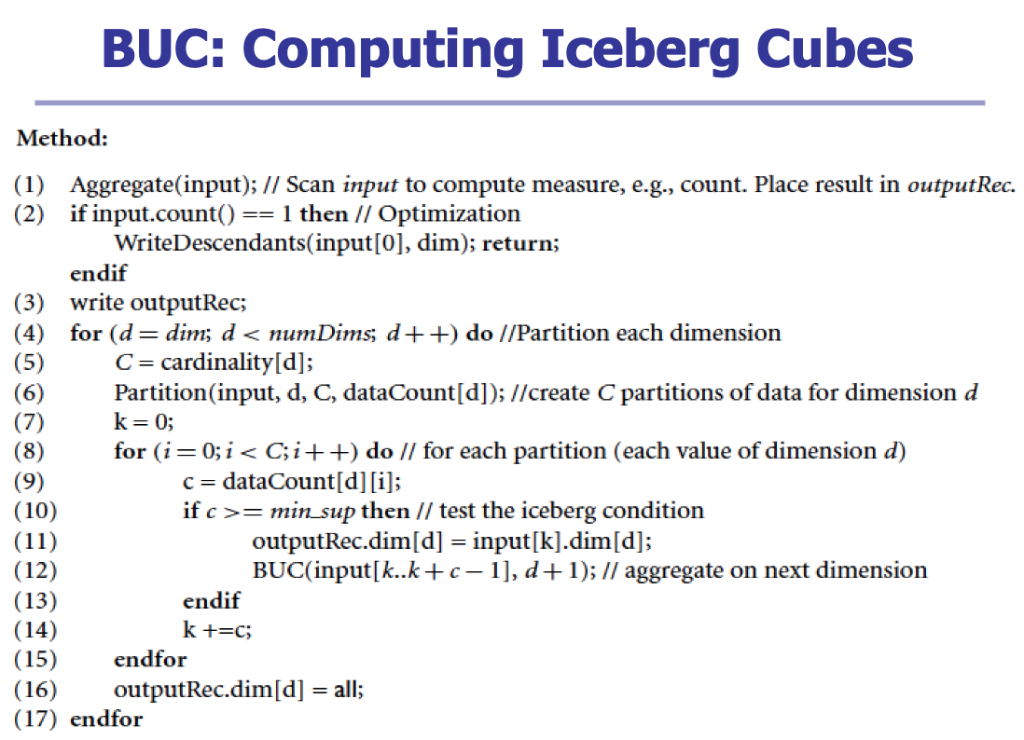
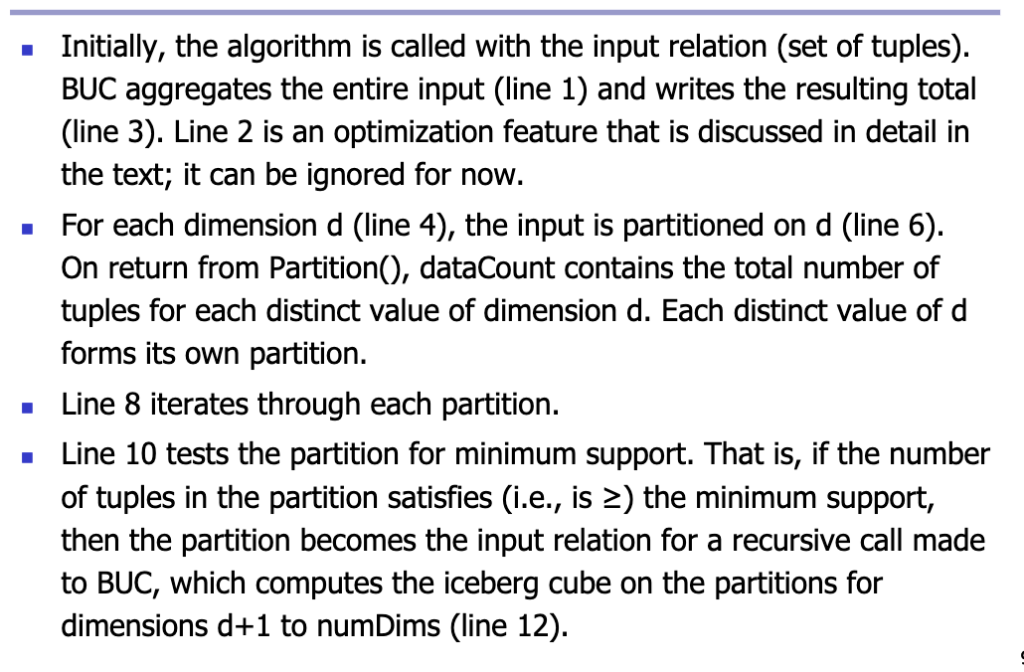
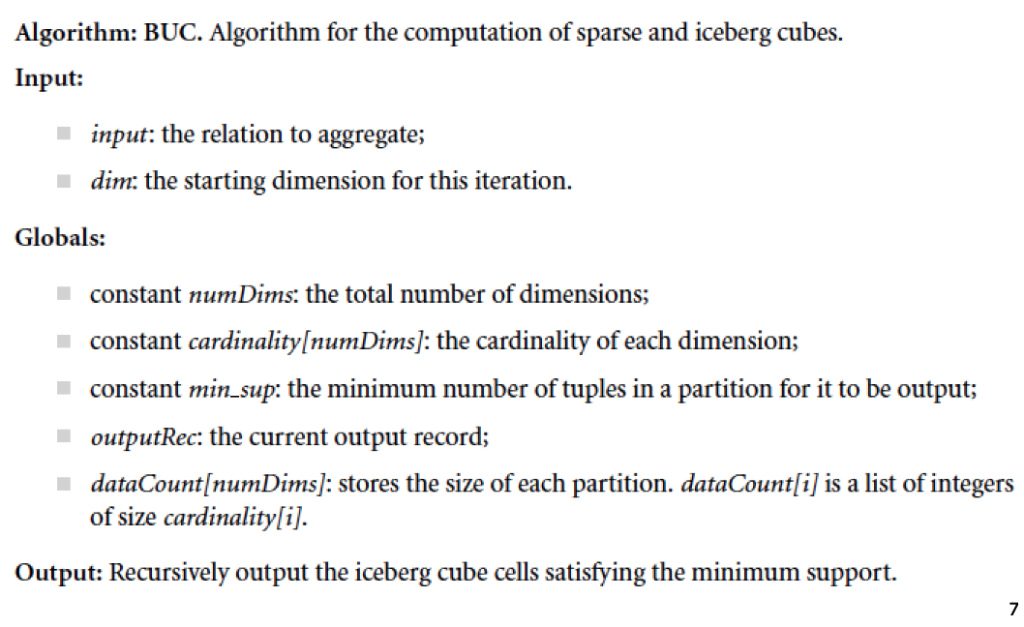
-Initially, the algorithm is called with the input relation (set of tuples). BUC aggregates the entire input (line 1) and writes the resulting total (line 3). Line 2 is an optimization feature that is discussed in detail in the text; it can be ignored for now. For each dimension d (line 4), the input is partitioned on d (line 6). On return from Partition(), dataCount contains the total number of tuples for each distinct value of dimension d. Each distinct value of d forms its own partition. Line 8 iterates through each partition. Line 10 tests the partition for minimum support. That is, if the number of tuples in the partition satisfies (i.e., is 2) the minimum support, then the partition becomes the input relation for a recursive call made to BUC, which computes the iceberg cube on the partitions for dimensions d+1 to numDims (line 12) Algorithm: BUC. Algorithm for the computation of sparse and iceberg cubes. Input: input: the relation to aggregate; dim. the starting dimension for this iteration. Globals: constant numDims: the total number of dimensions; constant cardinality[numDims]: the cardinality of each dimension; constant min sup: the minimum number of tuples in a partition for it to be output; outputRec: the current output record; dataCountlnumDims]: stores the size of each partition. dataCountli] is a list of integers of size cardinalityli]. Output: Recursively output the iceberg cube cells satisfying the minimum support. 7 BUC: Computing Iceberg Cubes Method: (1) Aggregate(input); // Scan input to compute measure, e.g., count. Place result in outputRec. (2) if input.count)1 then // Optimization WriteDescendants(input[0], dim); return; (3) (4) endif write outputRec; for (d- dim; d minsup then // test the iceberg condition (10) outputRec.dim[d] - input[k].dim[d]; BUC(input[k..k +c-1],d+1); aggregate on next dimension (12) (13) (14) (15) endfor (16)outputRec.dim[d] all; (17) endfor endif -Initially, the algorithm is called with the input relation (set of tuples). BUC aggregates the entire input (line 1) and writes the resulting total (line 3). Line 2 is an optimization feature that is discussed in detail in the text; it can be ignored for now. For each dimension d (line 4), the input is partitioned on d (line 6). On return from Partition(), dataCount contains the total number of tuples for each distinct value of dimension d. Each distinct value of d forms its own partition. Line 8 iterates through each partition. Line 10 tests the partition for minimum support. That is, if the number of tuples in the partition satisfies (i.e., is 2) the minimum support, then the partition becomes the input relation for a recursive call made to BUC, which computes the iceberg cube on the partitions for dimensions d+1 to numDims (line 12) Algorithm: BUC. Algorithm for the computation of sparse and iceberg cubes. Input: input: the relation to aggregate; dim. the starting dimension for this iteration. Globals: constant numDims: the total number of dimensions; constant cardinality[numDims]: the cardinality of each dimension; constant min sup: the minimum number of tuples in a partition for it to be output; outputRec: the current output record; dataCountlnumDims]: stores the size of each partition. dataCountli] is a list of integers of size cardinalityli]. Output: Recursively output the iceberg cube cells satisfying the minimum support. 7 BUC: Computing Iceberg Cubes Method: (1) Aggregate(input); // Scan input to compute measure, e.g., count. Place result in outputRec. (2) if input.count)1 then // Optimization WriteDescendants(input[0], dim); return; (3) (4) endif write outputRec; for (d- dim; d minsup then // test the iceberg condition (10) outputRec.dim[d] - input[k].dim[d]; BUC(input[k..k +c-1],d+1); aggregate on next dimension (12) (13) (14) (15) endfor (16)outputRec.dim[d] all; (17) endfor endif
Step by Step Solution
There are 3 Steps involved in it

Get step-by-step solutions from verified subject matter experts
 Study Help