Question: can you help me also intergrate it with this Dis 3 Psych 350 Social What Makes Us Tick? Title: Reconciling Cognitive Dissonance: Aligning Attitudes and
can you help me also intergrate it with this
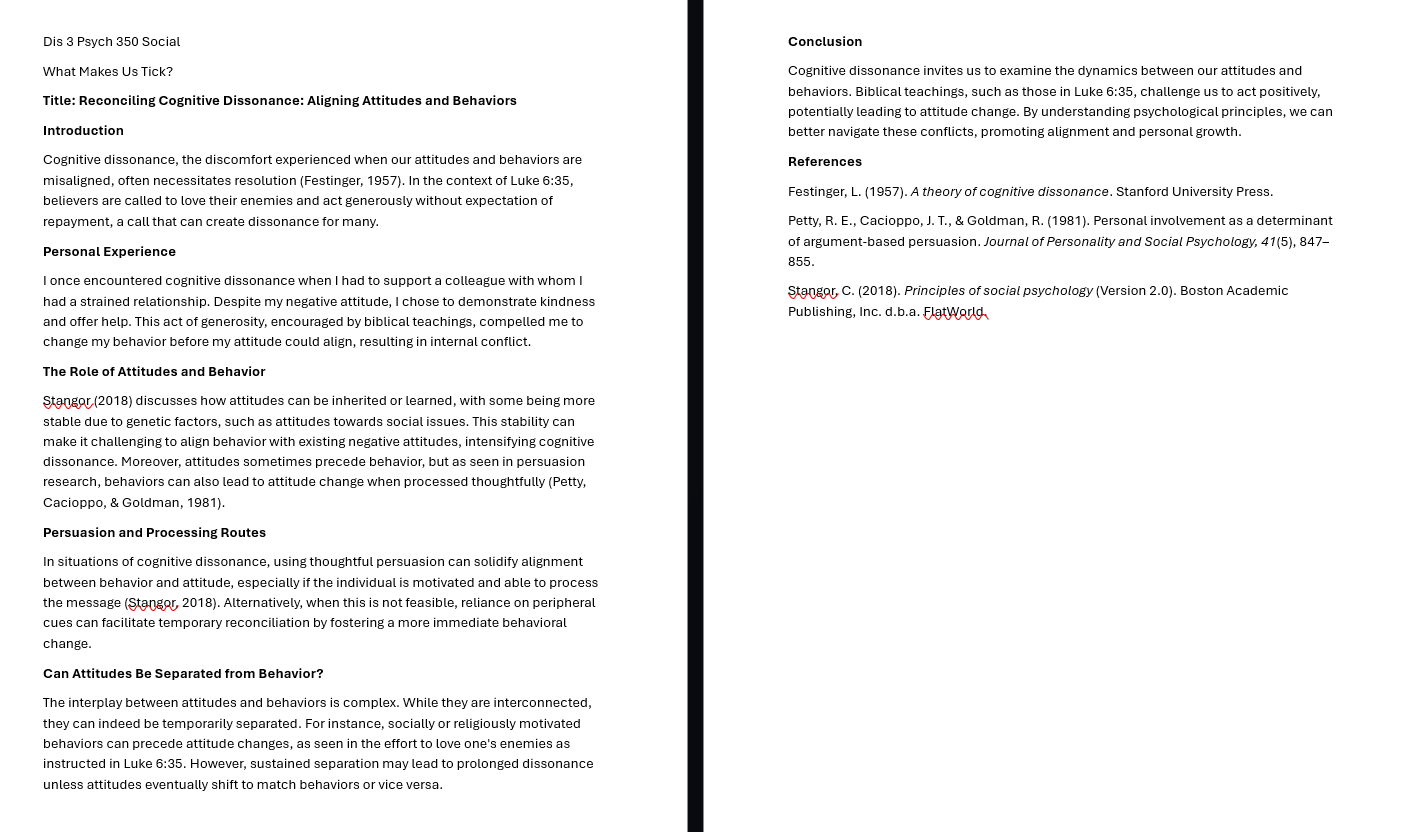
Dis 3 Psych 350 Social What Makes Us Tick? Title: Reconciling Cognitive Dissonance: Aligning Attitudes and Behaviors Introduction Cognitive dissonance, the discomfort experienced when our attitudes and behaviors are misaligned, often necessitates resolution (Festinger, 1957). In the context of Luke 6:35, believers are called to love their enemies and act generously without expectation of repayment, a call that can create dissonance for many. Personal Experience lonce encountered cognitive dissonance when | had to support a colleague with whom | had a strained relationship. Despite my negative attitude, | chose to demonstrate kindness and offer help. This act of generosity, encouraged by biblical teachings, compelled me to change my behavior before my attitude could align, resulting in internal conflict. The Role of Attitudes and Behavior Stenger(2018) discusses how attitudes can be inherited or learned, with some being more stable due to genetic factors, such as attitudes towards social issues. This stability can make it challenging to align behavior with existing negative attitudes, intensifying cognitive dissonance. Moreover, attitudes sometimes precede behavior, but as seen in persuasion research, behaviors can also lead to attitude change when processed thoughtfully (Petty, Cacioppo, & Goldman, 1981). Persuasion and Processing Routes. In situations of cognitive dissonance, using thoughtful persuasion can solidify alignment between behavior and attitude, especially if the individual is motivated and able to process the message (Stanger, 2018). Alternatively, when this is not feasible, reliance on peripheral cues can facilitate temporary reconciliation by fostering a more immediate behavioral change. Can Attitudes Be Separated from Behavior? The interplay between attitudes and behaviors is complex. While they are interconnected, they can indeed be temporarily separated. For instance, socially or religiously motivated behaviors can precede attitude changes, as seen in the effort to love one's enemies as instructed in Luke 6:35. However, sustained separation may lead to prolonged dissonance unless attitudes eventually shift to match behaviors or vice versa. Conclusion Cognitive dissonance invites us to examine the dynamics between our attitudes and behaviors. Biblical teachings, such as those in Luke 6:35, challenge us to act positively, potentially leading to attitude change. By understanding psychological principles, we can better navigate these conflicts, promoting alignment and personal growth. References Festinger, L. (1957). A theory of cognitive dissonance. Stanford University Press. Petty, R. E., Cacioppo, J. T., & Goldman, R. (1981). Personal involvement as a determinant of argument-based persuasion. Journal of Personality and Social Psychology, 41(5), 847- 855. Stangor, C. (2018). Principles of social psychology (Version 2.0). Boston Academic Publishing, Inc. d.b.a. ElatWarkd









 Study Help