







Question: Can you help me with section 2 This is the first part of my Annotated bibliography Section 1:? Injuries in youth soccer: A review of
Can you help me with section 2
This is the first part of my Annotated bibliography Section
1:?
Injuries in youth soccer: A review of the literature. Sports Medicine, 45(2), 141-152.?This source is an academic journal article, published in the journal Sports Medicine, by Steven Merritt. The author is a professor of exercise science and specializes in the study of sports injuries. In this article, the author reviews the literature on injuries in youth soccer, including the incidence and risk factors, prevention strategies, and treatment options. The author argues that, although the incidence of injuries in youth soccer is relatively low, more research is needed to identify the most effective injury prevention strategies. This article is highly relevant and credible, and provides a comprehensive overview of the current research on injuries in youth soccer. This article is an appropriate source for my research question, as it provides an overview of the literature on youth soccer injuries and prevention strategies. I could use this source to gain an understanding of the current research on youth soccer injuries, and to identify potential sources for further research.
Source 2:?Fleming, B., & Nelson, A. (2012). Understanding youth soccer injuries: A guide for coaches, parents and physicians. Pediatrics, 129(2), e492-e498.?This source is an academic journal article, published in the journal Pediatrics, by Brian Fleming and Andrew Nelson. The authors are medical professionals with expertise in the study of youth sports injuries. In this article, the authors provide an overview of the most common injuries in youth soccer, as well as effective strategies for coaches, parents, and physicians to help prevent injuries. The authors argue that, by understanding the risks of youth soccer and taking the necessary precautions, these injuries can be minimized. This article is highly relevant and credible, and provides a comprehensive overview of the most common injuries in youth soccer and effective strategies for prevention. This article is an appropriate source for my research question, as it provides an overview of the most common injuries in youth soccer and strategies for prevention. I could use this source to gain an understanding of the most common injuries in youth soccer and strategies for prevention, as well as to identify potential sources for further research.
Source 3:?Larsson, P., & Ekstrand, J. (2012). Soccer injuries in youth players. British Journal of Sports Medicine, 46(15), 1045-1050.?This source is an academic journal article, published in the British Journal of Sports Medicine, by Per Larsson and Jan Ekstrand. The authors are medical professionals with expertise in the study of youth sports injuries. In this article, the authors provide an overview of the patterns and risk factors for soccer injuries in youth players. The authors argue that, by understanding the patterns and risk factors of youth soccer injuries, these injuries can be prevented or minimized. This article is highly relevant and credible, and provides a comprehensive overview of the patterns and risk factors of youth soccer injuries. This article is an appropriate source for my research question, as it provides an overview of the patterns and risk factors of youth soccer injuries. I could use this source to gain an understanding of the patterns and risk factors of youth soccer injuries, as well as to identify potential sources for further research.
Source 4:?Scheidt, S., & Thomas, S. (2018). Soccer safety: A review of injury prevention strategies. Sports Medicine, 48(12), this Ann
https://www.soccertoday.com/john-osullivan-changing-soccer-for-the-better/
https://publications.aap.org/pediatrics/article/125/2/410/72058/Injuries-in-Youth-Soccer?autologincheck=redirected
i need help with section 2
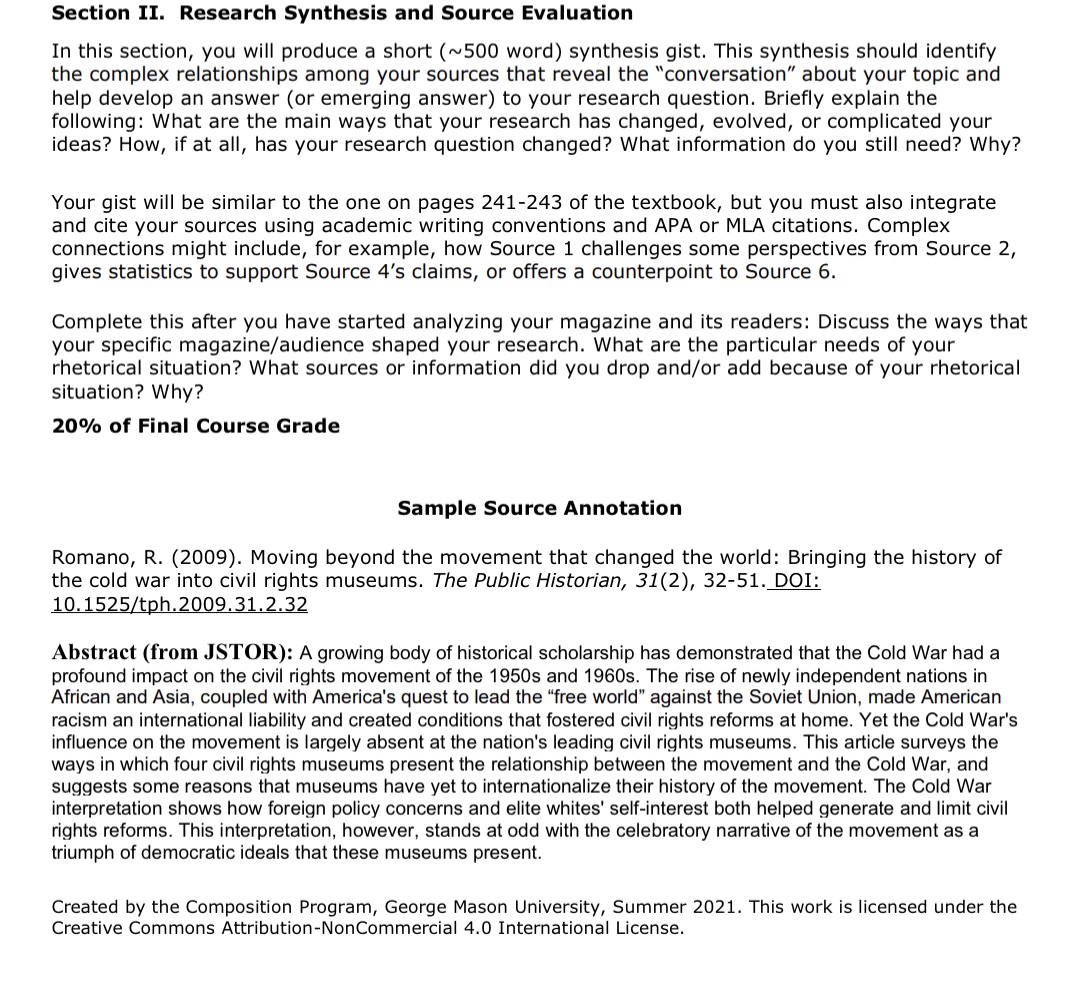
Section II. Research Synthesis and Source Evaluation In this section, you will produce a short (~500 word) synthesis gist. This synthesis should identify the complex relationships among your sources that reveal the \"conversation" about your topic and help develop an answer (or emerging answer) to your research question. Briefly explain the following: What are the main ways that your research has changed, evolved, or complicated your ideas? How, if at all, has your research question changed? What information do you still need? Why? Your gist will be similar to the one on pages 241-243 of the textbook, but you must also integrate and cite your sources using academic writing conventions and APA or MLA citations. Complex connections might include, for example, how Source 1 challenges some perspectives from Source 2, gives statistics to support Scurce 4's claims, or offers a counterpoint to Source 6. Complete this after you have Started analyzing your magazine and its readers: Discuss the ways that your specific magazine/audience shaped your research. What are the partiCUlar needs of y0ur rhetorical situation? What sources or information did you drop and/or add because of your rhetorical situation? Why? 20% of Final Course Grade Sample Source Annotation Romano, R. (2009}. Moving beyond the movement that changed the world: Bringing the history of the cold war into civil rights museums. The Public Historian, 31(2), 32-51. DDI: 10.1525/tph.2009.31.2.32 Abstract {from JSTOR): A growing body of historical scholarship has demonstrated that the Cold War had a profound impact on the civil rights movement of the 19505 and 1960s The rise of newly independent nations in African and Asia, coupled with America's quest to lead the \"free world\" against the Soviet Union, made American racism an international liability and created conditions that fostered civil rights reforms at home. Yet the Cold War's influence on the movement is largely absent at the nation's leading civil rights museums. This article surveys the ways in which four civil rights museums present the relationship between the movement and the Cold War, and suggests some reasons that museums have yet to internationalize their history of the movement. The Cold War interpretation shows how foreign policy concerns and elite whites' self-interest both helped generate and limit civil rights reforms. This interpretation, however, stands at odd with the celebratory narrative of the movement as a triumph of democratic ideals that these museums present. Created by the Composition Program, George Mason University, Summer 2021. This work is licensed under the Creative Commons AttributionNonCommercial 4.0 International License
Step by Step Solution
There are 3 Steps involved in it

Get step-by-step solutions from verified subject matter experts
 Study Help