







Question: can you help solve this |Hints for Working on this Assignment This exercises is a bit like solving a puzzle. First, you do the easy
can you help solve this
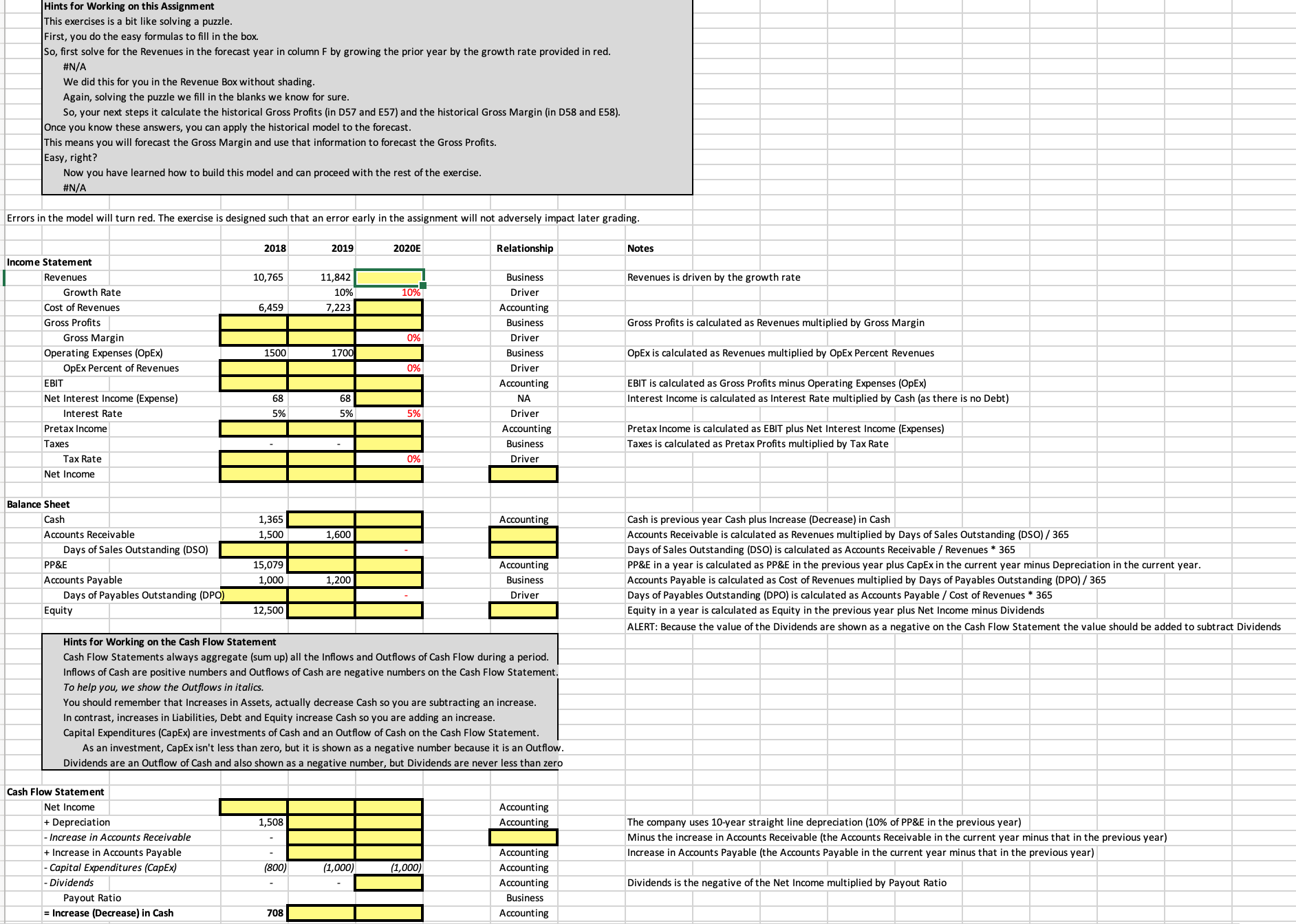
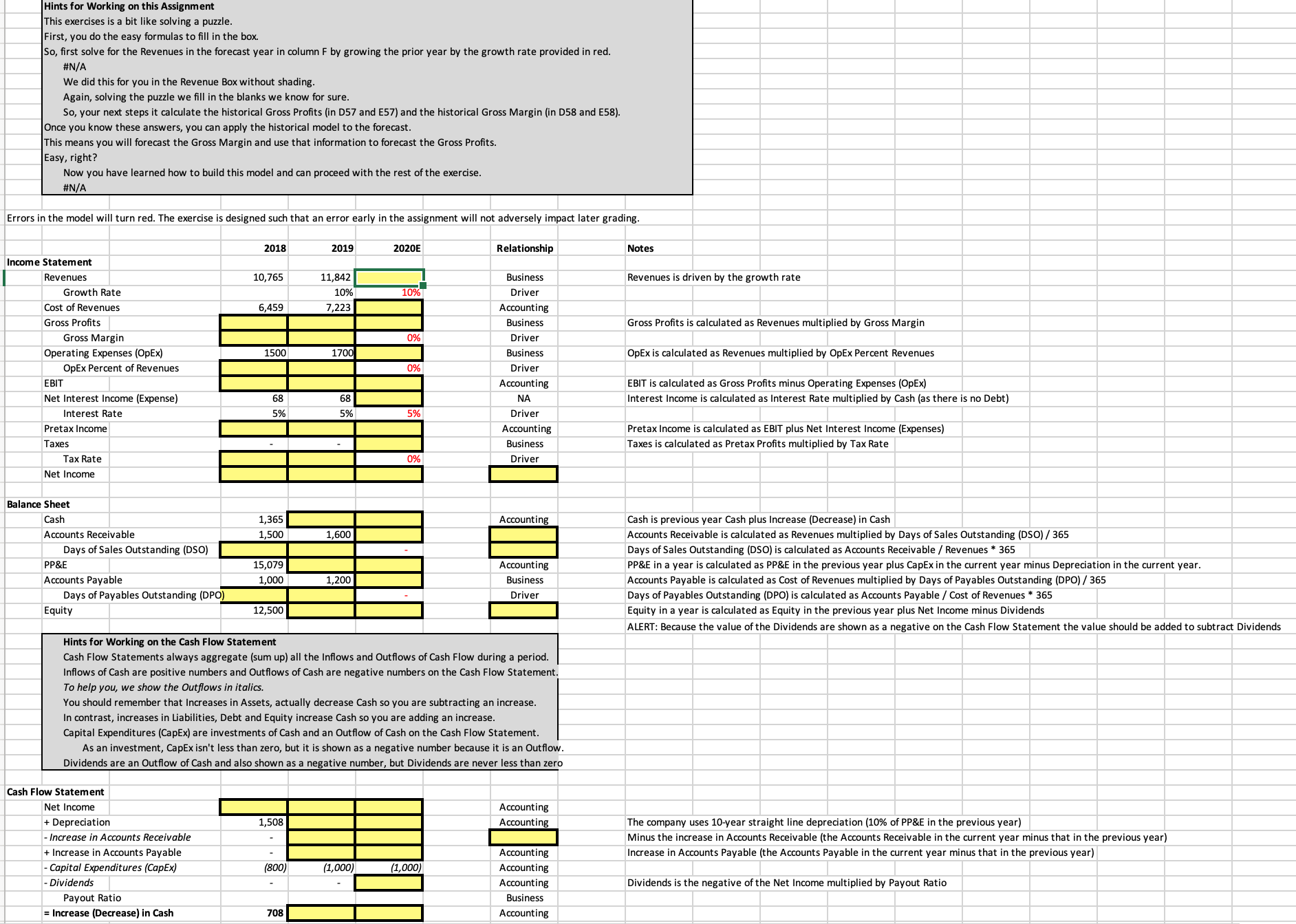
|Hints for Working on this Assignment This exercises is a bit like solving a puzzle. First, you do the easy formulas to fill in the box. So, first solve for the Revenues in the forecast year in column F by growing the prior year by the growth rate provided in red. #N/A We did this for you in the Revenue Box without shading. Again, solving the puzzle we fill in the blanks we know for sure. So, your next steps it calculate the historical Gross Profits (in D57 and E57) and the historical Gross Margin (in D58 and E58). Once you know these answers, you can apply the historical model to the forecast. This means you will forecast the Gross Margin and use that information to forecast the Gross Profits. Easy, right? Now you have learned how to build this model and can proceed with the rest of the exercise. #N/A Errors in the model will turn red. The exercise is designed such that an error early in the assignment will not adversely impact later grading. 2018 2019 2020E Relationship Notes Income Statement Revenues 10,765 11,842 Business Revenues is driven by the growth rate Growth Rate 10% 10% Drive Cost of Revenues 6,459 7,223 Accounting Gross Profits Business Gross Profits is calculated as Revenues multiplied by Gross Margin Gross Margin Driver Operating Expenses (OpEx) 1500 1700 Business OpEx is calculated as Revenues multiplied by OpEx Percent Revenues OpEx Percent of Revenues 0% Driver EBIT Accounting EBIT is calculated as Gross Profits minus Operating Expenses (OpEx) Net Interest Income (Expense) Interest Rate 68 5% 68 NA Interest Income is calculated as Interest Rate multiplied by Cash (as there is no Debt) Driver Pretax Income Accounting Pretax Income is calculated as EBIT plus Net Interest Income (Expenses) Taxes Business Taxes is calculated as Pretax Profits multiplied by Tax Rate Tax Rate Driver Net Income Balance Sheet Cast 1,365 Accounting Cash is previous year Cash plus Increase (Decrease) in Cash Accounts Receivable 1,500 1,60 Accounts Receivable is calculated as Revenues multiplied by Days of Sales Outstanding (DSO) / 365 Days of Sales Outstanding (DSO) Days of Sales Outstanding (DSO) is calculated as Accounts Receivable / Revenues * 365 PP&E 15,079 Accounting PP&E in a year is calculated as PP&E in the previous year plus CapEx in the current year minus Depreciation in the current year. Accounts Payable 1,000 1,200 Business Accounts Payable is calculated as Cost of Revenues multiplied by Days of Payables Outstanding (DPO) / 365 Days of Payables Outstanding (DPO) Driver Days of Payables Outstanding (DPO) is calculated as Accounts Payable / Cost of Revenues * 365 Equity .2,500 Equity in a year is calculated as Equity in the previous year plus Net Income minus Dividends ALERT: Because the value of the Dividends are shown as a negative on the Cash Flow Statement the value should be added to subtract Dividends Hints for Working on the Cash Flow Statement Cash Flow Statements always aggregate (sum up) all the Inflows and Outflows of Cash Flow during a period. Inflows of Cash are positive numbers and Outflows of Cash are negative numbers on the Cash Flow Statement. To help you, we show the Outflows in italics. You should remember that Increases in Assets, actually decrease Cash so you are subtracting an increase. In contrast, increases in Liabilities, Debt and Equity increase Cash so you are adding an increase Capital Expenditures (CapEx) are investments of Cash and an Outflow of Cash on the Cash Flow Statement. As an investment, CapEx isn't less than zero, but it is shown as a negative number because it is an Outflow Dividends are an Outflow of Cash and also shown as a negative number, but Dividends are never less than zero Cash Flow Statement Net Income Accounting + Depreciation 1,508 Accounting The company uses 10-year straight line depreciation (10% of PP&E in the previous year) - Increase in Accounts Receivable Minus the increase in Accounts Receivable (the Accounts Receivable in the current year minus that in the previous year) + Increase in Accounts Payable Accounting Increase in Accounts Payable (the Accounts Payable in the current year minus that in the previous year) Capital Expenditures (CapEx) (800) (1,000) (1,000) Accounting Dividends Accounting Dividends is the negative of the Net Income multiplied by Payout Ratio Payout Ratio Business Increase (Decrease) in Cash 708 Accounting
Step by Step Solution
There are 3 Steps involved in it

Get step-by-step solutions from verified subject matter experts
 Study Help