







Question: can you just answer #5 please 5. Calculate the initial concentrations of iodide, [1] ]0, and peroxydisulfate, [S2O32]0, for each experiment. 6. Beginning on a

![iodide, [1] ]0, and peroxydisulfate, [S2O32]0, for each experiment. 6. Beginning on](https://dsd5zvtm8ll6.cloudfront.net/si.experts.images/questions/2024/09/66f838ab9f947_46766f838ab43637.jpg)
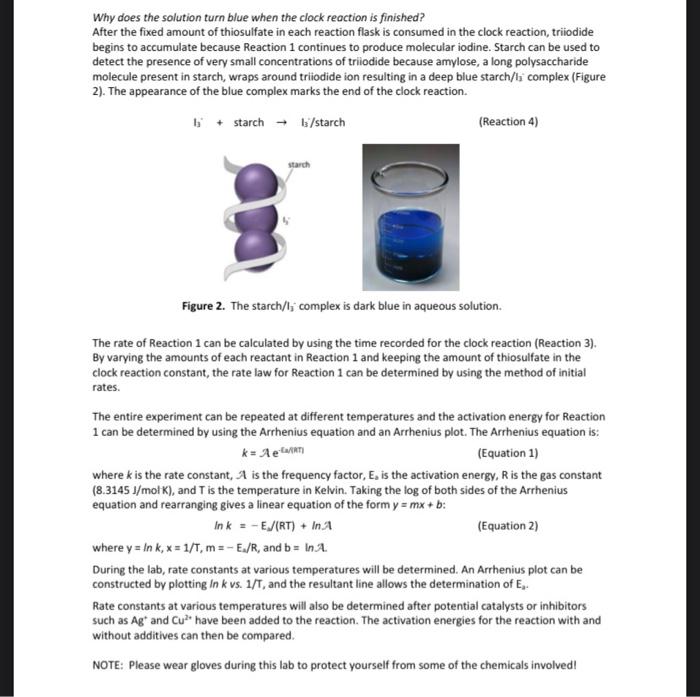
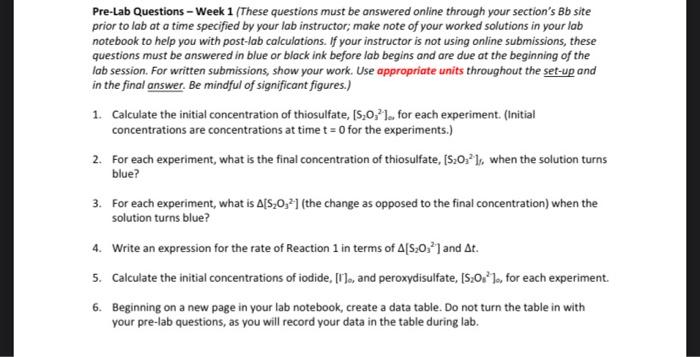
5. Calculate the initial concentrations of iodide, [1] ]0, and peroxydisulfate, [S2O32]0, for each experiment. 6. Beginning on a new page in your lab notebook, create a data table. Do not turn the table in with your pre-lab questions, as you will record your data in the table during lab. Intreduction in thit eaperiment, winetici of the reaction beteeen iobide ion and pwerydsultaen ion (Pruction 1) will be studied. The rate law will be determined by usine the method of incial rases and the actuvion energies with and withost catalyst will be determined by cosestructing Aertenias plets. 21+502+4+250y2 flextion 11) The rate of Reaction 1 is dependent upon the concentrations of iodibe and pemorithaftate and can be decectibed by the followint eeneral rate law: RateiifrisioyF where is as the rate constant, m is the order of the reaction whe respect to the concentrucion of iodide und n is the erder of the reaction with respect to the concentrition of perondoufter. Her fint part of this experiment ifrolves determining the eate constant, 1 , as well as the seactoen orden, m and a for feaction 1. Both reactanti and preducts in kraction 1 are colorless, se is is dmeut sp follow the progress of the reaction without special instruments, however the fixaction can be fellowed indrecby by obverving the acoompanying reaction between iodine and iodide. Principles of Chemistry ut Lab Molecular iodine is a product of Reaction 1, tut the presence of eacess iodide in the flack results in immediate formation of triodial ion \{Zeaction 2\}. b+ib Mexction 2 ) The rate of triodise formution, and thereby the rate of molecular iodine formution con be followed and used as an indirect measure of the main reaction rate. The reaction woed to medare the ratte of briedide formation is a cleck ricorfion, The lodine clock uned in this esperimest in vingly a iery tast reaction between triodide and thiowillate fReaction 33. 4:+25025023t (Reaction ) A faed amourt of thiotultate is preient in each reaction flat, and the amewnt of time it tules for the thiosullate to be consumied serves as a "timer" or "clock" indicating how paiclty Reuttion 1 tales place. When the teactant selutions are maxd, the solution nemain clear and colerles for some tine becaste al in that is beine peoduced in being conumed by thiosultate. When the thiondlate is comeletely used up, the solvion fyens blue. Becture the amoint of thietulfate in Meaction 3 is tonstant for every teperimental trak, the tincit hater 1 produces molecular iedine very euidly, then the faed amount of tiovidtate wilf be cemsed very quially and a fatt reaztion rase will be meaiured. Cotverselg, it Reaction 1 is stow and praducn iodine dowly, theo the thiouldate will be uled up more sloily teluting in a dew inkmion rate. This can be used to menitor the kinetici of kiation 1 becaus triodide lomution (Reaction a) and the dock reaction (Reaction 3) occur essentially inctantaneounly compared to Reaction 1. in tact, ahen the ciock reaction ia finiahed, only a small percentage of reactasti in keurfion 1 have been conewted to products; the concentration of reactants is esientially constant. Why does the solution turn blue when the clock reaction is finished? After the fixed amount of thiosulfate in each reaction flask is consumed in the clock reaction, triiodide begins to accumulate because Reaction 1 continues to produce molecular iodine. Starch can be used to detect the presence of very small concentrations of triodide because amylose, a long polysaccharide molecule present in starch, wraps around triiodide ion resulting in a deep blue starch/li complex (Figure 2). The appearance of the blue complex marks the end of the clock reaction. (Reaction 4) Figure 2. The starch /13 complex is dark blue in aqueous solution. The rate of Reaction 1 can be calculated by using the time recorded for the clock reaction (Reaction 3). By varying the amounts of each reactant in Reaction 1 and keeping the amount of thiosulfate in the clock reaction constant, the rate law for Reaction 1 can be determined by using the method of initial rates. The entire experiment can be repeated at different temperatures and the activation energy for Reaction 1 can be determined by using the Arrhenius equation and an Arrhenius plot. The Arrhenius equation is: k=ekankn (Equation 1) where k is the rate constant, A is the frequency factor, E2 is the activation energy, R is the gas constant (8.3145 J/molK ), and T is the temperature in Kelvin. Taking the log of both sides of the Arrhenius equation and rearranging gives a linear equation of the form y=mx+b : lnk=EJ/(RT)+lnA (Equation 2) where y=lnk,x=1/T,m=E/R, and b=lnA. During the lab, rate constants at various temperatures will be determined. An Arrhenius plot can be constructed by plotting in kvs.1/T, and the resultant line allows the determination of E2. Rate constants at various temperatures will also be determined after potential catalysts or inhibitors such as Ag+and Cu2+ have been added to the reaction. The activation energies for the reaction with and without additives can then be compared. NOTE: Please wear gloves during this lab to protect yourself from some of the chemicals involvedl Pre-Lab Questions - Week 1 (These questions must be answered online through your section's Bb site prior to lab ot a time specified by your lab instructor; make note of your worked solutions in your lab notebook to help you with post-lab calculations. If your instructor is not using online submissions, these questions must be answered in blue or black ink before lab begins and are due at the beginning of the lab session. For written submissions, show your work. Use appropriate units throughout the set-up and in the final answer. Be mindful of significant figures.) 1. Calculate the initial concentration of thiosulfate, [S2O32]o, for each experiment. (Initial concentrations are concentrations at time t=0 for the experiments.) 2. For each experiment, what is the final concentration of thiosulfate, [S2O32]5, when the solution turns blue? 3. For each experiment, what is [S2O32] (the change as opposed to the final concentration) when the solution turns blue? 4. Write an expression for the rate of Reaction 1 in terms of [S2O32] and t. 5. Calculate the initial concentrations of iodide, [I] ]0, and peroxydisulfate, [S2O12]0, for each experiment. 6. Beginning on a new page in your lab notebook, create a data table. Do not turn the table in with your pre-lab questions, as you will record your data in the table during lab. 5. Calculate the initial concentrations of iodide, [1] ]0, and peroxydisulfate, [S2O32]0, for each experiment. 6. Beginning on a new page in your lab notebook, create a data table. Do not turn the table in with your pre-lab questions, as you will record your data in the table during lab. Intreduction in thit eaperiment, winetici of the reaction beteeen iobide ion and pwerydsultaen ion (Pruction 1) will be studied. The rate law will be determined by usine the method of incial rases and the actuvion energies with and withost catalyst will be determined by cosestructing Aertenias plets. 21+502+4+250y2 flextion 11) The rate of Reaction 1 is dependent upon the concentrations of iodibe and pemorithaftate and can be decectibed by the followint eeneral rate law: RateiifrisioyF where is as the rate constant, m is the order of the reaction whe respect to the concentrucion of iodide und n is the erder of the reaction with respect to the concentrition of perondoufter. Her fint part of this experiment ifrolves determining the eate constant, 1 , as well as the seactoen orden, m and a for feaction 1. Both reactanti and preducts in kraction 1 are colorless, se is is dmeut sp follow the progress of the reaction without special instruments, however the fixaction can be fellowed indrecby by obverving the acoompanying reaction between iodine and iodide. Principles of Chemistry ut Lab Molecular iodine is a product of Reaction 1, tut the presence of eacess iodide in the flack results in immediate formation of triodial ion \{Zeaction 2\}. b+ib Mexction 2 ) The rate of triodise formution, and thereby the rate of molecular iodine formution con be followed and used as an indirect measure of the main reaction rate. The reaction woed to medare the ratte of briedide formation is a cleck ricorfion, The lodine clock uned in this esperimest in vingly a iery tast reaction between triodide and thiowillate fReaction 33. 4:+25025023t (Reaction ) A faed amourt of thiotultate is preient in each reaction flat, and the amewnt of time it tules for the thiosullate to be consumied serves as a "timer" or "clock" indicating how paiclty Reuttion 1 tales place. When the teactant selutions are maxd, the solution nemain clear and colerles for some tine becaste al in that is beine peoduced in being conumed by thiosultate. When the thiondlate is comeletely used up, the solvion fyens blue. Becture the amoint of thietulfate in Meaction 3 is tonstant for every teperimental trak, the tincit hater 1 produces molecular iedine very euidly, then the faed amount of tiovidtate wilf be cemsed very quially and a fatt reaztion rase will be meaiured. Cotverselg, it Reaction 1 is stow and praducn iodine dowly, theo the thiouldate will be uled up more sloily teluting in a dew inkmion rate. This can be used to menitor the kinetici of kiation 1 becaus triodide lomution (Reaction a) and the dock reaction (Reaction 3) occur essentially inctantaneounly compared to Reaction 1. in tact, ahen the ciock reaction ia finiahed, only a small percentage of reactasti in keurfion 1 have been conewted to products; the concentration of reactants is esientially constant. Why does the solution turn blue when the clock reaction is finished? After the fixed amount of thiosulfate in each reaction flask is consumed in the clock reaction, triiodide begins to accumulate because Reaction 1 continues to produce molecular iodine. Starch can be used to detect the presence of very small concentrations of triodide because amylose, a long polysaccharide molecule present in starch, wraps around triiodide ion resulting in a deep blue starch/li complex (Figure 2). The appearance of the blue complex marks the end of the clock reaction. (Reaction 4) Figure 2. The starch /13 complex is dark blue in aqueous solution. The rate of Reaction 1 can be calculated by using the time recorded for the clock reaction (Reaction 3). By varying the amounts of each reactant in Reaction 1 and keeping the amount of thiosulfate in the clock reaction constant, the rate law for Reaction 1 can be determined by using the method of initial rates. The entire experiment can be repeated at different temperatures and the activation energy for Reaction 1 can be determined by using the Arrhenius equation and an Arrhenius plot. The Arrhenius equation is: k=ekankn (Equation 1) where k is the rate constant, A is the frequency factor, E2 is the activation energy, R is the gas constant (8.3145 J/molK ), and T is the temperature in Kelvin. Taking the log of both sides of the Arrhenius equation and rearranging gives a linear equation of the form y=mx+b : lnk=EJ/(RT)+lnA (Equation 2) where y=lnk,x=1/T,m=E/R, and b=lnA. During the lab, rate constants at various temperatures will be determined. An Arrhenius plot can be constructed by plotting in kvs.1/T, and the resultant line allows the determination of E2. Rate constants at various temperatures will also be determined after potential catalysts or inhibitors such as Ag+and Cu2+ have been added to the reaction. The activation energies for the reaction with and without additives can then be compared. NOTE: Please wear gloves during this lab to protect yourself from some of the chemicals involvedl Pre-Lab Questions - Week 1 (These questions must be answered online through your section's Bb site prior to lab ot a time specified by your lab instructor; make note of your worked solutions in your lab notebook to help you with post-lab calculations. If your instructor is not using online submissions, these questions must be answered in blue or black ink before lab begins and are due at the beginning of the lab session. For written submissions, show your work. Use appropriate units throughout the set-up and in the final answer. Be mindful of significant figures.) 1. Calculate the initial concentration of thiosulfate, [S2O32]o, for each experiment. (Initial concentrations are concentrations at time t=0 for the experiments.) 2. For each experiment, what is the final concentration of thiosulfate, [S2O32]5, when the solution turns blue? 3. For each experiment, what is [S2O32] (the change as opposed to the final concentration) when the solution turns blue? 4. Write an expression for the rate of Reaction 1 in terms of [S2O32] and t. 5. Calculate the initial concentrations of iodide, [I] ]0, and peroxydisulfate, [S2O12]0, for each experiment. 6. Beginning on a new page in your lab notebook, create a data table. Do not turn the table in with your pre-lab questions, as you will record your data in the table during lab
Step by Step Solution
There are 3 Steps involved in it

Get step-by-step solutions from verified subject matter experts
 Study Help