







Question: Can you please answer question 11 and 13 and B do 11. Consecutive integers are whole numbers that follow each other. For example: 5, 6,
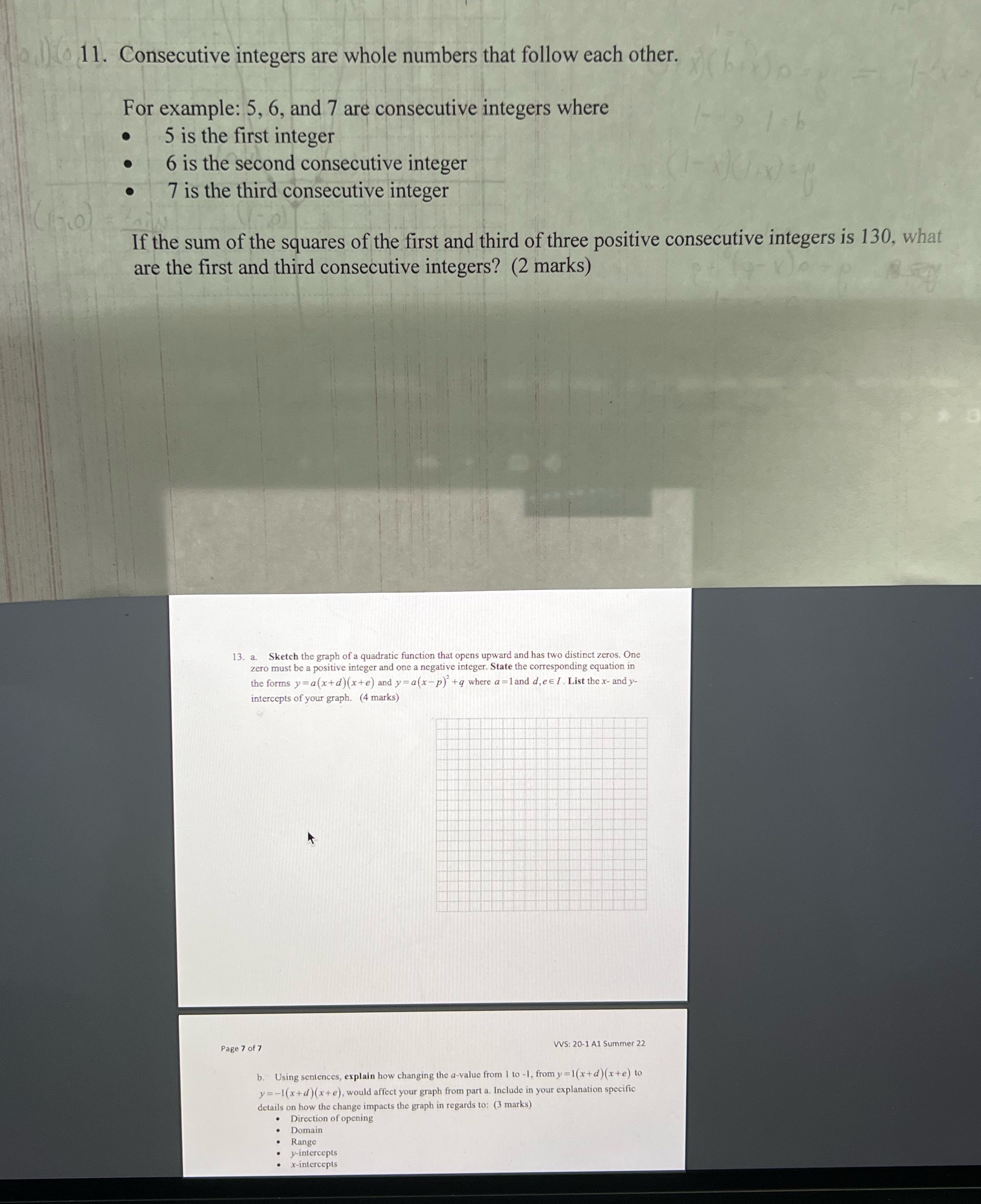
Can you please answer question 11 and 13 and B
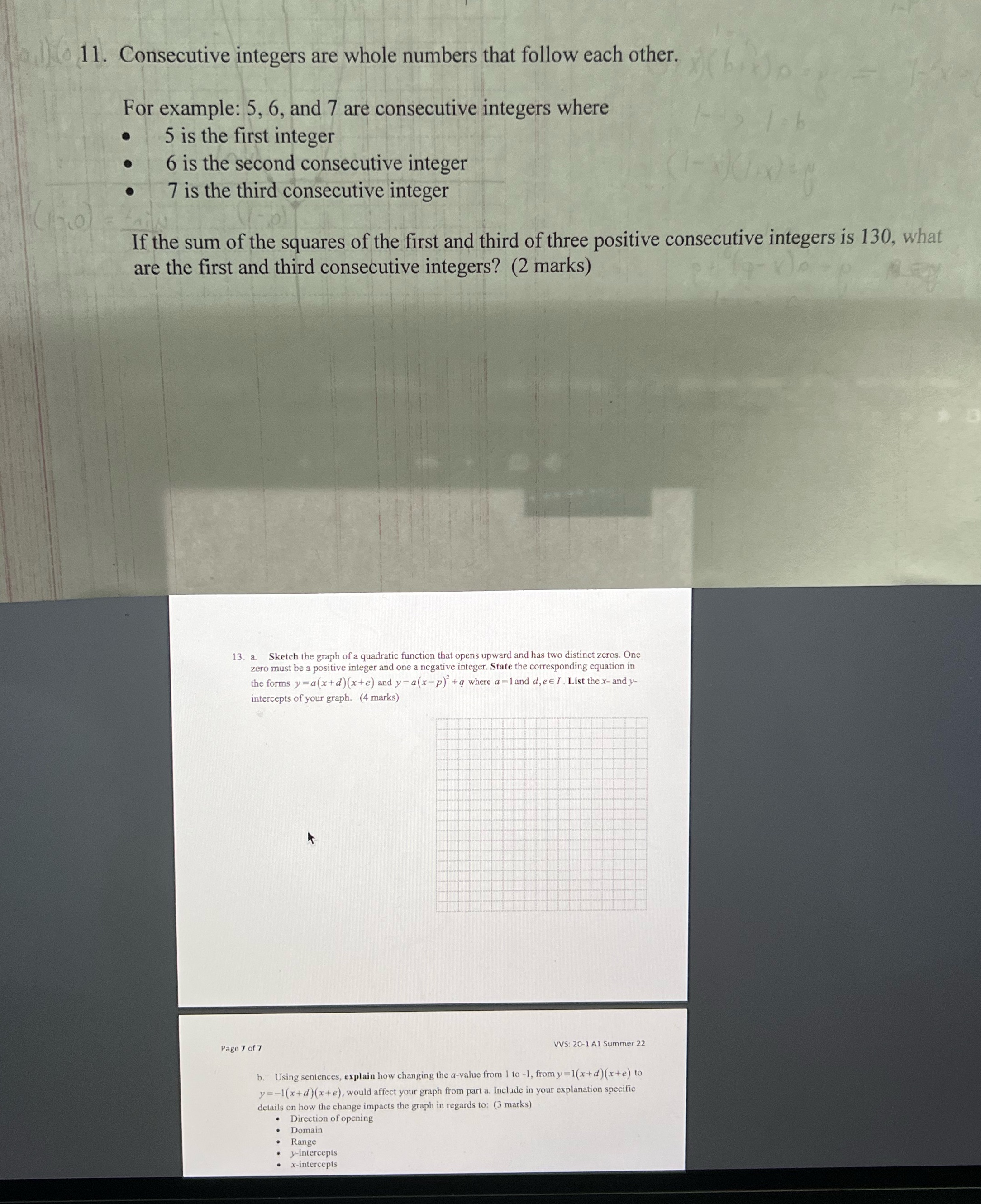
do 11. Consecutive integers are whole numbers that follow each other. For example: 5, 6, and 7 are consecutive integers where 5 is the first integer 1- 16 6 is the second consecutive integer 7 is the third consecutive integer If the sum of the squares of the first and third of three positive consecutive integers is 130, what are the first and third consecutive integers? (2 marks) 13. a. Sketch the graph of a quadratic function that opens upward and has two distinct zeros. One zero must be a positive integer and one a negative integer. State the corresponding equation in the forms y= a(x+d)(x+e) and y =a(x-p) +q where a=land d,es / . List the x- and y- intercepts of your graph. (4 marks) Page 7 of 7 VVS: 20-1 A1 Summer 22 b. Using sentences, explain how changing the a-value from 1 to -1, from y =1(x+d)(xte) to y=-1(x+d )(x+e), would affect your graph from part a. Include in your explanation specific details on how the change impacts the graph in regards to: (3 marks) Direction of opening Domain . Range . yrintercepts . x-intercepts
Step by Step Solution
There are 3 Steps involved in it

Get step-by-step solutions from verified subject matter experts
 Study Help