







Question: Can you please break down how to solve each one of these answers for question #3? 3. Dodger Stadium is the largest ballpark in the
Can you please break down how to solve each one of these answers for question #3?
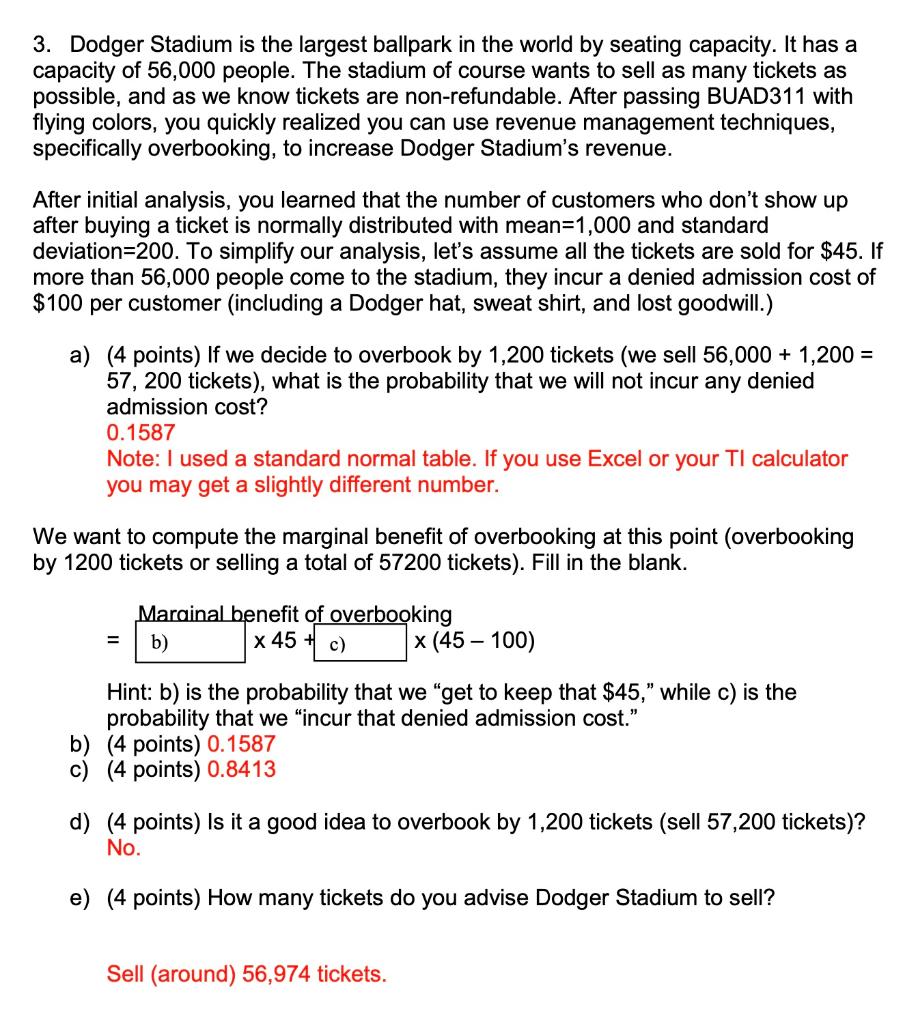
3. Dodger Stadium is the largest ballpark in the world by seating capacity. It has a capacity of 56,000 people. The stadium of course wants to sell as many tickets as possible, and as we know tickets are non-refundable. After passing BUAD311 with flying colors, you quickly realized you can use revenue management techniques, specifically overbooking, to increase Dodger Stadium's revenue. After initial analysis, you learned that the number of customers who don't show up after buying a ticket is normally distributed with mean =1,000 and standard deviation =200. To simplify our analysis, let's assume all the tickets are sold for $45. If more than 56,000 people come to the stadium, they incur a denied admission cost of $100 per customer (including a Dodger hat, sweat shirt, and lost goodwill.) a) (4 points) If we decide to overbook by 1,200 tickets (we sell 56,000+1,200= 57,200 tickets), what is the probability that we will not incur any denied admission cost? 0.1587 Note: I used a standard normal table. If you use Excel or your TI calculator you may get a slightly different number. We want to compute the marginal benefit of overbooking at this point (overbooking by 1200 tickets or selling a total of 57200 tickets). Fill in the blank. =45+(45100)Marainalbenefitofoverbooking Hint: b) is the probability that we "get to keep that $45," while c) is the probability that we "incur that denied admission cost." b) (4 points) 0.1587 c) (4 points) 0.8413 d) (4 points) Is it a good idea to overbook by 1,200 tickets (sell 57,200 tickets)? No. e) (4 points) How many tickets do you advise Dodger Stadium to sell? Sell (around) 56,974 tickets. 3. Dodger Stadium is the largest ballpark in the world by seating capacity. It has a capacity of 56,000 people. The stadium of course wants to sell as many tickets as possible, and as we know tickets are non-refundable. After passing BUAD311 with flying colors, you quickly realized you can use revenue management techniques, specifically overbooking, to increase Dodger Stadium's revenue. After initial analysis, you learned that the number of customers who don't show up after buying a ticket is normally distributed with mean =1,000 and standard deviation =200. To simplify our analysis, let's assume all the tickets are sold for $45. If more than 56,000 people come to the stadium, they incur a denied admission cost of $100 per customer (including a Dodger hat, sweat shirt, and lost goodwill.) a) (4 points) If we decide to overbook by 1,200 tickets (we sell 56,000+1,200= 57,200 tickets), what is the probability that we will not incur any denied admission cost? 0.1587 Note: I used a standard normal table. If you use Excel or your TI calculator you may get a slightly different number. We want to compute the marginal benefit of overbooking at this point (overbooking by 1200 tickets or selling a total of 57200 tickets). Fill in the blank. =45+(45100)Marainalbenefitofoverbooking Hint: b) is the probability that we "get to keep that $45," while c) is the probability that we "incur that denied admission cost." b) (4 points) 0.1587 c) (4 points) 0.8413 d) (4 points) Is it a good idea to overbook by 1,200 tickets (sell 57,200 tickets)? No. e) (4 points) How many tickets do you advise Dodger Stadium to sell? Sell (around) 56,974 tickets
Step by Step Solution
There are 3 Steps involved in it

Get step-by-step solutions from verified subject matter experts
 Study Help