







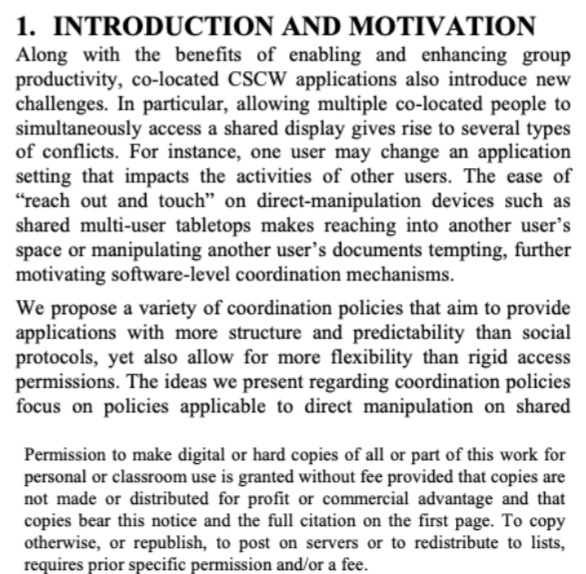
Question: Can you please help me make 2 separate annotations on this paragraph? 1. INTRODUCTION AND MOTIVATION Along with the benefits of enabling and enhancing group
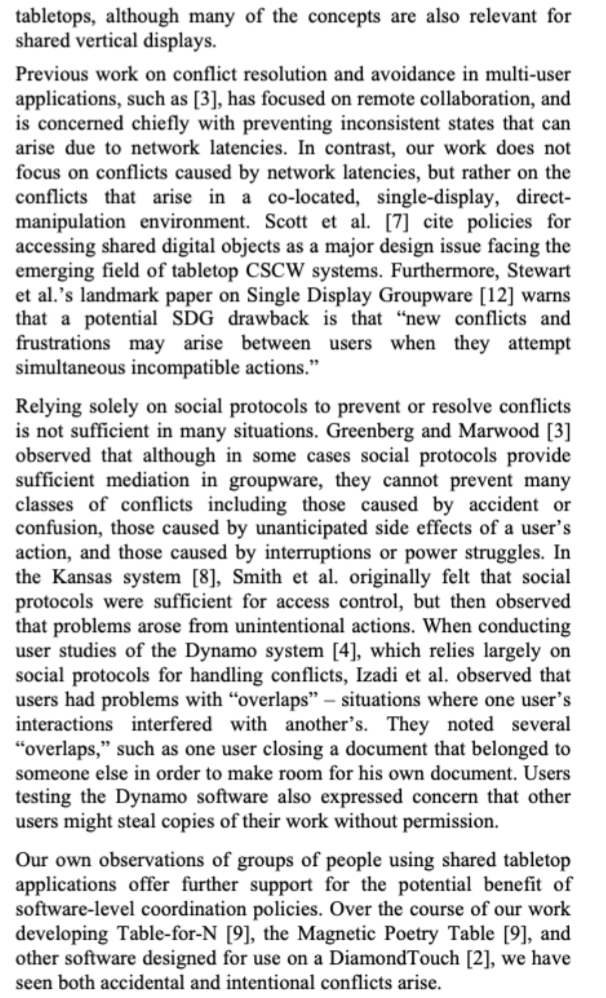
Can you please help me make 2 separate annotations on this paragraph?
1. INTRODUCTION AND MOTIVATION Along with the benefits of enabling and enhancing group productivity, co-located CSCW applications also introduce new challenges. In particular, allowing multiple co-located people to simultaneously access a shared display gives rise to several types of conflicts. For instance, one user may change an application setting that impacts the activities of other users. The ease of "reach out and touch on direct-manipulation devices such as shared multi-user tabletops makes reaching into another user's space or manipulating another user's documents tempting, further motivating software-level coordination mechanisms. We propose a variety of coordination policies that aim to provide applications with more structure and predictability than social protocols, yet also allow for more flexibility than rigid access permissions. The ideas we present regarding coordination policies focus on policies applicable to direct manipulation on shared Permission to make digital or hard copies of all or part of this work for personal or classroom use is granted without fee provided that copies are not made or distributed for profit or commercial advantage and that copies bear this notice and the full citation on the first page. To copy otherwise, or republish, to post on servers or to redistribute to lists, requires prior specific permission and/or a fee. tabletops, although many of the concepts are also relevant for shared vertical displays. Previous work on conflict resolution and avoidance in multi-user applications, such as [3], has focused on remote collaboration, and is concerned chiefly with preventing inconsistent states that can arise due to network latencies. In contrast, our work does not focus on conflicts caused by network latencies, but rather on the conflicts that arise in a co-located, single-display, direct- manipulation environment. Scott et al. [7] cite policies for accessing shared digital objects as a major design issue facing the emerging field of tabletop CSCW systems. Furthermore, Stewart et al.'s landmark paper on Single Display Groupware [12] warns that a potential SDG drawback is that "new conflicts and frustrations may arise between users when they attempt simultaneous incompatible actions. Relying solely on social protocols to prevent or resolve conflicts is not sufficient in many situations. Greenberg and Marwood [3] observed that although in some cases social protocols provide sufficient mediation in groupware, they cannot prevent many classes of conflicts including those caused by accident or confusion, those caused by unanticipated side effects of a user's action, and those caused by interruptions or power struggles. In the Kansas system [8], Smith et al. originally felt that social protocols were sufficient for access control, but then observed that problems arose from unintentional actions. When conducting user studies of the Dynamo system [4], which relies largely on social protocols for handling conflicts, Izadi et al. observed that users had problems with "overlaps" - situations where one user's interactions interfered with another's. They noted several "overlaps, such as one user closing a document that belonged to someone else in order to make room for his own document. Users testing the Dynamo software also expressed concern that other users might steal copies of their work without permission. Our own observations of groups of people using shared tabletop applications offer further support for the potential benefit of software-level coordination policies. Over the course of our work developing Table-for-N [9], the Magnetic Poetry Table [9], and other software designed for use on a DiamondTouch [2], we have seen both accidental and intentional conflicts arise. 1. INTRODUCTION AND MOTIVATION Along with the benefits of enabling and enhancing group productivity, co-located CSCW applications also introduce new challenges. In particular, allowing multiple co-located people to simultaneously access a shared display gives rise to several types of conflicts. For instance, one user may change an application setting that impacts the activities of other users. The ease of "reach out and touch on direct-manipulation devices such as shared multi-user tabletops makes reaching into another user's space or manipulating another user's documents tempting, further motivating software-level coordination mechanisms. We propose a variety of coordination policies that aim to provide applications with more structure and predictability than social protocols, yet also allow for more flexibility than rigid access permissions. The ideas we present regarding coordination policies focus on policies applicable to direct manipulation on shared Permission to make digital or hard copies of all or part of this work for personal or classroom use is granted without fee provided that copies are not made or distributed for profit or commercial advantage and that copies bear this notice and the full citation on the first page. To copy otherwise, or republish, to post on servers or to redistribute to lists, requires prior specific permission and/or a fee. tabletops, although many of the concepts are also relevant for shared vertical displays. Previous work on conflict resolution and avoidance in multi-user applications, such as [3], has focused on remote collaboration, and is concerned chiefly with preventing inconsistent states that can arise due to network latencies. In contrast, our work does not focus on conflicts caused by network latencies, but rather on the conflicts that arise in a co-located, single-display, direct- manipulation environment. Scott et al. [7] cite policies for accessing shared digital objects as a major design issue facing the emerging field of tabletop CSCW systems. Furthermore, Stewart et al.'s landmark paper on Single Display Groupware [12] warns that a potential SDG drawback is that "new conflicts and frustrations may arise between users when they attempt simultaneous incompatible actions. Relying solely on social protocols to prevent or resolve conflicts is not sufficient in many situations. Greenberg and Marwood [3] observed that although in some cases social protocols provide sufficient mediation in groupware, they cannot prevent many classes of conflicts including those caused by accident or confusion, those caused by unanticipated side effects of a user's action, and those caused by interruptions or power struggles. In the Kansas system [8], Smith et al. originally felt that social protocols were sufficient for access control, but then observed that problems arose from unintentional actions. When conducting user studies of the Dynamo system [4], which relies largely on social protocols for handling conflicts, Izadi et al. observed that users had problems with "overlaps" - situations where one user's interactions interfered with another's. They noted several "overlaps, such as one user closing a document that belonged to someone else in order to make room for his own document. Users testing the Dynamo software also expressed concern that other users might steal copies of their work without permission. Our own observations of groups of people using shared tabletop applications offer further support for the potential benefit of software-level coordination policies. Over the course of our work developing Table-for-N [9], the Magnetic Poetry Table [9], and other software designed for use on a DiamondTouch [2], we have seen both accidental and intentional conflicts ariseStep by Step Solution
There are 3 Steps involved in it
1 Expert Approved Answer
Step: 1 Unlock

Question Has Been Solved by an Expert!
Get step-by-step solutions from verified subject matter experts
Step: 2 Unlock
Step: 3 Unlock
 Study Help